Đề thi HSG Tiếng Anh 10 trường THPT Chuyên Lam Sơn (Thanh Hóa) năm 2024
Bài viết Đề thi học sinh giỏi Tiếng Anh 10 trường THPT Chuyên Lam Sơn, tỉnh Thanh Hóa năm 2024 đề xuất cho kì thi HSG Tiếng Anh 10 các trường THPT Chuyên khu vực Duyên hải và Đồng bằng Bắc Bộ. Mời các bạn đón đọc:
Đề thi HSG Tiếng Anh 10 trường THPT Chuyên Lam Sơn (Thanh Hóa) năm 2024
Chỉ từ 200k mua trọn bộ Đề thi học sinh giỏi Tiếng Anh 10 theo cấu trúc mới bản word có lời giải chi tiết:
- B1: gửi phí vào tk:
1133836868- CT TNHH DAU TU VA DV GD VIETJACK - Ngân hàng MB (QR) - B2: Nhắn tin tới Zalo VietJack Official - nhấn vào đây để thông báo và nhận đề thi
|
SỞ GIÁO DỤC VÀ ĐÀO TẠO THANH HOÁ TRƯỜNG THPT CHUYÊN LAM SƠN ĐỀ ĐỀ XUẤT |
ĐỀ THI HSG CÁC TRƯỜNG THPT CHUYÊN KHU VỰC DUYÊN HẢI VÀ ĐỒNG BẰNG BẮC BỘ LẦN THỨ XV, NĂM 2024 ĐỀ THI MÔN: TIẾNG ANH – LỚP 10 Thời gian làm bài: 180 phút, không kể thời gian phát đề. Đề thi gồm 14 trang |
SECTION A: LISTENING (50 points)
HƯỚNG DẪN PHẦN THI NGHE HIỂU
• Bài nghe gồm 4 phần; mỗi phần được nghe 2 lần, mỗi lần cách nhau 05 giây; mở đầu và kết thúc mỗi phần nghe có tín hiệu. Thí sinh có 20 giây để đọc mỗi phần câu hỏi.
• Mở đầu và kết thúc bài nghe có tín hiệu nhạc. Thí sinh có 03 phút để hoàn chỉnh bài trước tín hiệu nhạc kết thúc bài nghe.
• Mọi hướng dẫn cho thí sinh (bằng tiếng Anh) đã có trong bài nghe
Part 1. Listen to a talk given by Peter Powell about how to give up smoking. For questions 1-5, complete the notes using NO MORE THAN THREE WORDS for each answer. Write your answers in the corresponding numbered boxes provided on the answer sheet. (10 points)
Bài nghe:
Ways to give up smoking
To stop smoking, it is important to remember that there is not only one way.
1. Having willpower means having the determination to _________.
2. Starting a hobby or having _________ can help take your mind off smoking.
3. Another way to keep on track is to find suitable _________ such as nicotine patches.
4. You may experience ________ as your body becomes accustomed to less nicotine.
5. You can buy smoking aids from supermarkets or ________.
Part 2: For questions 6-10, listen to part of a recording and decide if the following statement is true (T) or false (F). Write your answers in the corresponding numbered boxes provided on the answer sheet. (10 points)
Bài nghe:
6. Lauren administers a club about living green.
7. What Lauren has done is to find surrogates for disposable stuff in her daily life.
8. The US’s EPA prohibits the use of plastic straws.
9. Findings of a survey in California show that just under 20% of people will use plastic bags if they are free.
10. Lauren argues that the government must require manufacturers to be held accountable for recycling theirproducts.
Part 3. You will hear an interview with a woman called Amy Martles, who works as a choreographer, creating dance performances for live shows. For questions 11-15, choose the answer which fits best according to what you hear. Write your answers in the corresponding numbered boxes provided on the answer sheet. (10 points)
Bài nghe:
11. Amy traces her decision to become a choreographer back to __________.
A. the advice of her first dance teacher.
B. her need to express herself through movement.
C. the emphasis placed on dance in her primary school.
D. her failure to reach a high level of sporting achievement.
12. Amy feels that, above all, a good choreographer is one who __________.
A. remains in touch with the everyday feeling of dancers.
B. keeps dancers motivated during long tiring sessions.
C. has experience of appearing on stage as a dancer.
D. is able to join in with the dancing itself if necessary.
13. In her work as a choreographer, Amy aims to __________.
A. challenge the audience’s ideas about what dance is.
B. feel that she is conveying a message to the audience.
C. thrill the audience with some cutting-edge dance techniques.
D. draw the audience’s attention away from other elements in the show.
14. When asked about choosing dancers to work with, Amy says she __________.
A. relies on the expertise top professionals bring to the creative process.
B. accepts the need to accommodate the feelings of sensitive people.
C. finds those with less experience an easier proposition.
D. likes to help those she has previous taught.
15. When she’s working on a new production of a well-known piece, Amy __________.
A. tries to build on the work of those who have gone before.
B. is aware of the need to update the ideas in a play.
C. is annoyed if people make unfair comparisons.
D. remains faithful to her usual guiding principles.
Part 4. You will listen to a recording about ecotourism. For questions 16-25, fill in the gaps with NO MORE THAN THREE WORDS for each gap. Write your answers in the corresponding numbered boxes provided on the answer sheet. (20 points)
Bài nghe:
Ecotourism is the idea that in some places tourism can be specifically designed to support the conservation of biodiversity and the well-being of local communities.
16. Ecotourism, theoretically, is a _______________.
17. One advantage of ecotourism is that agencies have ____________ to support reserves. Much fund is provided to protect threatened or rare species.
18. They have also provided ____________ to local inhabitants, which has moved them always from destructive forest practices.
19. In Madagasca’s Anja reserve, ecotourism has supported jobs for the local, sponsored public schools, encouraged reforestation and restored the _____________ from 80 to about 350 at present.
20. Ecotourism has also helped to instill a ______________ among local residents for the wildlife and heritage.
21. In fact, several ecotourism projects have led to deforestation because of a high ____________ to construct hotels to accommodate tourists.
22. _____________ can be turned into farmland due to high demand for food as well.
The vast quantity of tourists puts pressure on wildlife.
23. As wealthier individuals may own more money than the poor ones, the financial gain from green travel can’t be _________________.
24. Ecotourism ventures that cannot provide _______________ or reachable accommodations often fail to appeal to tourists.
25. Lack of tourism income can _______________ or deforestation, thereby diminishing efforts of preservation.
SECTION B: LEXICO- GRAMMAR (40 points)
Part 1. For questions 26-55, choose the best option A, B, C, or D to complete the following sentences and write your answers in the corresponding numbered boxes provided on the answer sheet. (30 points)
26. My quarterly performance ________ went very well; my ratings were good and I was praised for my efforts by my line manager.
A. benefit
B. appraisal
C. freeze
D. career
27. As a result of hitting the glass ______ in corporate America, African American women are starting businesses of their own.
A. basement
B. attic
C. ceiling
D. staircase
28. The ongoing ________ looks likely to harm the company from a PR perspective and could also yet result in strike action being taken by the employees affected.
A. payslip
B. pay dispute
C. payroll
D. pay bed
29. She won her claim for ________ dismissal because she had been pressured into resigning.
A. negative
B. positive
C. constructive
D. casual
30. We had no choice but to ________ two-thirds of the workforce.
A. pay off
B. take off
C. drive off
D. lay off
31. You are in ________ of your contract; consider yourself relieved of your duties as of now.
A. return
B. terms
C. breach
D. act
32. I am presently jobless and _______ the dole.
A. drawing
B. giving
C. taking
D. pursuing
33. We were forced to take ________ action when our salaries were cut by 15%.
A. legal
B. industrial
C. disciplinary
D. class
34. They have ________ a motion for debate at the next Party Conference.
A. taken
B. drived
C. accepted
D. tabled
35. The owners have made the decision to ____ the business ____ as it can no longer operate as a going concern.
A. wind/up
B. put/up
C. set/up
D. take/up
36. All staff have been warned that they ________ should productivity not improve, and that no one, no matter how senior, is exempt from having to up their performance.
A. face the axe
B. break even
C. set their sights on
D. appear numbered
37. It was imperative for the authorities to _________ the epidemic.
A. succeed
B. localise
C. define
D. evacuate
38. Ronald had the ________ to blame his teacher for his failure.
A. concern
B. audacity
C. regard
D. chilvary
39. The vegetation on the island was ________.
A. exuberant
B. chilvalrous
C. overcast
D. ingenious
40. People ________ their spending power when prices rise.
A. increase
B. prolong
C. curtail
D. entail
41. His ________ excuses invariably exasperated the manager.
A. frail
B. robust
C. wealthy
D. feeble
42. Don’t trust him, he’s cruel, _______ and unscrupulous.
A. treacherous
B. trustworthy
C. loving
D. slack
43. The young man felt _______ in the presence of so many young ladies.
A. inhospitable
B. inhibited
C. hindered
D. prohibited
44. Prices at Greek hotels are still affordable, but in Switzerland they are ________.
A. moderate
B. reasonable
C. exorbitant
D. inaccessible
45. Many poets have ________ the beauties of the countryside.
A. feared
B. excited
D. inhibited
D. extolled
46. I haven’t got time to do my own work, ________ help you with yours.
A. not counting
B. apart from
C. leaving aside
D. much less
47. – But I didn’t know the information was confidential. ________, it is still no excuse.
A. Be that as it may
B. By that be as it is
C. Be that as it is
D. Be that as it be
48. It is estimated that _____ 10% of the population goes to university.
A. a
B. some
C. the
D. any
49. – How did you know I liked modern art? – Well, for one thing you have ______ books on the subject.
A. quite a few
B. quite few
C. only a few
D. really few
50. – I’ll ask Austin to help us. – Austin? I’m afraid he’s hardly a man _______.
A. whom to rely on
B. to be relied on
C. whom to count on
D. with whom to count
51. The Prime Minister of Malaysia opened his country to foreign investment, _________ came from Japan.
A. which bulk
B. whose bulk
C. of which the bulk
D. the bulk of which
52. I was looking for _________ more expensive book than this. It’s for a present, you see.
A. a fairly
B. rather a bit
C. a somewhat
D. a quite
53. The answer is no. That’s all ________.
A. there is at it
B. how it is
C. there is to it
D. there it is
54. As often happens at the Kennedy Center, _______ of the audience drifted in late.
A. many
B. few
C. some
D. much
55. We ______ flown there but, due to the air controllers’ strike, we had to drive.
A. had to have
B. were to have
C. might have been
D. must have
Part 2. For questions 56-65, fill each gap with the correct form of the words in brackets. Write your answer in the boxes provided on the answer sheet. (10 points)
56. She was (LOOK) __________ for the position because the interviewing panel felt there were other candidates with more relevant experience.
57. Five hundred jobs were lost when the company went into (RECEIVE) __________ last year.
58. There were serious riots among economically (AFFECT) __________ youths in some cities.
59. We live in a (TECHNOLOGY) __________ where progress involves the mastering of increasingly complex data.
60. Fundamentally the (TOTAL) __________ regime did not change, only its methods changed.
61. The survival of a (PARTY) __________ soldiers' honour ameliorated relations between enemies.
62. The subject of interest rates continues to (POLE) __________ the business community.
63. The move has triggered a (SHUFFLE) __________ of responsibilities among some of the group's most senior executives.
64. The transactions were an attempt to conceal the (APPROPRIATE) __________ of money.
65. Economist generally reserve the term (INFLATE) __________ for cases when the monthly rate reaches over 50 percent.
SECTION C: READING (60 points)
Part 1. For questions 66-75, read the following passage and decide which option (A, B, C, or D) best fits each gap. Write your answers in corresponding numbered boxes on the answer sheet. (15 points)
Bill Gates
The founder of Microsoft, Bill Gates, has achieved (66) _____success as a computer programmer, inventor and entrepreneur. His path to that point, however, was (67) _______ but typical. While attending Harvard University in the 1970s, he made a (68) ______ move and left university before graduating to start his own company. His parents did not like the idea at first, but Gates (69) _______ down and worked hard to get their support. He founded Microsoft in 1975, which after a few short years caused a revolution in personal computing. During the time that Gate was at the head of the company, some of his employees regarded him as (70) ______ and arrogant. He would sometimes (71) ______ in on presentations, expressing his dislike for certain ideas and proposals. He was often described as being (72) _____; he did whatever he liked and was often hard to reach either in or out of the office. But whatever anyone may have thought of these minor shortcomings, Gates was a (73) ______ competitor in the computer software industry who often (74) _____ the competition. In his years as CEO of the company, he laboured hard at broadening Microsoft’s range of software products, and whenever he achieved success in a particular area of computing, Gates guarded the position with all his might. Since then, he has won international (75) ______ as one of the greatest computer software investors of all time.
66.
A. gruelling
B. cunning
C. crushing
D. staggering
67.
A. something
B. nothing
C. anything
D. everything
68.
A. gutsy
B. virtuous
C. candid
D. noble
69.
A. trickled
B. knuckled
C. bogged
D. tied
70.
A. impartial
B. prudent
C. inferior
D. conceited
71.
A. cut
B. break
C. put
D. come
72.
A. considerate
B. candid
C. noble
D. impetuous
73.
A. ruthless
B. reckless
C. worthless
D. selfless
74.
A. executed
B. crushed
C. snatched
D. pocketed
75.
A. assent
B. endorsement
C. acclaim
D. concurrence
Part 2. For questions 76-85, fill each of the following numbered blanks with ONE suitable word and write your answers in the corresponding numbered boxes on the answer sheet. (15 points)
The Special Needs of Special Kids
‘Gifted’ or ‘talented’ youngsters are those who develop much more quickly than other children their age in one or more areas. They, therefore, find themselves significantly (76) __________ of their peers in some ways. Gifted children may excel in (77) __________ subjects, such as science or languages, or in more creative areas such as music or art. (78) __________ talented youngsters display exceptional leadership, decision-making or organizational skills.
It is important for educators to (79) __________ gifted children because they often suffer when placed in classes with children of average abilities. They frequently experience boredom and frustration (80) __________ for their peers to grasp concepts or complete tasks that seem easy to them. (81) __________, many of them are made to feel like outsiders due to the fact that they can sometimes be very intense or show strong preferences for hobbies, books, music or even foods that are (82) __________ with others in their age group. As a result, they often feel misunderstood or isolated, and may become very sensitive unless educators make (83) __________ for their special needs. Certain learning difficulties are more common in gifted children than they are among the (84) __________ of the population, and this also needs to be taken into account when planning the (85) __________ of gifted children.
Part 3. For questions 86-95, read the following passage and choose the best answer (A, B, C or D) to each question. Write your answers in the corresponding numbered boxes provided.
What causes cancer? Tobacco smoke, most people would say. Probably too much alcohol, sunshine or grilled meat; infection with cervical papillomaviruses; asbestos. All have strong links to cancer, certainly. But they cannot be root causes. Much of the population is exposed to these carcinogens, yet only a tiny minority suffers dangerous tumors as a consequence.
A cause, by definition, leads invariably to its effect. The immediate cause of cancer must be some combination of insults and accidents that induces normal cells in a healthy human body to turn malignant, growing like weeds and sprouting in unnatural places.
At this level, the cause of cancer is not entirely a mystery. In fact, a decade ago many geneticists were confident that science was homing in on a final answer: cancer is the result of cumulative mutations that alter specific locations in a cell's DNA and thus change the particular proteins encoded by cancer-related genes at those spots. The mutations affect two kinds of cancer genes. The first is called tumor suppressors. They normally restrain cells' ability to divide, and mutations permanently disable the genes. The second variety, known as oncogenes, stimulates growth – in other words, cell division. Mutations lock oncogenes into an active state. Some researchers still consider that such significant growth-promoting changes to a small number of cancer genes are the initial event and root cause of every human cancer.
For the past few years, however, prominent oncologists have increasingly challenged that theory. No one questions that cancer is ultimately a disease of the DNA. But as biologists trace tumors to their roots, they have discovered pieces of chromosomes are frequently scrambled, truncated or fused together. Chemical addition to the DNA, or to the histone protein around which it coils, somehow silences important genes, but in a reversible process quite different from mutation.
The accumulating evidence has spawned at least three hypotheses that compete with the standard dogma to explain what changes come first and which aberrations matter most in the decade-long transformation of a cell and its descendants from well-behaved tissue to invasive tumor. The challengers dispute the dominant view of the disease as the product of a defined genetic state. [A] They argue that it is more useful to think of cancer as the consequence of a chaotic process, a combination of Murphy’s Law and Darwin’s Law: anything can go wrong, and in a competitive environment, the best adapted survive and prosper.
[B] Despite that shared underlying principle, the new theories make different predictions about what kind of treatments will work best. [C] Some suggest that many cancers could be prevented altogether by better screening, changes in diet and new drugs – or even by old drugs, such as aspirin. [D].
(Adapted from https://www.scientificamerican.com/)
86. The word “malignant” in paragraph 2 is CLOSEST in meaning to ______.
A. perilous
B. benign
C. uncontrollable
D. invasive
87. Theoretically, what is the direct cause of cancer?
A. Tobacco smoke
B. Unhealthy diet
C. papillomavirus infection
D. Changes in normal cells
88. It is TRUE that oncogenes _______.
A. deactivate cancerous genes
B. spur cell expansion
C. constrain cell increase
D. keep mutations in active state
89. According to the passage, there are several ways genetic alterations can contribute to cancer. Which of the following statements about these alterations is most likely TRUE based on the information provided?
A. Mutations in tumor suppressor genes always directly activate cell growth pathways.
B. Chemical modifications to DNA can only occur through exposure to environmental carcinogens.
C. Disruptions of chromosomes will invariably create oncogenes.
D. Most oncologists believe cancers involve the alteration of a cell's DNA.
90. Which of the following sentences would be the best restatement for the sentence “Chemical addition to the DNA, or to the histone protein around which it coils, somehow silences important genes, but in a reversible process quite different from mutation” in paragraph 4?
A. Chemical addition coils around DNA and deactivates important genes in a reversed process.
B. Important genes are deactivated due to chemical addition in a reversed process compared to mutation.
C. Important genes are deactivated in a reversed chemical process compared to mutation.
D. DNA is silenced because of chemical addition to important genes, a process different from mutation.
91. The word “aberrations” in paragraph 5 is CLOSEST in meaning to _____.
A. defects
B. principles
C. beliefs
D. phenomena
92. The word “dispute” in paragraph 5 could be best replaced by _____.
A. question
B. analyze
C. puzzle
D. canvass
93. Why does the author mention Murphy’s Law and Darwin’s Law in paragraph 5?
A. To argue the shared view of the challengers on both sides
B. To illustrate the view of cancer as the consequence of a disordered process
C. To support the view of cancer as the product of a defined genetic state
D. To introduce the logical combination of the two laws
94. Which would be the best place in the passage to insert the sentence “Other theories cast doubt on that hope”?
A. [A]
B. [B]
C. [C]
D. [D]
95. What would be the best title for this passage?
A. Untangling The Roots of Cancer
B. New Understanding of A Dreaded Disease
C. New Hypotheses of Cancer
D. Controlling The Roots of Cancer
Part 4. For questions 96-105, read the passage and do the following tasks. Write your answers in the corresponding numbered boxes on the answer sheet. (15 points)
Time Travel
Time travel took a small step away from science fiction and toward science recently when physicists discovered that sub-atomic particles known as neutrinos – progeny of the sun’s radioactive debris – can exceed the speed of light. The unassuming particle – it is electrically neutral, small but with a “non-zero mass” and able to penetrate the human form undetected – is on its way to becoming a rock star of the scientific world.
Researchers from the European Organisation for Nuclear Research (CERN) in Geneva sent the neutrinos hurtling through an underground corridor toward their colleagues at the Oscillation Project with Emulsion-Tracing Apparatus (OPERA) team 730 kilometres away in Gran Sasso, Italy. The neutrinos arrived promptly – so promptly, in fact, that they triggered what scientists are calling the unthinkable – that everything they have learnt, known or taught stemming from the last one hundred years of the physics discipline may need to be reconsidered.
The issue at stake is a tiny segment of time – precisely sixty nanoseconds (which is sixty billionths of a second), which is how much faster than the speed of light the neutrinos managed to go in their underground travels and at a consistent rate (15,000 neutrinos were sent over three years). Even allowing for a margin of error of ten billionths of a second, this stands as proof that it is possible to race against light and win. The duration of the experiment also accounted for and ruled out any possible lunar effects or tidal bulges in the earth’s crust.
Nevertheless, there’s plenty of reason to remain sceptical. According to Harvard University science historian Peter Galison, Einstein’s relativity theory has been “pushed harder than any theory in the history of the physical sciences”. Yet each prior challenge has come to no avail, and relativity has so far refused to buckle.
So is time travel just around the corner? The prospect has certainly been wrenched much closer to the realm of possibility now that a major physical hurdle – the speed of light – has been cleared. If particles can travel faster than light, in theory travelling back in time is possible. How anyone harnesses that to some kind of helpful end is far beyond the scope of any modern technologies, however, and will be left to future generations to explore.
Certainly, any prospective time travellers may have to overcome morephysical and logical hurdles than merely overtaking the speed of light. One such problem, posited by René Barjavel in his 1943 text Le Voyageur Imprudent is the so- called grandfather paradox. Barjavel theorised that, if it were possible to go back in time, a time traveller could potentially kill his own grandfather. If this were to happen, however, the time traveller himself would not be born, which is already known to be true. In other words, there is a paradox in circumventing an already known future; time travel is able to facilitate past actions that mean time travel itself cannot occur.
Other possible routes have been offered, though. For Igor Novikov, astrophysicist behind the 1980s’ theorem known as the self-consistency principle, time travel is possible within certain boundaries. Novikov argued that any event causing a paradox would have zero probability. It would be possible, however, to “affect” rather than “change” historical outcomes if travellers avoided all inconsistencies. Averting the sinking of the Titanic, for example, would revoke any future imperative to stop it from sinking – it would be impossible. Saving selected passengers from the water and replacing them with realistic corpses would not be impossible, however, as the historical record would not be altered in any way.
A further possibility is that of parallel universes. Popularised by Bryce Seligman DeWitt in the 1960s (from the seminal formulation of Hugh Everett), the many-worlds interpretation holds that an alternative pathway for every conceivable occurrence actually exists. If we were to send someone back in time, we might therefore expect never to see him again – any alterations would divert that person down a new historical trajectory.
A final hypothesis, one of unidentified provenance, reroutes itself quite efficiently around the grandfather paradox. Non-existence theory suggests exactly that – a person would quite simply never exist if they altered their ancestry in ways that obstructed their own birth. They would still exist in person upon returning to the present, but any chain reactions associated with their actions would not be registered. Their “historical identity” would be gone.
So, will humans one day step across the same boundary that the neutrinos have? World-renowned astrophysicist Stephen Hawking believes that once spaceships can exceed the speed of light, humans could feasibly travel millions of years into the future in order to repopulate earth in the event of a forthcoming apocalypse. This is because, as the spaceships accelerate into the future, time would slow down around them (Hawking concedes that bygone eras are off limits – this would violate the fundamental rule that cause comes before effect).
Questions 96-100
Do the following statements agree with the information given in the Reading Passage ?
In boxes 31-35 on your answer sheet, write
TRUE if the statement agrees with the information
FALSE if the statement contradicts the information
NOT GIVEN if there is no information on this
96. It is unclear where neutrinos come from.
97. Neutrinos can pass through a person’s body without being noticed.
98. It took scientists between 50-70 nanoseconds to send the neutrinos from Geneva to Italy.
99. Researchers accounted for effects the moon might have had on the experiment.
100. The theory of relativity has often been called into question unsuccessfully.
Questions 101-105
Complete the table below.
Choose NO MORE THAN THREE WORDS from the passage for each answer.
Write your answers in boxes 36-40 provided.
Original Theorist |
Theory |
Principle |
René Barjavel |
Grandfather paradox |
Time travel would allow for101 __________ that would actually make time travel impossible. |
Igor Novikov |
Self-consistency principle |
It is only possible to alter history in ways that result in no 102 __________. |
103 __________ |
Many-worlds interpretation |
Each possible event has an 104 __________, so a time traveller changing the past would simply end up in a different branch of history than the one he left. |
Unknown |
Non-existence theory |
If a time traveller changed the past to prevent his future life, he would not have a 105 __________ as the person never existed. |
IV. WRITING (50 points)
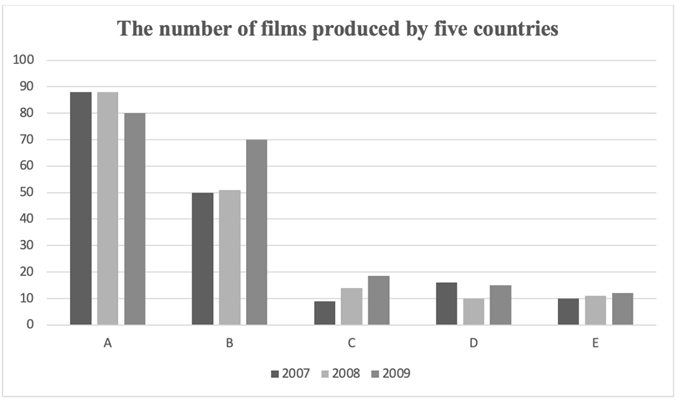
Part 1. The graph below shows the number of films produced by five countries in three years. Summarise the information by selecting and reporting the main features, and make comparisons where relevant.
Write at least 150 words.
..................................................................................................................................................
..................................................................................................................................................
..................................................................................................................................................
Part 2. Write an essay of around 250 words on the topic below.
Many employees can now do their work from home using modern technology. Is this a positive or negative trend?
Give reasons for your answer and include any relevant examples from your own knowledge or experience.
..................................................................................................................................................
..................................................................................................................................................
..................................................................................................................................................
THE END
................................
................................
................................
Xem thêm đề thi học sinh giỏi Tiếng Anh lớp 10 hay khác:
Đề thi học sinh giỏi Tiếng Anh 10 trường THPT Chuyên Lào Cai (Lào Cai) năm 2024
Đề thi học sinh giỏi Tiếng Anh 10 trường THPT Chuyên Lê Hồng Phong (Nam Định) năm 2024
Đề thi học sinh giỏi Tiếng Anh 10 trường THPT Chuyên Hùng Vương (Bình Dương) năm 2024
Đề thi học sinh giỏi Tiếng Anh 10 trường THPT Chuyên Hưng Yên (Hưng Yên) năm 2024
Đề thi học sinh giỏi Tiếng Anh 10 trường THPT Chuyên Bắc Ninh (Bắc Ninh) năm 2022-2023
Đề thi học sinh giỏi Tiếng Anh 10 trường THPT Chuyên Lê Khiết (Quảng Ngãi) năm 2023
TÀI LIỆU CLC DÀNH CHO GIÁO VIÊN VÀ PHỤ HUYNH LỚP 9
Bộ giáo án, bài giảng powerpoint, đề thi file word có đáp án 2026 tại https://tailieugiaovien.com.vn/
Hỗ trợ zalo: VietJack Official
Tổng đài hỗ trợ đăng ký: 084 283 45 85
 Đề thi vào 10 các sở Hà Nội, Tp. Hồ Chí Minh...
41 tài liệu
Đề thi vào 10 các sở Hà Nội, Tp. Hồ Chí Minh...
41 tài liệu
 Giáo án Word 9
95 tài liệu
Giáo án Word 9
95 tài liệu
 Đề thi giữa kì, cuối kì 9
254 tài liệu
Đề thi giữa kì, cuối kì 9
254 tài liệu
 Chuyên đề dạy thêm Toán, Lí, Hóa... 9
71 tài liệu
Chuyên đề dạy thêm Toán, Lí, Hóa... 9
71 tài liệu
 Đề thi HSG 9
8 tài liệu
Đề thi HSG 9
8 tài liệu
 Bài giảng Powerpoint 9
42 tài liệu
Bài giảng Powerpoint 9
42 tài liệu
Công cụ giáo viên (2048.VN)
Tạo- trộn đề thi miễn phí từ file PDF, Word, Giao bài nhanh chóng, Hoàn toàn Free
Bộ đề thi các lớp các môn học được Giáo viên nhiều năm kinh nghiệm tổng hợp và biên soạn theo Thông tư mới nhất của Bộ Giáo dục và Đào tạo, được chọn lọc từ đề thi của các trường trên cả nước.
- Đề thi lớp 1 (các môn học)
- Đề thi lớp 2 (các môn học)
- Đề thi lớp 3 (các môn học)
- Đề thi lớp 4 (các môn học)
- Đề thi lớp 5 (các môn học)
- Đề thi lớp 6 (các môn học)
- Đề thi lớp 7 (các môn học)
- Đề thi lớp 8 (các môn học)
- Đề thi lớp 9 (các môn học)
- Đề thi lớp 10 (các môn học)
- Đề thi lớp 11 (các môn học)
- Đề thi lớp 12 (các môn học)
- Giáo án lớp 1 (các môn học)
- Giáo án lớp 2 (các môn học)
- Giáo án lớp 3 (các môn học)
- Giáo án lớp 4 (các môn học)
- Giáo án lớp 5 (các môn học)
- Giáo án lớp 6 (các môn học)
- Giáo án lớp 7 (các môn học)
- Giáo án lớp 8 (các môn học)
- Giáo án lớp 9 (các môn học)
- Giáo án lớp 10 (các môn học)
- Giáo án lớp 11 (các môn học)
- Giáo án lớp 12 (các môn học)