Đề thi HSG Tiếng Anh 10 trường THPT Chuyên Bắc Ninh (Bắc Ninh) năm 2022-2023
Bài viết Đề thi học sinh giỏi Tiếng Anh 10 trường THPT Chuyên Bắc Ninh, tỉnh Bắc Ninh năm 2022-2023 đề xuất cho kì thi HSG Tiếng Anh 10 các trường THPT Chuyên khu vực Duyên hải và Đồng bằng Bắc Bộ. Mời các bạn đón đọc:
Đề thi HSG Tiếng Anh 10 trường THPT Chuyên Bắc Ninh (Bắc Ninh) năm 2022-2023
Chỉ từ 200k mua trọn bộ Đề thi học sinh giỏi Tiếng Anh 10 theo cấu trúc mới bản word có lời giải chi tiết:
- B1: gửi phí vào tk:
1133836868- CT TNHH DAU TU VA DV GD VIETJACK - Ngân hàng MB (QR) - B2: Nhắn tin tới Zalo VietJack Official - nhấn vào đây để thông báo và nhận đề thi
THPT CHUYÊN BẮC NINH |
ĐỀ ĐỀ XUẤT THI CHỌN HỌC SINH GIỎI KHU VỰC DUYÊN HẢI VÀ ĐBBB NĂM HỌC 2022-2023 MÔN: TIẾNG ANH 10 (Thời gian làm bài: 180 phút) |
* Ghi chú:
- Đề thi gồm 15 trang. Thí sinh làm bài trực tiếp vào đề thi.
- Thí sinh không được sử dụng tài liệu, kể cả từ điển.
- Giám thị coi thi không giải thích gì thêm.
HƯỚNG DẪN PHẦN THI NGHE HIỂU
• Bài nghe gồm 4 phần, mỗi phần được nghe 2 lần, mỗi lần cách nhau 30 giây, mở đầu và kết thúc mỗi phần nghe có tín hiệu.
• Mở đầu và kết thúc bài nghe có tín hiệu nhạc. Thí sinh có 3 phút để hoàn chỉnh bài trước tín hiệu nhạc kết thúc bài nghe.
• Mọi hướng dẫn cho thí sinh (bằng tiếng Anh) đã có trong bài nghe.
I. LISTENING (50 points)
Part 1: For questions 1-5, listen to the recording and complete the form below. Write NO MORE THAN TWO WORDS AND/ OR NUMBERS for each answer. Write your answers in the corresponding numbered boxes provided. (10 pts)
Bài nghe:
Hire for: birthday party
Day and date of event 1. _______________ November
Number of attendees 55
Notes on rental
Items |
Quantity |
dinner plates and bowls for finger food and a 2. _______________ |
60 each |
knives and forks |
3. _______________ |
plastic chairs that are 4. _______________ |
48 |
small/medium glasses |
60 each |
5. _______________ for cooling drinks |
06 |
Part 2: You will hear a news segment about ChatGPT. For questions 6-10, decide whether the statement is TRUE (T) or FALSE (F). (10 points)
Bài nghe:
6. ChatGPT is characterized by natural language response not limited to one single writing style.
7. ChatGPT admits being able to converse, provide assistance, and emote.
8. The program is capable of producing certain literature works to complex academic compositions.
9. One weakness of the technology is that the system itself cannot fathom its own output.
10. Predictions made by people in the field about chatbot technologies’ progress were accurate.
Part 3: For questions 11-15, listen to an interview with the head of an employment agency about job expectations and choose the best answer (A, B, C or D) which fits best according to what you hear. Write your answers in the corresponding numbered boxes provided. (10 points)
Bài nghe:
11. How does Diane Webber view ‘jobs for life’?
A. She regrets the fact that this situation is no longer the norm.
B. She feels that many long-serving employees failed to make a useful contribution.
C. She believes that people should have challenged their employers’ motives more.
D. She wishes the workplace had been more secure in the past.
12. According to Diane, younger workers in today’s workplace _______________.
A. learn all the skills they need early on.
B. accept lateral moves if they are attractive.
C. expect to receive benefits right from the start.
D. change jobs regularly to achieve a higher level.
13. What does Diane say about staff continuity in companies?
A. It is desirable in both junior and senior management.
B. It is impossible to achieve in today’s more competitive environment.
C. It is unimportant, due to the greater emphasis on teamwork.
D. It is necessary, but only up to a point.
14. According to Diane, what is the actual benefit of higher levels of personnel movement?
A. higher levels of output
B. better problem-solving
C. more creativity
D. greater efficiency
15. Diane considers that nowadays, companies are at most risk from _______________.
A. run-of-the-mill employees who play safe.
B. successful high-fliers who quickly move on.
C. unreliable staff who lack commitment.
D. external advisors who have undue power.
Part 4: For questions 16-25, listen to a piece of news about the changing face of Hollywood and supply the blanks with the missing information. Write NO MORE THAN THREE WORDS taken from the recording for each answer in the space provided. (20 points)
Bài nghe:
Spectacular changes have been observed in Hollywood with more actors/actresses of 16. _______________ origin. According to the woman, such a movement was driven by the rising popularity of 17. _______________ services, making 18. _______________ in the film industry just as relevant. As a result, emphasis is to be placed on 19. _______________ to ensure that 20. _______________ are portrayed. In particular, certain groups of people should less likely appear as 21. _______________ or perform supporting roles only, and the 22. _______________ about their community should also be eliminated. For example, followers of Islam should no longer be inaccurately depicted as merely victims or 23. _______________. However, currently only a tiny proportion of people working in Hollywood are Asians. Though 24. _______________, those strides can be seen as a welcome change. Still, the American film industry is expected to aim for expanding its 25. _______________.
II. LEXICO-GRAMMAR (40 points)
Part 1. For questions 26-45, choose the correct answer A, B, C, or D to each of the following questions. Write your answers in the corresponding numbered boxes provided. (20 points)
26. Their full skirts flared out as the dancers _______________ round and round at great speed.
A. slid
B. tripped
C. twirled
D. winched
27. Little Tom _______________ his gaze to avoid making eye contact when his mother caught him eating icecream.
A. converted
B. averted
C. reverted
D. diverted
28. The board of directors finally reached a _______________ and were able to draw up the agreement to implement the new strategy.
A. consensus
B. cohesion
C. solidarity
D. resolution
29. My mother told me that, as a child, I used to _______________ continually for sweets and toys.
A. whine
B. grumble
C. savage
D. pester
30. The company’s attempt to attract new customers with a flashy _______________ failed to resonate with its target audience.
A. scam
B. snare
C. gimmick
D. plot
31. My teacher emphasized the importance of _______________ the line when it came to academic integrity.
A. drawing
B. facing
C. touching
D. toeing
32. It takes time to get a financial system up and _______________ after the introduction of a new currency.
A. walking
B. proceeding
C. running
D. going
33. Despite advancements in technology, some individuals still prefer to communicate _______________ by using outdated methods.
A. fortuitously
B. gratuitously
C. circuitously
D. felicitously
34. During the award ceremony, the host decided to _______________ a surprise _______________ the audience by announcing an additional category for the awards.
A. apprise/of
B. remit/to
C. devolve/to
D. spring/on
35. After the floods, volunteers _______________ with trucks to help the three thousand residents.
A. touched up
B. dealt in
C. flung off
D. pitched in
36. The car was launched with a massive media _______________, involving newspapers, magazines, television and radio.
A. raid
B. blitz
C. blast
D. spree
37. The board of directors finally reached a _______________ and were able to draw up the agreement to implement the new strategy.
A. consensus
B. cohesion
C. solidarity
D. resolution
38. The company’s attempt to attract new customers with a flashy _______________ failed to resonate with its target audience.
A. scam
B. snare
C. gimmick
D. plot
39. Despite advancements in technology, some individuals still prefer to communicate _______________ by using outdated methods.
A. fortuitously
B. gratuitously
C. circuitously
D. felicitously
40. No, I won’t support such a risky project this time and end up _______________ again.
A. getting my bearings
B. pulling my weight
C. carrying the can
D. raising the roof
41. The contents were _______________ that she did not mention them when we discussed after the programme.
A. so great a mystery
B. so a great mystery
C. such great a mystery
D. a such great mystery
42. _______________ by thousands of kilometres, India and Germany have had an influence on each other.
A. Although separating
B. Though separated
C. Despite being separating
D. Much as separated
43. I feel like the luckiest person in the world, _______________.
A. having been born at this time
B. being born at this time
C. to be born at this time
D. to have been born at this time
44. Last night, when he arrived home, he crept in _______________ his parents should wake up.
A. lest
B. otherwise
C. unless
D. nontheless
45. _______________ with being so busy both at work and at home, she became increasingly tired and bad-tempered.
A. Which
B. How
C. What
D. Where
Part 2. Write the correct form of the words given in the brackets. Write your answers in the corresponding numbered boxes. (10 points)
46. The newly renovated airport terminal with efficient check-in processes offers a _______________ travel experience for tourists. (STREAM)
47. Growth and _______________ of vascular plants are often controlled by light, usually in conjunction with temperature. (MATURE)
48. The valedictorian delivered a _______________ sppech, expressing gratitude to their teachers and classmates for the unforgettable experiences. (HEART)
49. During the natural disaster, relief supples were _______________ to the affected region, ensuring prompt assistance to those in need. (AIR)
50. In response to the escalating climate crisis, the government implemented _______________ measures to mitigate the adverse effects. (CAUTION)
51. The team worked together seamlessly as if their movement were orchestrated like _______________. (CLOCK)
52. British public schools are regarded as one of the last _______________ of upper-class privilege. (BASTE)
53. They have a store of _______________ drugs and vaccines that can be flown anywhere in the nation within twelve hours. (DEFEND)
54. The company is famous for _______________ former employees, long after they have gone into retirement. (FEATHER)
55. The children of _______________ parents often do not develop the skills they need to take care of themselves when they leave home. (PROTECT)
Part 3. Complete each sentence with one suitable particle or preposition. Write your answers in the box provided. (10 points)
56. I knew _______________ the word go this book would be difficult to write.
57. I knew I was _______________ the hill when I started needing glasses to read.
58. He went _______________ his own accord: nobody forced him to go.
59. My son has gone _______________ computer games. They are not as interesting as before.
60. ‘This will cause all sorts of problems.’ - ‘I know. It is a recipe _______________ disaster.’
61. When the cost was set _______________ the benefits, the scheme looked good.
62. The company has laid _______________ strict procedures for this kind of situation.
63. It was a difficult concept to grasp, but he soon latched _______________.
64. He's going to have to pull his socks _______________ if he wants to stay in the team.
65. The company pulled _______________ despite the economic crisis.
III. READING (50 POINTS)
Part 1. Read the following passage and decide which answer (A, B, C, or D) best fits each gap. Write your answers in corresponding numbered boxes. (15 points)
A LACK OF COMMUNICATION
Recent research has revealed that a third of people in Britain have not met their (66) _______________ neighbors, and those who know each other (67) _______________ speak. Neighbors gossiping over garden fences and in the street was a common (68) _______________ in the 1950s, says Dr Carl Chinn, an expert on local communities. Now, however, longer hours spent working at the office, together with the Internet and satellite television, are eroding neighborhood (69) _______________. ‘Poor neighborhoods once had strong kinship, but now prosperity buys privacy,’ said Chinn.
Professor John Locke, a social scientist at Cambridge University, has analyzed a large (70) _______________ of surveys. He found that in America and Britain the amount of time spent in social activity is decreasing. A third of people said they never spoke to their neighbors at (71) _______________. Andrew Mayer, 25, a strategy consultant, rents a large apartment in west London, with two flatmates, who work in e-commerce. ‘We have a family of teachers upstairs and lawyers below, but our only contact comes via letters (72) _______________ to the communal facilities or complaints that we’ve not put out our bin bags properly,’ said Mayer.
The (73) _______________ of communities can have serious effects. Concerned at the rise in burglaries and (74) _______________ of vandalism, the police have relaunched crime prevention schemes such as Neighborhood Watch, (75) _______________ on people who live in the same area to keep an eye on each others’ houses and report anything they see which is unusual.
66.
A. side-on
B. next-door
C. close-up
D. nearside
67.
A. barely
B. roughly
C. nearly
D. virtually
68.
A. outlook
B. view
C. vision
D. sight
69.
A. ties
B. joints
C. strings
D. laces
70.
A. deal
B. amount
C. number
D. measure
71. A. least
B. once
C. all
D. most
72.
A. concerning
B. regarding
C. applying
D. relating
73.
A. breakout
B. breakthrough
C. breakdown
D. breakaway
74.
A. acts
B. shows
C. counts
D. works
75.
A. asking
B. calling
C. inviting
D. trying
Part 2: For questions 46-55, fill each of the following numbered blanks with ONE suitable word and write your answers in the corresponding numbered boxes provided. (15 points)
Autism spectrum disorder (ASD) is a developmental disability caused by differences in the brain. Some people with ASD have a (76) _______________ difference, such as a genetic condition. Other causes are not yet known. Scientists believe there are multiple causes of ASD that (77) _______________ together to change the most common ways people (78) _______________. We still have much to learn about these causes and how they impact people with ASD.
People with ASD may behave, communicate, interact, and learn in ways that are different from most other people. There is often (79) _______________ about how they look that sets them (80) _______________ from other people. The abilities of people with ASD can vary significantly. For example, some people with ASD may have (81) _______________ conversation skills whereas others may be nonverbal. Some people with ASD need a lot of help in their daily lives; others can work and live with little to no support.
ASD begins before the age of 3 years and can last throughout a person’s life, (82) _______________ symptoms may improve over time. As children with ASD become adolescents and young adults, they may have difficulties developing and (83) _______________ friendships, communicating with peers and adults, or understanding what behaviors are expected in school or on the job. They may come to the attention of (84) _______________ providers because they also have conditions such as anxiety, depression, or hyperactivity (85) _______________, which occur more often in people with ASD than in people without ASD.
Part 3. For questions 76-85, read an extract from an article on a model and choose the answer A, B, C or D that fits best according to the text. Write your answers in the corresponding numbered boxes provided. (15 points)
In the 1980s the United States Department of Energy was looking for suitable sites to bury radioactive waste material generated by its nuclear energy programs. The government was considering burying the dangerous wastes in deep underground chambers in remote desert areas. The problem, however, was that nuclear waste remains highly radioactive for thousands of years. The commission entrusted with tackling the problem of waste disposal was aware that the dangers posed by radioactive emissions must be communicated to our descendants of at least 10,000 years hence. So the task became one of finding a way to tell future societies about the risk posed by these deadly deposits.
Of course, human society in the distant future may be well aware of the hazards of radiation. Technological advances may one day provide the solutions to this dilemma. But the belief in constant technological advancement is based on our perceptions of advances made throughout history and prehistory. We cannot be sure that society won’t have slipped backward into an age of barbarism due to any of several catastrophic events, whether the result of nature such as the onset of a new ice age or perhaps mankind’s failure to solve the scourges of war and pollution. In the event of global catastrophe, it is quite possible that humans of the distant future will be on the far side of a broken link of communication and technological understanding.
The problem then becomes how to inform our descendants that they must avoid areas of potential radioactive seepage given that they may not understand any currently existing language and may have no historical or cultural memory. So, any message indicated to future reception and decipherment must be as universally understandable as possible.
It was soon realized by the specialists assigned the task of devising the communication system that material in which the message was written might not physically endure the great lengths of time demanded. The second law of thermodynamics shows that all material disintegrates over time. Even computers that might carry the message cannot be expected to endure long enough. Besides, electricity supplies might not be available in 300 generations. Other media storage methods were considered and rejected for similar reasons.
The task force under the linguist Thomas Sebeok finally agreed that no foolproof way would be found to send a message across so many generations and have it survive physically and be decipherable by a people with few cultural similarities to us. Given this restriction, Sebeok suggested the only possible solution was the formation of a committee of guardians of knowledge. Its task would be to dedicate itself to maintaining and passing the knowledge of the whereabouts and dangers of the nuclear waste deposits. This so-called atomic priesthood would be entrusted with keeping knowledge of this tradition alive through millennia and developing the tradition into a kind of mythical taboo forbidding people to tamper in a way with the nuclear waste sites. Only the initiated atomic priesthood of experts would have the scientific knowledge to fully understand the danger. Those outside the priesthood would be kept away by a combination of rituals and legends designed to warn off intruders.
This proposal has been criticized because of the possibility of a break in continuity of the original message. Furthermore, there is no guarantee that any warning or sanction passed on for millennia would be obeyed, nor that it could survive with its original meaning intact. To counterbalance this possibility, Sebeok’s group proposed a “relay system” in which information is passed on over relatively short periods of time, just three generations ahead. The message then to be renewed and redesigned if necessary for the following three generations and so on over the required time span. In this way information could be relayed into the future and avoid the possibility of physical degradation.
A second defect is more difficult to dismiss, however. This is the problem of social exclusiveness brought about through possession of vital knowledge. Critics point out that the atomic priesthood could use its secret knowledge to control those who are scientifically ignorant. The establishment of such an association of insiders holding powerful knowledge not available except in mythic form to nonmembers would be a dangerous precedent for future social developments.
86. The word "chambers" in the passage is closest in meaning to _______________.
A. partitions
B. openings
C. cavities
D. fissures
87 . What problem faced the commission assigned to deal with the burial of nuclear waste _______________.
A. How to reduce the radioactive life of nuclear waste materials
B. How to form a committee that could adequately express various nuclear risks
C. How to notify future generations of the risks of nuclear contamination
D. How to choose burial sites so as to minimize dangers to people.
88. In paragraph 2, the author explains the possible circumstances of future societies_______________.
A. to warn about the possible natural catastrophe
B. to question the value of advances
C. to highlight humankind's inability to resolve problems
D. to demonstrate the reason nuclear hazards must be communicated
89. The word "scourges" in the passage is closest in meaning to _______________.
A. pressures
B. afflictions
C. worries
D. annoyances
90. In paragraph 4, the author mentions the second law of thermodynamics _______________.
A. to support the view that nuclear waste will disperse with time
B. to show that knowledge can be sustained over millennia
C. to give the basic scientific reason behind the breakdown of material objects
D. to contrast the potential life span of knowledge with that of material objects
91. The word "Its" in the passage refers to _______________.
A. knowledge
B. committee
C. solution
D. guardians
92. In paragraph 5, why is the proposed committee of guardians referred to as the "atomic priesthood"?
A. Because they would be an exclusive group with knowledge about nuclear waste sites.
B. Because they would use rituals and legends to maintain their exclusiveness
C. Because they would be an exclusive religious order
D. Because they would develop mythical taboos surrounding their traditions
93. According to the author, why did the task force under Sebeok propose a relay system for passing on information?
A. To show that Sebeok 's ideas created more problems than they solved
B. To support the belief that breaks in communication are inevitable over time
C. To contrast Sebeok's ideas with those proposed by his main critics
D. To compensate for the fact that meaning will not stable over long periods of time
94. According to paragraph 7, the second defect of the atomic priesthood proposal is that it could lead to _______________.
A. the nonmembers turning knowledge into dangerous mythical forms
B. the possible misuse of exclusive knowledge
C. the establishment of a scientifically ignorant society
D. the priesthood's criticism of points concerning vital knowledge
95. All of the following are mentioned in the passage as difficulties in devising a communication system with the future EXCEPT _______________.
A. the failure to maintain communication link
B. the loss of knowledge about today's civilization
C. the inability of materials to endure over time
D. the exclusiveness of priesthood
Part 4. For questions 96-105, read the following passage and do the tasks that follow. (15 points)
THE GROWTH MINDSET
Over the past century, a powerful idea has taken root in the educational landscape. The concept of intelligence as something innate has been supplanted by the idea that intelligence is not fixed, and that, with the right training, we can be the authors of our own cognitive capabilities. Psychologist Alfred Binet, the developer of the first intelligence tests, was one of many 19th-century scientists who held that earlier view and sought to quantify cognitive ability. Then, in the early 20th century, progressive thinkers revolted against the notion that inherent ability is destiny. Instead, educators such as John Dewey argued that every child's intelligence could be developed, given the right environment.
'Growth mindset theory' is a relatively new - and extremely popular - version of this idea. In many schools today you will see hallways covered in motivational posters and hear speeches on the mindset of great sporting heroes who simply believed their way to the top. A major focus of the growth mindset in schools is coaxing students away from seeing failure as an indication of their ability, and towards seeing it as a chance to improve that ability. As educationalist Jeff Howard noted several decades ago: 'Smart is not something that you just are, smart is something that you can get.'
The idea of the growth mindset is based on the work of psychologist Carol Dweck in California in the 1990s. In one key experiment, Dweck divided a group of 10- to 12-year-olds into two groups. All were told that they had achieved a high score on a test but the first group were praised for their intelligence in achieving this, while the others were praised for their effort. The second group - those who had been instilled with a 'growth mindset' - were subsequently far more likely to put effort into future tasks. Meanwhile, the former took on only those tasks that would not risk their sense of worth. This group had inferred that success or failure is due to innate ability, and this 'fixed mindset' had led them to fear of failure and lack of effort. Praising ability actually made the students perform worse, while praising effort emphasised that change was possible.
One of the greatest impediments to successfully implementing a growth mindset, however, is the education system itself: in many parts of the world, the school climate is obsessed with performance in the form of constant testing, analysing and ranking of students - a key characteristic of the fixed mindset. Nor is it unusual for schools to create a certain cognitive dissonance, when they applaud the benefits of a growth mindset but then hand out fixed target grades in lessons based on performance.
Aside from the implementation problem, the original growth mindset research has also received harsh criticism. The statistician Andrew Gelman claims that 'their research designs have enough degrees of freedom that they could take their data to support just about any theory at all'. Professor of Psychology Timothy Bates, who has been trying to replicate Dweck's work, is finding that the results are repeatedly null. He notes that: 'People with a growth mindset don't cope any better with failure ... Kids with the growth mindset aren't getting better grades, either before or after our intervention study.'
Much of this criticism is not lost on Dweck, and she deserves great credit for responding to it and adapting her work accordingly. In fact, she argues that her work has been misunderstood and misapplied in a range of ways. She has also expressed concerns that her theories are being misappropriated in schools by being conflated with the self-esteem movement: 'For me the growth mindset is a tool for learning and improvement. It's not just a vehicle for making children feel good.'
But there is another factor at work here. The failure to translate the growth mindset into the classroom might reflect a misunderstanding of the nature of teaching and learning itself. Growth mindset supporters David Yeager and Gregory Walton claim that interventions should be delivered in a subtle way to maximise their effectiveness. They say that if adolescents perceive a teacher's intervention as conveying that they are in need of help, this could undo its intended effects.
A lot of what drives students is their innate beliefs and how they perceive themselves. There is a strong correlation between self-perception and achievement, but there is evidence to suggest that the actual effect of achievement on self-perception is stronger than the other way round. To stand up in a classroom and successfully deliver a good speech is a genuine achievement, and that is likely to be more powerfully motivating than vague notions of 'motivation' itself.
Recent evidence would suggest that growth mindset interventions are not the elixir of student learning that its proponents claim it to be. The growth mindset appears to be a viable construct in the lab, which, when administered in the classroom via targeted interventions, doesn't seem to work. It is hard to dispute that having faith in the capacity to change is a good attribute for students. Paradoxically, however, that aspiration is not well served by direct interventions that try to instil it.
Motivational posters and talks are often a waste of time, and might well give students a deluded notion of what success actually means. Teaching concrete skills such as how to write an effective introduction to an essay then praising students' effort in getting there is probably a far better way of improving confidence than telling them how unique they are, or indeed how capable they are of changing their own brains. Perhaps growth mindset works best as a philosophy and not an intervention.
Questions 96 - 101: Look at the following statements (Questions 17-22) and the list of people below. Match each statement with the correct person or people, A-E. Write the correct letter, A-E, in boxes 17-22 on your answer sheet.
NB You may use any letter more than once.
96. The methodology behind the growth mindset studies was not strict enough.
97. The idea of the growth mindset has been incorrectly interpreted.
98. Intellectual ability is an unchangeable feature of each individual.
99. The growth mindset should be promoted without students being aware of it.
100. The growth mindset is not simply about boosting students' morale.
101. Research shows that the growth mindset has no effect on academic achievement.
|
List of People A Alfred Binet B Carol Dweck C Andrew Gelman D Timothy Bates E David Yeager and Gregory Walton |
Questions 102-105: Do the following statements agree with the views of the writer in Reading Passage 2? In boxes 102-105 on your answer sheet, write
YES if the statement agrees with the views of the writer
NO if the statement contradicts the views of the writer
NOT GIVEN if it is impossible to say what the writer thinks about this
102. Dweck has handled criticisms of her work in an admirable way.
103. Students' self-perception is a more effective driver of self-confidence than actual achievement is.
104. Recent evidence about growth mindset interventions has attracted unfair coverage in the media.
105. Deliberate attempts to encourage students to strive for high achievement may have a negative effect.
IV. WRITING (50 points)
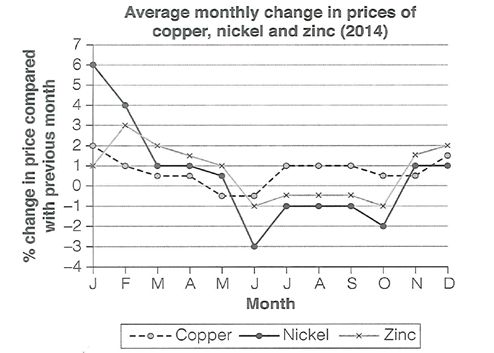
Part 1. Chart description (20 points)
The graph below shows the average monthly change in the prices of three metals during 2014.
Summarise the information by selecting and reporting the main features, and make comparisons where relevant. You should write at least 150 words.
..................................................................................................................................................
..................................................................................................................................................
..................................................................................................................................................
Part 2. Write an essay of at least 250 words on the following topic. (30 points)
Many people say that children should be free to choose what they do in their free time rather than being organized by parents. To what extent do you agree or disagree with the statement?
..................................................................................................................................................
..................................................................................................................................................
..................................................................................................................................................
THE END
................................
................................
................................
Xem thêm đề thi học sinh giỏi Tiếng Anh lớp 10 hay khác:
Đề thi học sinh giỏi Tiếng Anh 10 trường THPT Chuyên Lào Cai (Lào Cai) năm 2024
Đề thi học sinh giỏi Tiếng Anh 10 trường THPT Chuyên Lam Sơn (Thanh Hóa) năm 2024
Đề thi học sinh giỏi Tiếng Anh 10 trường THPT Chuyên Lê Hồng Phong (Nam Định) năm 2024
Đề thi học sinh giỏi Tiếng Anh 10 trường THPT Chuyên Hùng Vương (Bình Dương) năm 2024
Đề thi học sinh giỏi Tiếng Anh 10 trường THPT Chuyên Hưng Yên (Hưng Yên) năm 2024
Đề thi học sinh giỏi Tiếng Anh 10 trường THPT Chuyên Lê Khiết (Quảng Ngãi) năm 2023
ĐỀ THI, GIÁO ÁN, SÁCH ĐỀ THI DÀNH CHO GIÁO VIÊN VÀ PHỤ HUYNH LỚP 9
Bộ giáo án, bài giảng powerpoint, đề thi dành cho giáo viên và sách dành cho phụ huynh tại https://tailieugiaovien.com.vn/ . Hỗ trợ zalo VietJack Official
Tổng đài hỗ trợ đăng ký : 084 283 45 85



Đã có app VietJack trên điện thoại, giải bài tập SGK, SBT Soạn văn, Văn mẫu, Thi online, Bài giảng....miễn phí. Tải ngay ứng dụng trên Android và iOS.


Bộ đề thi các lớp các môn học được Giáo viên nhiều năm kinh nghiệm tổng hợp và biên soạn theo Thông tư mới nhất của Bộ Giáo dục và Đào tạo, được chọn lọc từ đề thi của các trường trên cả nước.
Nếu thấy hay, hãy động viên và chia sẻ nhé! Các bình luận không phù hợp với nội quy bình luận trang web sẽ bị cấm bình luận vĩnh viễn.
- Đề thi lớp 1 (các môn học)
- Đề thi lớp 2 (các môn học)
- Đề thi lớp 3 (các môn học)
- Đề thi lớp 4 (các môn học)
- Đề thi lớp 5 (các môn học)
- Đề thi lớp 6 (các môn học)
- Đề thi lớp 7 (các môn học)
- Đề thi lớp 8 (các môn học)
- Đề thi lớp 9 (các môn học)
- Đề thi lớp 10 (các môn học)
- Đề thi lớp 11 (các môn học)
- Đề thi lớp 12 (các môn học)
- Giáo án lớp 1 (các môn học)
- Giáo án lớp 2 (các môn học)
- Giáo án lớp 3 (các môn học)
- Giáo án lớp 4 (các môn học)
- Giáo án lớp 5 (các môn học)
- Giáo án lớp 6 (các môn học)
- Giáo án lớp 7 (các môn học)
- Giáo án lớp 8 (các môn học)
- Giáo án lớp 9 (các môn học)
- Giáo án lớp 10 (các môn học)
- Giáo án lớp 11 (các môn học)
- Giáo án lớp 12 (các môn học)



 Giải bài tập SGK & SBT
 Tài liệu giáo viên
 Sách
Sách
 Khóa học
 Thi online
 Hỏi đáp