Đề thi HSG Tiếng Anh 10 trường THPT Chuyên Lê Khiết (Quảng Ngãi) năm 2023
Bài viết Đề thi học sinh giỏi Tiếng Anh 10 trường THPT Chuyên Lê Khiết, tỉnh Quảng Ngãi năm 2023 đề xuất cho kì thi HSG Tiếng Anh 10 các trường THPT Chuyên khu vực Duyên hải và Đồng bằng Bắc Bộ. Mời các bạn đón đọc:
Đề thi HSG Tiếng Anh 10 trường THPT Chuyên Lê Khiết (Quảng Ngãi) năm 2023
Chỉ từ 200k mua trọn bộ Đề thi học sinh giỏi Tiếng Anh 10 theo cấu trúc mới bản word có lời giải chi tiết:
- B1: gửi phí vào tk:
1133836868- CT TNHH DAU TU VA DV GD VIETJACK - Ngân hàng MB (QR) - B2: Nhắn tin tới Zalo VietJack Official - nhấn vào đây để thông báo và nhận đề thi
|
TRƯỜNG THPT CHUYÊN LÊ KHIẾT TỈNH QUẢNG NGÃI (Đề thi gồm 16 trang) |
KỲ THI HỌC SINH GIỎI CÁC TRƯỜNG THPT CHUYÊN KHU VỰC DUYÊN HẢI VÀ ĐỒNG BẰNG BẮC BỘ LẦN THỨ XIV, NĂM 2023 ĐỀ THI MÔN: TIẾNG ANH 10 Thời gian: 180 phút (không kể thời gian giao đề) (Thí sinh làm bài trực tiếp vào đề) |
A. LISTENING (50 points)
Part 1.You will listen to a short conversation about a lost property. For questions 1-5, complete the form below by writing NO MORE THAN ONE WORD OR A NUMBER for each answer. Write your answers in the corresponding numbered boxes provided. (10 points)
Bài nghe:
Incident report
Type of incident: theft
Items(s) missing: laptop, _____________ (1) and contents.
Type or make of missing item(s): Sonic 2500
Colour: _____________ (2)
Where incident occurred: In the _____________ (3) at Bigton _____________ (4).
Time of incident: (5)_____________
Part 2. For questions 6-10, listen to a talk about how to keep calm under pressure and decide whether these statements are True (T), False (F). Write your answers in the corresponding numbered boxes provided. (10 points)
Bài nghe:
6. A repeated breathing exercise will help you feel calmer.
7. If you are going to speak in public, it’s helpful to breathe quickly.
8. When you feel panic, a deep breathing through your nose will do you good.
9. Researches have shown that humming cannot stimulate heart rate.
10. Sport trainers always use “ process thinking” to help athletes focus.
Part 3. You will hear part of an interview with Fergus Reilly, a marine scientist, about the non-profit organisation he works for: Sustainable Fishing. For questions 15-20, choose the answer (A, B, C or D) which fits best according to what you hear. Write your answers in the space provided.
Bài nghe:
11. Fergus Reilly says he is mainly concerned about _____________.
A. the size of the industries involved in processing the fish.
B. the number of stages the fish pass through before being sold.
C. the methods used by the fishing industry to maximise their catches.
D. the financial motivation for the industry to continue over-fishing.
12. According to Reilly, how is Sustainable Fishing going about its campaign?
A. It is increasing the amount of publicity in the media for the work it does.
B. It is improving consumers' knowledge about the fish they are buying.
C. It is persuading supermarkets to offer less endangered species for sale.
D. It is encouraging suppliers to research into the sustainability of fish stocks.
13. What does Reilly say about the situation for the more popular fish species?
A. It has proved impossible to convince people of the rate of their depletion.
B. Scientists are under increasing pressure to rescue them from final collapse.
C. The growing number of people in the world is adding to their vulnerability.
D. Their survival depends on the fishing industry agreeing to unpopular controls.
14 How does Sustainable Fishing find out what happens to fish after they are caught?
A. It puts pressure on fishing companies to supply the information.
B. It funds retailers to trace the supply chain and send back reports.
C. It receives updates from environmental groups around the world.
D. It makes use of technology to follow the fish's progress at all stages.
16. In order to motivate consumers to buy sustainably caught fish, retailers can _____________.
A. display advertisements about the need to maintain healthy oceans.
B. go into schools to give talks about the serious threat to fish stocks.
C. bring down the price by preparing fish for sale without waste.
D. employ chefs to create affordable dishes that are easy to cook.
Part 4. You will listen to a recording about Koalas. For questions 16-25, complete the summary by writing NO MORE THAN THREE WORDS in each gap. Write your answers in the corresponding numbered boxes provided. (20 points)
Bài nghe:
Koalas are being particularly (16)_____________in New South Wales as their habitats are being destroyed.
Koala seems to be (17) _____________and probably quite hungry.
It is estimated that hundreds of koalas have died in (18)_____________raging in Eastern Australia since September.
Over (19) _____________koalas have been admitted by the region's Port Macquarie Koala Hospital so far this year.
While the disaster has inflicted serious damage on the animal, the support from the public has been (20)_____________.
The number of visitors coming to the Koala Hospital over the last 5-6 weeks has been (21) _____________.
A large amount of money has been set aside to help (22)_____________koalas.
There are concerns that a new heat wave could further intensify the raging (23) _____________.
Very little would actually survive in there (24) _____________,
Rising temperatures, which dry out their habitats, deforestation and disease are (25)_____________.
B. LEXICO AND GRAMMAR (40 points)
Part 1. For questions 26-45, choose the best option A, B, C, or D to complete the following sentences and write your answers in the corresponding numbered boxes. (20 points)
26. Wendy is on the _____________of a dilemma: she just wonders whether to go for a picnic with her friends or to stay at home with her family.
A. torms
B. horns
C. forms
D. rorns
27. Unless these strong winds _____________, I’m afraid we’ll have to postpone our barbeque.
A. brighten up
B. beat down
C. break through
D. die down
28. I like watching _____________of cows grazing in a field; I find them very relaxing .
A. numbers
B. flocks
C. herds
D. groups
29. The successful applicant will receive a generous _____________, company car and relocation expenses.
A. salary
B. earning
C. reference
D. occupation
30. You've got to be _____________certain before you decide.
A. dead
B. deathly
C. deadly
D. dearly
31. If everyone chips _____________, we’ll be able to buy her a really nice present.
A. on
B. at
C. in
D. out
32. Do you need to give your speech another _____________or do you already know it by heart?
A. break-down
B. check-up
C. run-through
D. mix-up
33. Please don't _____________it amiss if I make a few suggestions for improvements.
A. think
B. assume
C. judge
D. take
34. I know you’re upset about breaking up with Tom, but there are plenty more _____________.
A. horses in the table
B. cows in the shed
C. tigers in the jungle
D. fish in the sea
35. He decided to make a claim _____________damages to his car.
A. for
B. in
C. about
D. on
36. Tony convinced _____________would be a good idea.
A. to buy shares
B. that buying me shares
C. me that buying shares
D. to me that to buy shares
37. The hotel was fine, the rain held off, the beach wasn’t too crowded and the food was Ok; _____________, we had a pretty good holiday.
A. first of all
B. all in all
C. namely
D. that said
38. I gave Kelly _____________on her birthday.
A. an action-packed exciting adventure book
B. an exciting action-packed adventure book
C. an adventure exciting action-packed book
D. an adventure action- packed exciting book
39.Suddenly, _____________a helicopter.
A. it flew over the hill
B. flew over the hill
C. over the hill flew
D. there flew over the hill
40. If you can win his attention _____________for you.
A. the so much better
B. the better so much
C. so the much better
D. so much the better
41. One can’t think of Africa without thinking of Egypt, _____________of Egypt without the Nile.
A. nor
B. either
C. too
D. and
42. Before they go to the university, most senior high school graduates have _____________idea of what college life is like.
A. no less
B. no least
C. not less
D. not the least
43. I would appreciate _____________it a secret.
A. you to keep
B. your keeping
C. that you keep
D. that you will keep
44. “ Ruth told me your remark about her haircut was unkind.”
“ All _____________that the hairdresser must have been a chimpanzee.”
A. I say is
B. I had said
C. I am saying is
D. I said was
45. One of the professor’s greatest attributes is _____________.
A. when he gives lectures
B. how in the manner that he lectures
C. the way which give lectures
D. his ability to lecture
Part 2. For questions 46-55, fill each gap with the correct form of the words in brackets. Write your answer in the boxes provided. (10 points)
46. The similarity between these tests is too great to be _____________. (COINCIDE)
47. His conduct is _____________to a priest and people don’t go to his church. (BECOME)
48. He was a modest and _____________man who never gave the impression that he knew all the answers. (ASSUME)
49. We are disappointed by her approaching this matter so _____________. (AMATEUR)
50. The scan shown here indicates _____________metabolism and blood flow in the brain's emotional center. (FUNCTION)
51. He raved about the _____________punishment made by the manager regarding his fault. (JUST)
52. The children were _____________at the thought of going to the seaside on holiday. (JOY)
53. Some economists are now predicting the danger of _____________inflation.(RUN)
54. She has travelled to the most _____________corners of the world. (FAR)
55. His failures _____________the difference between theatre and film direction. (LINE)
Part 3. For questions 56-65, complete each of the following sentences with a suitable preposition or particle. Write your answer in the boxes provided on the answer sheet. (10 points)
56. I was a little taken _____________at the directness of the question.
57. We’re having a few people _____________for drinks on Saturday.
58. I don’t understand how this situation came _____________so suddenly.
59. This car is inferior _____________the one I bought last year.
60. Our dog has been _____________its food for days now.
61. Queen Victoria reigned _____________Britain and Ireland for over sixty years.
62. My cousin talked _____________length about his recent holiday and bored everyone to death!
63. People who eat an unhealthy diet are susceptible _____________all kind of illnesses and diseases.
64. It’s been raining for three hours now and it doesn’t look like it will let _____________today.
65. Hundreds of people turned _____________in the rain to see the prince.
III. READING: (60 points)
Part 1. Read the following passage and decide which answer (A, B, C, or D) best fits each gap. Write your answers in corresponding numbered boxes. (15points)
SMART SHOES
Smart shoes that adjust their size throughout the day could soon be available. A prototype has already been produced and a commercial version may be in production within a few years. The shoe contains sensors that constantly check the amount of (66)_____________left in it. If the foot has become too large, a tiny valve opens and the shoe expands slightly. The entire control system is about 5mm square and is located inside the shoe. This radical shoe (67)_____________a need because the volume of the (68)_____________foot can change by as much as 8% during the course of the day. The system is able to learn about the wearer’s feet and (69)_____________up a picture of the size of his or her feet throughout the day. It will allow the shoes to change in size by up to 8% so that they always fit (70) _____________. They are obviously more comfortable and less likely to (71)_____________blisters. From an athlete’s point of view, they can help improve (72)_____________a little, and that is why the first (73)_____________for the system is likely to be in a sports shoe.
Eventually, this system will find a (74)_____________in many other household items, from beds that automatically change to fit the person sleeping in them, to power tools that (75)_____________themselves to the user’s hand for better grip.
66.
A. room
B. gap
C. area
D. chasm
67.
A. detects
B. finds
C. meets
D. faces
68.
A. average
B. general
C. usual
D. medium
69.
A. build
B. pick
C. grow
D. set
70.
A. exactly
B. absolutely
C. completely
D. totally
71.
A. provoke
B. form
C. initiate
D. cause
72.
A. achievement
B. performance
C. success
D. winning
73.
A. purpose
B. exercise
C. use
D. operation
74.
A. function
B. part
C. way
D. place
75.
A. shape
B. change
C. respond
D. convert
(Adapted from Cambridge CAE 3)
Part 2. Read the following text and fill in the blank with ONE suitable word. Write your answers in corresponding numbered boxes.(15 points)
GLOBAL ENGLISH
Global English exists (76)_____________a political and cultural reality. Many misguided theories attempt to explain why the English language should have succeeded internationally, whilst (77)_____________have not. Is it because there is something inherently logical or beautiful about the structure of English? Does its simple grammar make it easy to learn? Such ideas are misconceived. Latin was once a major international language, (78)_____________having a complicated grammatical structure, and English also presents learners with all manner of real difficulties, (79)_____________least its spelling system. Ease of learning, therefore, has (80)_____________to do with it.(81)_____________all, children learn to speak their mother tongue in approximately the same period of time, (82)_____________of their language. English has spread not (83)_____________much for linguistic reasons, but rather because it has often found (84)_____________in the right place, at the right time. Since the 1960s, two major developments have contributed to strengthening this global status. Firstly, in a number of countries, English is now used in addition to national or regional languages. As well as this, an electronic revolution has taken place. It is estimated that (85)_____________the region of 80% of worldwide electronic communication is now in English.
(Adapted from CPE Handbook)
Part 3. Read the following passage and circle the best answer to each of the following questions. Write your answers in corresponding numbered boxes.(15 points)
RUNNING WATER ON MARS
Photographic evidence suggests that liquid water once existed in great quantity on the surface of Mars. Two types of flow features are seen: runoff channels and outflow channels. Runoff channels are found in the southern highlands. These flow features are extensive systems - sometimes hundreds of kilometers in total length - of interconnecting, twisting channels that seem to merge into larger, wider channels. They bear a strong resemblance to river systems on Earth, and geologists think that they are dried-up beds of long-gone rivers that once carried rainfall on Mars from the mountains down into the valleys. Runoff channels on Mars speak of a time 4 billion years ago (the age of the Martian highlands), when the atmosphere was thicker, the surface warmer, and liquid water widespread.
Outflow channels are probably relics of catastrophic flooding on Mars long ago. They appear only in equatorial regions and generally do not form extensive interconnected networks. Instead, they are probably the paths taken by huge volumes of water draining from the southern highlands into the northern plains. The onrushing water arising from these flash floods likely also formed the odd teardrop-shaped “islands” (resembling the miniature versions seen in the wet sand of our beaches at low tide) that have been found on the plains close to the ends of the outflow channels. Judging from the width and depth of the channels, the flow rates must have been truly enormous - perhaps as much as a hundred times greater than the 105 tons per second carried by the great Amazon river. Flooding shaped the outflow channels approximately 3 billion years ago, about the same time as the northern volcanic plains formed.
Some scientists speculate that Mars may have enjoyed an extended early period during which rivers, lakes, and perhaps even oceans adorned its surface. A 2003 Mars Global Surveyor image shows what mission specialists think may be a delta - a fan-shaped network of channels and sediments where a river once flowed into a larger body of water, in this case a lake filling a crater in the southern highlands. Other researchers go even further, suggesting that the data provide evidence for large open expanses of water on the early Martian surface. A computer-generated view of the Martian north polar region shows the extent of what may have been an ancient ocean covering much of the northern lowlands. The Hellas Basin, which measures some 3,000 kilometers across and has a floor that lies nearly 9 kilometers below the basin’s rim, is another candidate for an ancient Martian sea.
These ideas remain controversial. Proponents point to features such as the terraced “beaches” shown in one image, which could conceivably have been left behind as a lake or ocean evaporated and the shoreline receded. But detractors maintain that the terraces could also have been created by geological activity, perhaps related to the geologic forces that depressed the Northern Hemisphere far below the level of the south, in which case they have nothing whatever to do with Martian water. Furthermore, Mars Global Surveyor data released in 2003 seem to indicate that the Martian surface contains too few carbonate rock layers - layers containing compounds of carbon and oxygen - that should have been formed in abundance in an ancient ocean. Their absence supports the picture of a cold, dry Mars that never experienced the extended mild period required to form lakes and oceans. However, more recent data imply that at least some parts of the planet did in fact experience long periods in the past during which liquid water existed on the surface.
Aside from some small-scale gullies (channels) found since 2000, which are inconclusive, astronomers have no direct evidence for liquid water anywhere on the surface of Mars today, and the amount of water vapor in the Martian atmosphere is tiny. Yet even setting aside the unproven hints of ancient oceans, the extent of the outflow channels suggests that a huge total volume of water existed on Mars in the past. Where did all the water go? The answer may be that virtually all the water on Mars is now locked in the permafrost layer under the surface, with more contained in the planet’s polar caps.
86. The word “merge” in the passage is closest in meaning to _____________.
A. expand
B. separate
C. straighten out
D. combine
87. What does the discussion in paragraph 1 of runoff channels in the southern highlands suggest about Mars?
A. The atmosphere of Mars was once thinner than it is today.
B. Large amounts of rain once fell on parts of Mars.
C. The river systems of Mars were once more extensive than Earth’s.
D. The rivers of Mars began to dry up about 4 billion years ago.
88. The word “relics” in the passage is closest in meaning to _____________.
A. remains
B. sites
C. requirements
D. sources
89. In paragraph 2, why does the author include the information that 105 tons of water flow through the Amazon River per second?
A. To emphasize the great size of the volume of water that seems to have flowed through Mars’outflow channels.
B. To indicate data used by scientists to estimate how long ago Mars’ outflow channels were formed.
C. To argue that flash floods on Mars may have been powerful enough to cause tear-shaped “islands” to form.
D. To argue that the force of flood waters on Mars was powerful enough to shape the northern volcanic plains.
90. According to paragraph 2, all of the following are true of the outflow channels on Mars EXCEPT:
A. They formed at around the same time that volcanic activity was occurring on the northern plains.
B. They are found only on certain parts of the Martian surface.
C. They sometimes empty onto what appear to have once been the wet sands of tidal beaches.
D. They are thought to have carried water northward from the equatorial regions.
91. All of the following questions about geological features on Mars are answered in paragraph 3 EXCEPT:
A. What are some regions of Mars that may have once been covered with an ocean?
B. Where do mission scientists believe that the river forming the delta emptied?
C. Approximately how many craters on Mars do mission scientists believe may once have been lakes filled with water?
D. During what period of Mars’ history do some scientists think it may have had large bodies of water?
92. According to paragraph 3, images of Mars’ surface have been interpreted as support for the idea that_____________.
A. a large part of the northern lowlands may once have been under water.
B. the polar regions of Mars were once more extensive than they are now.
C. deltas were once a common feature of the Martian landscape.
D. the shape of the Hellas Basin has changed considerably over time.
93. What can be inferred from paragraph 3 about liquid water on Mars?
A. If ancient oceans ever existed on Mars’ surface, it is likely that the water in them has evaporated by now.
B. If there is any liquid water at all on Mars’ surface today, its quantity is much smaller than the amount that likely existed there in the past.
C. Small-scale gullies on Mars provide convincing evidence that liquid water existed on Mars in the recent past.
D. The small amount of water vapor in the Martian atmosphere suggests that there has never been liquid water on Mars.
94. Which of the sentences below best expresses the essential information in the sentence in bold type in the passage? Incorrect choices change the meaning in important ways or leave out essential information.
A. But detractors argue that geological activity may be responsible for the water associated with the terraces.
B. But detractors argue that the terraces may be related to geological forces in the Northern Hemisphere of Mars, rather than to Martian water in the south.
C. But detractors argue that geological forces depressed the Northern Hemisphere so far below the level of the south that the terraces could not have been formed by water.
D. But detractors argue that the terraces may have been formed by geological activity rather than by the presence of water.
95. According to paragraph 4, what do the 2003 Global Surveyor data suggest about Mars?
A. Ancient oceans on Mars contained only small amounts of carbon.
B. The climate of Mars may not have been suitable for the formation of large bodies of water.
C. Liquid water may have existed on some parts of Mars’ surface for long periods of time.
D. The ancient oceans that formed on Mars dried up during periods of cold, dry weather.
Part 4. Read the following passage and do the tasks that follow. (10 pts)
THE PROBLEM OF SCARCE RESOURCES
Section A
The problem of how health-care resources should be allocated or apportioned, so that they are distributed in both the most just and most efficient way, is not a new one. Every health system in an economically developed society is faced with the need to decide (either formally or informally) what proportion of the community’s total resources should be spent on health-care; how resources are to be apportioned; what diseases and disabilities and which forms of treatment are to be given priority; which members of the community are to be given special consideration in respect of their health needs; and which forms of treatment are the most cost-effective.
Section B
What is new is that, from the 1950s onwards, there have been certain general changes in outlook about the finitude of resources as a whole and of health-care resources in particular, as well as more specific changes regarding the clientele of health-care resources and the cost to the community of those resources. Thus, in the 1950s and 1960s, there emerged an awareness in Western societies that resources for the provision of fossil fuel energy were finite and exhaustible and that the capacity of nature or the environment to sustain economic development and population was also finite. In other words, we became aware of the obvious fact that there were ‘limits to growth’. The new consciousness that there were also severe limits to health-care resources was part of this general revelation of the obvious. Looking back, it now seems quite incredible that in the national health systems that emerged in many countries in the years immediately after the 1939-45 World War, it was assumed without question that all the basic health needs of any community could be satisfied, at least in principle; the ‘invisible hand’ of economic progress would provide.
Section C
However, at exactly the same time as this new realization of the finite character of health-care resources was sinking in, an awareness of a contrary kind was developing in Western societies: that people have a basic right to health-care as a necessary condition of a proper human life. Like education, political and legal processes and institutions, public order, communication, transport and money supply, health-care came to be seen as one of the fundamental social facilities necessary for people to exercise their other rights as autonomous human beings. People are not in a position to exercise personal liberty and to be self-determining if they are poverty-stricken, or deprived of basic education, or do not live within a context of law and order. In the same way, basic health-care is a condition of the exercise of autonomy.
Section D
Although the language of ‘rights’ sometimes leads to confusion, by the late 1970s it was recognized in most societies that people have a right to health-care (though there has been considerable resistance in the United Sates to the idea that there is a formal right to health-care). It is also accepted that this right generates an obligation or duty for the state to ensure that adequate health-care resources are provided out of the public purse. The state has no obligation to provide a health-care system itself, but to ensure that such a system is provided. Put another way, basic health-care is now recognized as a ‘public good’, rather than a ‘private good’ that one is expected to buy for oneself. As the 1976 declaration of the World Health Organisation put it: ‘The enjoyment of the highest attainable standard of health is one of the fundamental rights of every human being without distinction of race, religion, political belief, economic or social condition’. As has just been remarked, in a liberal society basic health is seen as one of the indispensable conditions for the exercise of personal autonomy.
Section E
Just at the time when it became obvious that health-care resources could not possibly meet the demands being made upon them, people were demanding that their fundamental right to health-care be satisfied by the state. The second set of more specific changes that have led to the present concern about the distribution of health-care resources stems from the dramatic rise in health costs in most OECD countries, accompanied by large-scale demographic and social changes which have meant, to take one example, that elderly people are now major (and relatively very expensive) consumers of health-care resources. Thus in OECD countries as a whole, health costs increased from 3.8% of GDP in 1960 to 7% of GDP in 1980, and it has been predicted that the proportion of health costs to GDP will continue to increase. (In the US the current figure is about 12% of GDP, and in Australia about 7.8% of GDP.)
As a consequence, during the 1980s a kind of doomsday scenario (analogous to similar doomsday extrapolations about energy needs and fossil fuels or about population increases) was projected by health administrators, economists and politicians. In this scenario, ever-rising health costs were matched against static or declining resources.
Notes:
- OECD: Organisation for Economic Cooperation and Development
- GDP: Gross Domestic Products
Questions 96-100
Choose the correct heading for the five sections A-E of the Reading Passage from the list of headings below.
List of Headings
i The connection between health-care and other human rights
ii The development of market-based health systems.
iii The role of the state in health-care
iv A problem shared by every economically developed country
v The impact of recent change
vi The views of the medical establishment
vii The end of an illusion
viii Sustainable economic development
96. Section A _____________
97. Section B _____________
98. Section C _____________
99. Section D _____________
100. Section E_____________
Questions 101-105
Do the following statements agree with the view of the writer in the Reading Passage?
Write
YES if the statement agrees with the views of the writer
NO if the statement contradicts the views of the writer
NOT GIVEN if it is impossible to say what the writer thinks about this
101. Personal liberty and independence have never been regarded as directly linked to health-care.
102. Health-care came to be seen as a right at about the same time that the limits of health-care resources became evident.
103. In OECD countries population changes have had an impact on health-care costs in recent years.
104. OECD governments have consistently underestimated the level of health-care provision needed.
105. In most economically developed countries the elderly will to make special provision for their health-care in the future.
WRITING (60 points)
Part 1: The chart shows the average daily minimum and maximum levels of air pollutants in 4 cities 2000. Summarize the information by selecting and reporting the main features and make comparisons where relevant. (20 points)
Write at least 150 words.
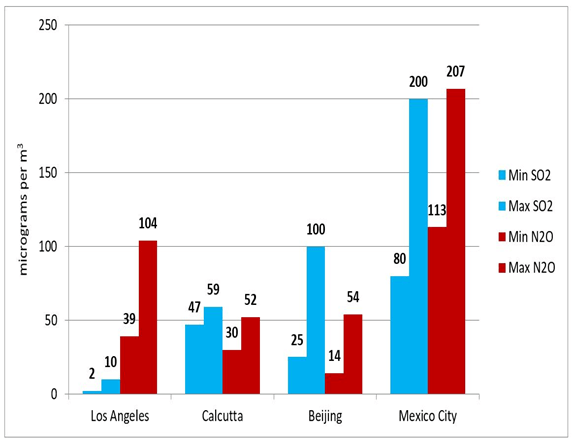
..................................................................................................................................................
..................................................................................................................................................
..................................................................................................................................................
Part 2. Writing an essay (35 points)
Write an essay of about 300 words to answer the following questions. Give reasons and include any relevant examples to support your answer.
Too much emphasis is placed on testing these days. The need to prepare for tests and examinations is a restriction on teachers and also exerts unnecessary pressure on young learners. To what extent do you agree or disagree?
..................................................................................................................................................
..................................................................................................................................................
..................................................................................................................................................
THE END
................................
................................
................................
Xem thêm đề thi học sinh giỏi Tiếng Anh lớp 10 hay khác:
Đề thi học sinh giỏi Tiếng Anh 10 trường THPT Chuyên Lào Cai (Lào Cai) năm 2024
Đề thi học sinh giỏi Tiếng Anh 10 trường THPT Chuyên Lam Sơn (Thanh Hóa) năm 2024
Đề thi học sinh giỏi Tiếng Anh 10 trường THPT Chuyên Lê Hồng Phong (Nam Định) năm 2024
Đề thi học sinh giỏi Tiếng Anh 10 trường THPT Chuyên Hùng Vương (Bình Dương) năm 2024
Đề thi học sinh giỏi Tiếng Anh 10 trường THPT Chuyên Hưng Yên (Hưng Yên) năm 2024
Đề thi học sinh giỏi Tiếng Anh 10 trường THPT Chuyên Bắc Ninh (Bắc Ninh) năm 2022-2023
ĐỀ THI, GIÁO ÁN, SÁCH ĐỀ THI DÀNH CHO GIÁO VIÊN VÀ PHỤ HUYNH LỚP 9
Bộ giáo án, bài giảng powerpoint, đề thi dành cho giáo viên và sách dành cho phụ huynh tại https://tailieugiaovien.com.vn/ . Hỗ trợ zalo VietJack Official
Tổng đài hỗ trợ đăng ký : 084 283 45 85



Đã có app VietJack trên điện thoại, giải bài tập SGK, SBT Soạn văn, Văn mẫu, Thi online, Bài giảng....miễn phí. Tải ngay ứng dụng trên Android và iOS.


Bộ đề thi các lớp các môn học được Giáo viên nhiều năm kinh nghiệm tổng hợp và biên soạn theo Thông tư mới nhất của Bộ Giáo dục và Đào tạo, được chọn lọc từ đề thi của các trường trên cả nước.
Nếu thấy hay, hãy động viên và chia sẻ nhé! Các bình luận không phù hợp với nội quy bình luận trang web sẽ bị cấm bình luận vĩnh viễn.
- Đề thi lớp 1 (các môn học)
- Đề thi lớp 2 (các môn học)
- Đề thi lớp 3 (các môn học)
- Đề thi lớp 4 (các môn học)
- Đề thi lớp 5 (các môn học)
- Đề thi lớp 6 (các môn học)
- Đề thi lớp 7 (các môn học)
- Đề thi lớp 8 (các môn học)
- Đề thi lớp 9 (các môn học)
- Đề thi lớp 10 (các môn học)
- Đề thi lớp 11 (các môn học)
- Đề thi lớp 12 (các môn học)
- Giáo án lớp 1 (các môn học)
- Giáo án lớp 2 (các môn học)
- Giáo án lớp 3 (các môn học)
- Giáo án lớp 4 (các môn học)
- Giáo án lớp 5 (các môn học)
- Giáo án lớp 6 (các môn học)
- Giáo án lớp 7 (các môn học)
- Giáo án lớp 8 (các môn học)
- Giáo án lớp 9 (các môn học)
- Giáo án lớp 10 (các môn học)
- Giáo án lớp 11 (các môn học)
- Giáo án lớp 12 (các môn học)



 Giải bài tập SGK & SBT
 Tài liệu giáo viên
 Sách
Sách
 Khóa học
 Thi online
 Hỏi đáp