Đề thi HSG Tiếng Anh 10 trường THPT Chuyên Hưng Yên (Hưng Yên) năm 2024
Bài viết Đề thi học sinh giỏi Tiếng Anh 10 trường THPT Chuyên Hưng Yên, tỉnh Hưng Yên năm 2024 đề xuất cho kì thi HSG Tiếng Anh 10 các trường THPT Chuyên khu vực Duyên hải và Đồng bằng Bắc Bộ. Mời các bạn đón đọc:
Đề thi HSG Tiếng Anh 10 trường THPT Chuyên Hưng Yên (Hưng Yên) năm 2024
Chỉ từ 200k mua trọn bộ Đề thi học sinh giỏi Tiếng Anh 10 theo cấu trúc mới bản word có lời giải chi tiết:
- B1: gửi phí vào tk:
1133836868- CT TNHH DAU TU VA DV GD VIETJACK - Ngân hàng MB (QR) - B2: Nhắn tin tới Zalo VietJack Official - nhấn vào đây để thông báo và nhận đề thi
|
Sở HƯNG YÊN TRƯỜNG THPT CHUYÊN HƯNG YÊN (Đề thi đề xuất) |
ĐỀ THI CHỌN HỌC SINH GIỎI KHU VỰC DH&ĐB BẮC BỘ NĂM 2024 ĐỀ THI MÔN TIẾNG ANH - LỚP 10 Thời gian: 180 phút (Đề thi gồm có 17 trang, 4 câu) |
SECTION A: LISTENING (50 points)
Part 1. Complete the notes below. Write NO MORE TWO WORDS AND/OR NUMBER for each answer. Write your answers in the corresponding numbered boxes provided. (10 points)
Bài nghe:
TAUBER INSURANCE CO.
|
Example Insurance type: Policy #: Make & Model: Engine size: Name: Date of Birth: Password: Change valuation?
Reduce value to: |
Answer vehicle 1. _______________ Masda Marvel 2. _______________ Lisa Marie Heathcote 3. _______________1955 4. _______________ Yes √ No 5. $ _______________ |
Part 2. You will hear a woman talking about the layers of the Earth. For questions 6-10, decide whether the following statements are true (T) or false (F). Write your answers in the corresponding numbered boxes provided. (10 points)
Bài nghe:
6. There exist some underground cities in the crust like a city in Switzerland.
7. Locals say to have heard the screams of tortured souls coming from the deepest hole ever excavated in the world.
8. The effort to drill into the mantle of the Earth made by a group of scientists brought a positive outcome.
9. Professor Otto Lidenbrock discovers an entire underground world in Jules Verne's beloved novel Journey to the Center of the Earth, filled with prehistoric plants.
10. The pressure in the final layer, known as the inner core, is so great that the metals have crystallized and formed a solid sphere in the planet's center.
Part 3. For questions 11-15, you will hear an interview in which two students called Bella and Tom discussed an article they have read about a woman astronaut. Choose the answer (A, B, C or D) which fits best according to what you hear. Write your answers in the corresponding numbered boxes provided. (10 points)
Bài nghe:
11. The speakers agree that being an astronaut _______________.
A. requires a specific personality type.
B. is not a career that appeals to them.
C. is an unexpected job for a woman.
D. would be very challenging work.
12. Bella particularly admires the astronaut Ellen Ochoa because of _______________.
A. her ability to put her experiences into words.
B. her determination to fulfil a childhood dream.
C. her scientific and technical skills.
D. her attitude towards her colleagues.
13. Tom was surprised to learn that people who want to become astronauts should _______________.
A. have experience as aeroplane pilots.
B. have more than one university degree.
C. be a specific height.
D. be good at sports.
14. What does Bella think is the most interesting part of Ellen's life?
A. spacewalking
B. working in mission control
C. coping with unexpected problems
D. working in conditions of weightlessness
15. Tom and Bella both now decide to _______________.
A. do a project on Ellen Ochoa as part of their coursework.
B. do a study of the first people in space.
C. find out more about the current state of space research.
D. go to some talks on space travel in films and literature.
Part 4: You will listen to a recording about a famous canal. For questions 16-25, complete the summary by writing NO MORE THAN FOUR WORDS in each gap. Write your answers in the corresponding numbered boxes provided. (20 points)
Bài nghe:
In March 2021, powerful winds blew a container ship from its intended part. While such an event might be considered insignificant in many locations, it turned out to be a (16) _______________ in the Suez Canal.
To facilitate the transportation of goods from Asia to the Mediterranean Basin, merchants had to (17) _______________ the narrow isthmus dividing the Red Sea and the Nile.
Making a (18) _______________ connecting the Indian Ocean and the Mediterranean Sea would eliminate the need for such a journey.
The whole Europe took notice when interest in (19) _______________ was rekindled in 1798.
The plan from the (20) _______________ French diplomat, Ferdinand de Lesseps, was approved by Sa’id Pasha, who came to power in 1854.
Signed in the same year and 1856, two agreements granted de Lesseps the authority to form the Suez Canal Company and fund it by selling shares to (21) _______________.
In 1864, despite pressing forward with the construction of Suez Canal, Isma’il Pasha, the new ruler put an end to the (22) _______________.
Due to the infrastructure needed to (23) _______________ and other necessities to the enormous labor force, a flourishing economy of restaurants, brothels, and smuggled items was created.
On (24) _______________, the completed canal was officially inaugurated.
Depsite the impressive volume of traffic on Suez Canal these days, the incident of the Ever Given is still a (25) _______________ of manmade system’s fragility.
SECTION B: LEXICO- GRAMMAR (40 points)
Part 1. For questions 26-55, choose the best option A, B, C, or D to complete the following sentences and write your answers in the corresponding numbered boxes provided. (30 points)
26. Thousands of lives will be at _______________ if emergency aid does not arrive in the city soon.
A. peril
B. interest
C. stake
D. doubt
27. Sandra will be at least 15 minutes late – That’s a _______________.
A. must
B. definite
C.deal
D. given
28. The researchers determined that concentration effects are applicable to overrepresented minorities living in _______________ impoverished ghettos.
A. severely
B. strictly
C. sharply
D. harshly
29. She's been told that her husband is being _______________ treated in prison.
A. severely
B. strictly
C. sharply
D. harshly
30. A: ‘Oh, I’m exhausted! I’ve been doing homework all day.’
B: ‘Come and put your _______________ up for 5 minutes and I’ll make you a cup of tea.’
A. hands
B. hair
C. heart
D. feet
31. I overslept this morning and caught the last bus to school by the skin of my _______________.
A. mouth
B. leg
C. neck
D. teeth
32. My manager is a typical working mother who has to deal with _______________ activities every day.
A. miscellaneous
B. multifarious
C. many
D. manifold
33. He'll have to buckle _______________ to his work soon if he wants to pass his finals.
A. up
B. in
C. down
D. for
34. He spoke well though it was his _______________ speech.
A. first-hand
B. maiden
C. slurred
D. prime
35. You've got a whole week to yourself and you can read to your heart's _______________.
A. happiness
B. content
C. contentment
D. delight
36. We intend this to be a(n) _______________ project, taking us into the next decade.
A. constant
B. incessant
C. steady
D. ongoing
37. I'd like to reserve _______________ until I see the report.
A. condemnation
B. thought
C. criticism
D. judgement
38. After a few years in one place, I get _______________ feet
A. itchy
B. scratchy
C. sore
D. light
39. It seems like _______________ justice that he should lose his house as well as his wife.
A. poetic
B. only
C. small
D. rough
40. John and Sarah lived in the back of _____ and it always took us a whole day to drive there.
A. the country
B. isolation
C. nowhere
D. beyond
41. It’s time we had a _______________ talk with each other in an effort to clear the air.
A. heart to heart
B. eye to eye
C. face to face
D. cheek to cheek
42. The government needs to _______________ businesses that have been trying to evade the tax.
A. put the screws on
B. get into gear
C. put one over on
D. wipe off the map
43. My mother decided to _______________ early yesterday while I stayed up to watch Korean movies.
A. doze off
B. let up
C. get off
D. turn in
44. Scientists warn that global warming will soon go beyond _______________.
A. the U-turn
B. the firing line
C. the red line
D. the point of no return
45. The community should take the doctor’s advice into consideration since he’s in _______________ earnest about the epidemic.
A. mortally
B. fatally
C. deadly
D. gravely
46. Last weekend, _______________ nothing to watch on TV, we played chest together.
A. there being
B. there having
C. having had
D. being
47. I’d sooner you ______ a noise last night; I couldn’t get to sleep.
A. wouldn’t make
B. didn’t make
C. haven’t made
D. hadn’t made
48. The students, _______________ are graduating this year, are as thick as thieves.
A. of whom five
B. five of whose
C. whose five
D. of five whom
49. Tourists _______________ when large numbers of middle-class people _______________ to join the more wealthy aristocratic travellers.
A. have originated/ have begun
B. had originated/ began
C. could have originated/ have begun
D. originated/ began
50. Jimmy asked Lily about her favorite celebrity.
Jimmy: “You don’t like Taylor Swift, do you?” Lily: “_______________”
A. No, I don’t
B. Yes
C. Yes, I don’t
D. A & B are correct
51. _______________ chair the meeting.
A. John was decided to
B. It was decided that John
C. There was decided that John should
D. John had been decided to
52. In front of the door _______________,
A. a dog sat
B. was seated a dog
C. seated a dog
D. was a dog seating
53. The film was expected _______________ by the end of the month.
A. to being completed
B. to have completed
C. having been completed
D. to have been completed
54. The mini dress was _______________, but now it is making a comeback.
A. a fad once thought to be finished
B. once thought a fad to be finishing
C. thought a fad to be finished once
D. once thought to be a finishing fad
55. My aunt gave me a _______________ cake.
A. round Italian bread-like Christmas
B. sponge square Dutch wedding
C. layer moist chocolate birthday
D. lovely pink round graduation
Part 2. For questions 56-65, fill each gap with the correct form of the words in brackets. Write your answer in the boxes provided. (10 points)
56. She is very active and sociable, so it is surprising that she dates such a quiet and _______________ man like Khoi. (ASSUME)
57. After just 3 days, Donald has been able to dive _______________ into the pool. (HEAD)
58. Most homeless people in the US are _______________, they are all around cafes and restaurants ready to pick up wasted food or leftovers. (FREE)
59. The sandwich shop she's opening is a _______________ alternative to the town's male-dominated coffee shop culture. (STAFF)
60. Being a war _______________ is a dangerous job because you will have to bring yourself to the most conflict-ridden parts of the world. (RESPOND)
61. Under _______________, white people were not allowed to marry their non-white counterparts. (APART)
62. The teacher threatened to _______________ their phones if they kept using them in class. (FISCAL)
63. You should dress in a way that _______________ a woman of your age, which is not so gaudy. (FIT)
64. The so-called ‘norm’ of the nuclear family is in fact _______________ of many families. (TYPICAL)
65. Temperature records have _______________ confirmed the existence of global warming. (EQUAL)
SECTION C: READING (60 points)
Part 1. For questions 66-75, read the following passage and decide which option (A, B, C, or D) best fits each gap. Write your answers in corresponding numbered boxes. (15 points)
LOOKING INTO SPACE
Outer space has (66) _______________ mankind ever since we first gazed upward. It was easy enough to see stars in the night sky (67) _______________ the naked eyes and many (68) _______________ civilizations also noticed that certain groups appeared to form familiar shapes. They used these constellations to help with navigation and as a means of predicting the seasons and making calendars. Ancient astronomers also perceived points of light that moved. They believed they were wandering stars and the word “planet” was (69) _______________ from the Greek word for “wanderers”. For much of human history, it was also believed that the Earth was the center of the Universe and that the planets circled the Earth, and that falling meteorites and solar eclipses were (70) _______________ of disaster.
It wasn’t until the 16th century that Polish mathematician and astronomer Nicolaus Copernicus presented a mathematical model of how the sun actually moved around the Earth, challenging the (71) _______________ understanding of how the solar system worked. The Italian physicist and astronomer Galileo Galilei then used a telescope to prove this theory to be correct.
Many technological advances have allowed us to probe (72) _______________ space since then, and one of the most pioneering was when the first manned spacecraft, the Apollo 11, successfully (73) _______________ gravity and touched down on the moon’s surface. Nevertheless, much of our research must be done from far greater distances. The Hubble Space Telescope was carried into orbit by a space shuttle in April 1990 and it has allowed cosmologists to gather incredible data.
Most (74) _______________, it has provided a great deal of evidence to support the Big Bang Theory, that is, the idea that the Universe originated as a hot, (75) _______________ state at a certain time in the past and has continued to expand since then.
66.
A. aroused
B. struck
C. inquired
D. intrigued
67.
A. by
B. with
C. from
D. in
68.
A. primary
B. early
C. first
D. initial
69.
A. derived
B. originated
C. descended
D. inferred
70.
A. signals
B. images
C. heralds
D. omens
71.
A. domineering
B. prevailing
C. controlling
D. dominating
72.
A. at
B. on
C. into
D. towards
73.
A. broke through
B. got over
C. came off
D. went ahead
74.
A. magnificently
B. brilliantly
C. significantly
D. expressively
75.
A. thick
B. dense
C. intense
D. fraught
Part 2. For questions 76-85, fill each of the following numbered blanks with ONE suitable word and write your answers in the corresponding numbered boxes. (15 points)
SOCIAL ENTERPRISE – A WORTHWHILE WAY TO MAKE MONEY?
Every so often, a new buzzword takes the business world (76) _______________ storm. A paradigm shift in how things are done, or a whole new lexicon of abstruse terms to (77) _______________ the novice’s head in knots. In recent years, one such concept that (78) _______________ gained considerable traction is social enterprise. Social enterprises are business which champion the honourable intention of changing the world for the (79) _______________. By selling goods and services in the open market, social enterprises generate profits which are then reinvested in the local, or indeed global, community. The aim is to tackle social problems, improve opportunities and address inequality, among (80) _______________.
While examples of social enterprises are inspiring and offer a vision of corporate caring (81) _______________ is hard not to warm to, it’s perfectly reasonable to have reservations about the philosophy as a whole. There is certainly a growing trend for companies that have never really shown much compassion suddenly (82) _______________ on the impact investment bandwagon. (83) _______________ you have long been perceived as a rapacious multinational focused on profit above people, then one of the best ways to redress the balance is to show a big heart.
There are a number of high-profile companies who have joined (84) _______________ with NGOs and charitable organisations to ensure that their hard-earned dollars are invested into a whole plethora of needy causes. These tend to be extremely well-publicised initiatives, news of which often takes (85) _______________ over concerns about working conditions or corporate accountability. In fact, many business advisors highly recommend the social enterprise route to change negative public perceptions.
Part 3. For questions 86-95, read the following passage and circle the best answer to each of the following questions. Write your answers in corresponding numbered boxes provided. (15 points)
The deserts, which already occupy approximately a fourth of the Earth’s land surface, have in recent decades been increasing at an alarming pace. The expansion of desertlike conditions into areas where they did not previously exist is called desertification. It has been estimated that an additional one-fourth of the Earth’s land surface is threatened by this process.
Desertification is accomplished primarily through the loss of stabilizing natural vegetation and the subsequent accelerated erosion of the soil by wind and water. In some cases, the loose soil is blown completely away, leaving a stony surface. In other cases, the finer particles may be removed, while the sand-sized particles are accumulated to form mobile hills or ridges of sand.
Even in the areas that retain a soil cover, the reduction of vegetation typically results in the loss of the soil’s ability to absorb substantial quantities of water. The impact of raindrops on the loose soil tends to transfer fine clay particles into the tiniest soil spaces, sealing them and producing a surface that allows very little water penetration. Water absorption is greatly reduced, consequently runoff is increased, resulting in accelerated erosion rates. The gradual drying of the soil caused by its diminished ability to absorb water results in the further loss of vegetation, so that a cycle of progressive surface deterioration is established.
In some regions, the increase in desert areas is occurring largely as the result of a trend toward drier climatic conditions. Continued gradual global warming has produced an increase in aridity for some areas over the past few thousand years. The process may be accelerated in subsequent decades if global warming resulting from air pollution seriously increases.
There is little doubt, however, that desertification in most areas results primarily from human activities rather than natural processes. The semiarid lands bordering the deserts exist in a delicate ecological balance and are limited in their potential to adjust to increased environmental pressures. Expanding populations are subjecting the land to increasing pressures to provide them with food and fuel. In wet periods, the land may be able to respond to these stresses. During the dry periods that are common phenomena along the desert margins, though, the pressure on the land is often far in excess of its diminished capacity, and desertification results.
Four specific activities have been identified as major contributors to the desertification process: overcultivation, overgrazing, firewood gathering, and overirrigation. The cultivation of crops has expanded into progressively drier regions as population densities have grown. These regions are especially likely to have periods of severe dryness so that crop failures are common. Since the raising of most crops necessitates the prior removal of the natural vegetation, crop failures leave extensive tracts of land devoid of a plant cover and susceptible to wind and water erosion.
■ [A] The raising of livestock is a major economic activity in semiarid lands, where grasses are generally the dominant type of natural vegetation. ■ [B] The consequences of an excessive number of livestock grazing in an area are the reduction of the vegetation cover and the trampling and pulverization of the soil. ■ [C]This is usually followed by the drying of the soil and accelerated erosion. ■ [D]
Firewood is the chief fuel used for cooking and heating in many countries. The increased pres- sures of expanding populations have led to the removal of woody plants so that many cities and towns are surrounded by large areas completely lacking in trees and shrubs. The increasing use of dried animal waste as a substitute fuel has also hurt the soil because this valuable soil conditioner and source of plant nutrients is no longer being returned to the land.
The final major human cause of desertification is soil salinization resulting from overirrigation. Excess water from irrigation sinks down into the water table. If no drainage system exists, the water table rises, bringing dissolved salts to the surface. The water evaporates and the salts are left behind, creating a white crustal layer that prevents air and water from reaching the underlying soil.
The extreme seriousness of desertification results from the vast areas of land and the tremendous numbers of people affected, as well as from the great difficulty of reversing or even slowing the process. Once the soil has been removed by erosion, only the passage of centuries or millen- nia will enable new soil to form. In areas where considerable soil still remains, though, a rigorously enforced program of land protection and cover-crop planting may make it possible to reverse the present deterioration of the surface.
86. According to paragraph 3, the loss of natural vegetation has which of the following consequences for soil?
A. Increased stony content
B. Reduced water absorption
C. Increased numbers of spaces in the soil
D. Reduced water runoff
87. The word delicate in the passage is closest in meaning to _______________.
A. fragile
B. predictable
C. complex
D. valuable
88. According to paragraph 5, in dry periods, border areas have difficulty _______________.
A. adjusting to stresses created by settlement
B. retaining their fertility after desertification
C. providing water for irrigating crops
D. attracting populations in search of food and fuel
89. The phrase devoid of in the passage is closest in meaning to _______________.
A. consisting of
B. hidden by
C. except for
D. lacking in
90. According to paragraph 6, which of the following is often associated with raising crops?
A. Lack of proper irrigation techniques
B. Failure to plant crops suited to the particular area
C. Removal of the original vegetation
D. Excessive use of dried animal waste
91. According to paragraph 9, the ground's absorption of excess water is a factor in desertification because it can _______________.
A. interfere with the irrigation of land
B. limit the evaporation of water
C. require more absorption of air by the soil
D. bring salts to the surface
92. All of the following are mentioned in the passage as contributing to desertification EXCEPT_______________.
A. soil erosion
B. global warming
C. insufficient irrigation
D. the raising of livestock
93. Which of the sentences below best expresses the essential information in the highlighted sentence in the passage?
The extreme seriousness of desertification results from the vast areas of land and the tremendous numbers of people affected, as well as from the great difficulty of reversing or even slowing the process.
A. Desertification is a significant problem because it is so hard to reverse and affects large areas of land and great numbers of people.
B. Slowing down the process of desertification is difficult because of population growth that has spread over large areas of land.
C. The spread of deserts is considered a very serious problem that can be solved only if large numbers of people in various countries are involved in the effort.
D. Desertification is extremely hard to reverse unless the population is reduced in the vast areas affected.
94. It can be inferred from the passage that the author most likely believes which of the following about the future of desertification?
A. Governments will act quickly to control further desertification.
B. The factors influencing desertification occur in cycles and will change in the future.
C. Desertification will continue to increase.
D. Desertification will soon occur in all areas of the world.
95. Look at the four squares that indicate where the following sentence can be added to thepassage.
■ [A] The raising of livestock is a major economic activity in semiarid lands, where grasses are generally the dominant type of natural vegetation. ■ [B] The consequences of an excessive number of livestock grazing in an area are the reduction of the vegetation cover and the trampling and pulverization of the soil. ■ [C]This is usually followed by the drying of the soil and accelerated erosion. ■ [D]
Where would the sentence best fit?
This economic reliance on livestock in certain regions makes large tracts of land susceptible to overgrazing.
A. [A]
B. [B]
C. [C]
D. [D]
Part 4. For questions 96-105, read the passage and do the following tasks. Write your answers in the corresponding numbered boxes. (15 points)
Climate change and the Inuit
The threat posed by climate change in the Arcticand the problems faced by Canada's Inuit people
A
Unusual incidents are being reported across the Arctic. Inuit families going off on snowmobiles to prepare their summer hunting camps have found themselves cut off from home by a sea of mud, following early thaws. There are reports of igloos losing their insulating properties as the snow drips and refreezes, of lakes draining into the sea as permafrost melts, and sea ice breaking up earlier than usual, carrying seals beyond the reach of hunters. Climate change may still be a rather abstract idea to most of us, but in the Arctic it is already having dramatic effects - if summertime ice continues to shrink at its present rate, the Arctic Ocean could soon become virtually ice-free in summer. The knock-on effects are likely to include more warming, cloudier skies, increased precipitation and higher sea levels. Scientists are increasingly keen to find out what's going on because they consider the Arctic the ‘canary in the mine’ for global warming - a warning of what's in store for the rest of the world.
B
For the Inuit the problem is urgent. They live in precarious balance with one of the toughest environments on earth. Climate change, whatever its causes, is a direct threat to their way of life. Nobody knows the Arctic as well as the locals, which is why they are not content simply to stand back and let outside experts tell them what's happening. In Canada, where the Inuit people are jealously guarding their hard-won autonomy in the country's newest territory, Nunavut, they believe their best hope of survival in this changing environment lies in combining their ancestral knowledge with the best of modern science. This is a challenge in itself.
C
The Canadian Arctic is a vast, treeless polar desert that's covered with snow for most of the year. Venture into this terrain and you get some idea of the hardships facing anyone who calls this home. Farming is out of the question and nature offers meagre pickings. Humans first settled in the Arctic a mere 4,500 years ago, surviving by exploiting sea mammals and fish. The environment tested them to the limits: sometimes the colonists were successful, sometimes they failed and vanished. But around a thousand years ago, one group emerged that was uniquely well adapted to cope with the Arctic environment. These Thule people moved in from Alaska, bringing kayaks, sleds, dogs, pottery and iron tools. They are the ancestors of today's Inuit people.
D
Life for the descendants of the Thule people is still harsh. Nunavut is 1.9 million square kilometres of rock and ice, and a handful of islands around the North Pole. It's currently home to 2,500 people, all but a handful of them indigenous Inuit. Over the past 40 years, most have abandoned their nomadic ways and settled in the territory's 28 isolated communities, but they still rely heavily on nature to provide food and clothing.
Provisions available in local shops have to be flown into Nunavut on one of the most costly air networks in the world, or brought by supply ship during the few ice-free weeks of summer. It would cost a family around £7,000 a year to replace meat they obtained themselves through hunting with imported meat. Economic opportunities are scarce, and for many people state benefits are their only income.
E
While the Inuit may not actually starve if hunting and trapping are curtailed by climate change, there has certainly been an impact on people's health. Obesity, heart disease and diabetes are beginning to appear in people for whom these have never before been problems. There has been a crisis of identity as the traditional skills of hunting, trapping and preparing skins have begun to disappear. In Nunavut's ‘igloo and email’ society, where adults who were born in igloos have children who may never have been out on the land, there's a high incidence of depression.
F
With so much at stake, the Inuit are determined to play a key role in teasing out the mysteries of climate change in the Arctic. Having survived there for centuries, they believe their wealth of traditional knowledge is vital to the task. And Western scientists are starting to draw on this wisdom, increasingly referred to as ‘Inuit Qaujimajatugangit’, or IQ. ‘In the early days scientists ignored us when they came up here to study anything. They just figured these people don't know very much so we won't ask them,’ says John Amagoalik, an Inuit leader and politician. ‘But in recent years IQ has had much more credibility and weight.’ In fact it is now a requirement for anyone hoping to get permission to do research that they consult the communities, who are helping to set the research agenda to reflect their most important concerns. They can turn down applications from scientists they believe will work against their interests, or research projects that will impinge too much on their daily lives and traditional activities.
G
Some scientists doubt the value of traditional knowledge because the occupation of the Arctic doesn't go back far enough. Others, however, point out that the first weather stations in the far north date back just 50 years. There are still huge gaps in our environmental knowledge, and despite the scientific onslaught, many predictions are no more than best guesses. IQ could help to bridge the gap and resolve the tremendous uncertainty about how much of what we're seeing is natural capriciousness and how much is the consequence of human activity.
Questions 96-32
Choose the correct heading for paragraphs B-F from the list of headings below..
Write the correct number i-ix, in boxes on your answer sheet.
List of Headings
i The reaction of the Inuit community to climate change
ii Understanding of climate change remains limited
iii Alternative sources of essential supplies
iv Respect for Inuit opinion grows
v A healthier choice of food
vi A difficult landscape
vii Negative effects on well-being
viii Alarm caused by unprecedented events in the Arctic
ix The benefits of an easier existence
Example Paragraph A Answer viii
96. Paragraph B _______________
97. Paragraph C _______________
98. Paragraph D _______________
99. Paragraph E _______________
100. Paragraph F _______________
Questions 101-105
Complete the summary of paragraphs C and D below.
Choose NO MORE THAN TWO WORDS from paragraphs C and D for each answer. Write your answers in boxes on your answer sheet.
If you visit the Canadian Arctic, you immediately appreciate the problems faced by people for whom this is home. It would clearly be impossible for the people to engage in 101 _______________ as a means of supporting themselves. For thousands of years, they have had to rely on catching 102 _______________ and fish as a means of sustenance. The harsh surroundings saw many who tried to settle there pushed to their limits, although some were successful. The 103 _______________ people were an example of the latter and for them the environment did not prove unmanageable. For the present inhabitants, life continues to be a struggle. The territory of Nunavut consists of little more than ice, rock and a few 104 _______________. In recent years, many of them have been obliged to give up their 105 _______________ lifestyle, but they continue to depend mainly on nature their food and clothes. Imported produce is particularly expensive.
D. WRITING (50 points)
Part 1. (20 points)
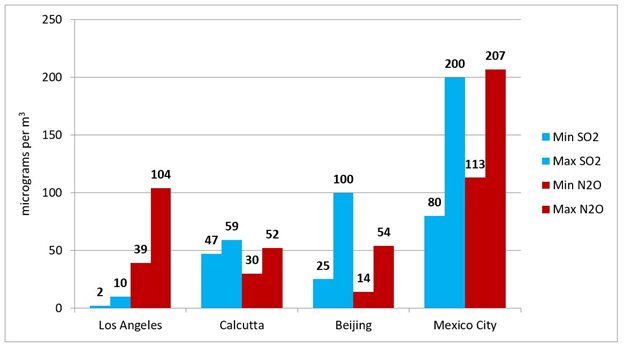
The chart shows the average daily minimum and maximum levels of air pollutants in 4 cities in the year 2000.
Summarize the information by selecting and reporting the main features and make comparisons where relevant.
..................................................................................................................................................
..................................................................................................................................................
..................................................................................................................................................
Part 2: (30 points)
People who decide on a career path early in their lives and keep to it are more likely to have a satisfying working life than those who change jobs frequently. To what extent do you agree or disagree?
Write an essay of about 250 words to answer the above question. Give reasons and include any relevant examples to support your answer.
..................................................................................................................................................
..................................................................................................................................................
..................................................................................................................................................
-------------- HẾT --------------
................................
................................
................................
Xem thêm đề thi học sinh giỏi Tiếng Anh lớp 10 hay khác:
Đề thi học sinh giỏi Tiếng Anh 10 trường THPT Chuyên Lào Cai (Lào Cai) năm 2024
Đề thi học sinh giỏi Tiếng Anh 10 trường THPT Chuyên Lam Sơn (Thanh Hóa) năm 2024
Đề thi học sinh giỏi Tiếng Anh 10 trường THPT Chuyên Lê Hồng Phong (Nam Định) năm 2024
Đề thi học sinh giỏi Tiếng Anh 10 trường THPT Chuyên Hùng Vương (Bình Dương) năm 2024
Đề thi học sinh giỏi Tiếng Anh 10 trường THPT Chuyên Bắc Ninh (Bắc Ninh) năm 2022-2023
Đề thi học sinh giỏi Tiếng Anh 10 trường THPT Chuyên Lê Khiết (Quảng Ngãi) năm 2023
TÀI LIỆU CLC DÀNH CHO GIÁO VIÊN VÀ PHỤ HUYNH LỚP 9
Bộ giáo án, bài giảng powerpoint, đề thi file word có đáp án 2026 tại https://tailieugiaovien.com.vn/
Hỗ trợ zalo: VietJack Official
Tổng đài hỗ trợ đăng ký: 084 283 45 85
 Đề thi vào 10 các sở Hà Nội, Tp. Hồ Chí Minh...
41 tài liệu
Đề thi vào 10 các sở Hà Nội, Tp. Hồ Chí Minh...
41 tài liệu
 Giáo án Word 9
95 tài liệu
Giáo án Word 9
95 tài liệu
 Đề thi giữa kì, cuối kì 9
254 tài liệu
Đề thi giữa kì, cuối kì 9
254 tài liệu
 Chuyên đề dạy thêm Toán, Lí, Hóa... 9
71 tài liệu
Chuyên đề dạy thêm Toán, Lí, Hóa... 9
71 tài liệu
 Đề thi HSG 9
8 tài liệu
Đề thi HSG 9
8 tài liệu
 Bài giảng Powerpoint 9
42 tài liệu
Bài giảng Powerpoint 9
42 tài liệu
Công cụ giáo viên (2048.VN)
Tạo- trộn đề thi miễn phí từ file PDF, Word, Giao bài nhanh chóng, Hoàn toàn Free
Bộ đề thi các lớp các môn học được Giáo viên nhiều năm kinh nghiệm tổng hợp và biên soạn theo Thông tư mới nhất của Bộ Giáo dục và Đào tạo, được chọn lọc từ đề thi của các trường trên cả nước.
- Đề thi lớp 1 (các môn học)
- Đề thi lớp 2 (các môn học)
- Đề thi lớp 3 (các môn học)
- Đề thi lớp 4 (các môn học)
- Đề thi lớp 5 (các môn học)
- Đề thi lớp 6 (các môn học)
- Đề thi lớp 7 (các môn học)
- Đề thi lớp 8 (các môn học)
- Đề thi lớp 9 (các môn học)
- Đề thi lớp 10 (các môn học)
- Đề thi lớp 11 (các môn học)
- Đề thi lớp 12 (các môn học)
- Giáo án lớp 1 (các môn học)
- Giáo án lớp 2 (các môn học)
- Giáo án lớp 3 (các môn học)
- Giáo án lớp 4 (các môn học)
- Giáo án lớp 5 (các môn học)
- Giáo án lớp 6 (các môn học)
- Giáo án lớp 7 (các môn học)
- Giáo án lớp 8 (các môn học)
- Giáo án lớp 9 (các môn học)
- Giáo án lớp 10 (các môn học)
- Giáo án lớp 11 (các môn học)
- Giáo án lớp 12 (các môn học)