Đề thi HSG Tiếng Anh 10 trường THPT Chuyên Lê Quý Đôn (Bình Định) năm 2024
Bài viết Đề thi học sinh giỏi Tiếng Anh 10 trường THPT Chuyên Lê Quý Đôn, tỉnh Bình Định năm 2024 đề xuất cho kì thi HSG Tiếng Anh 10 các trường THPT Chuyên khu vực Duyên hải và Đồng bằng Bắc Bộ. Mời các bạn đón đọc:
Đề thi HSG Tiếng Anh 10 trường THPT Chuyên Lê Quý Đôn (Bình Định) năm 2024
Chỉ từ 200k mua trọn bộ Đề thi học sinh giỏi Tiếng Anh 10 theo cấu trúc mới bản word có lời giải chi tiết:
- B1: gửi phí vào tk:
1133836868- CT TNHH DAU TU VA DV GD VIETJACK - Ngân hàng MB (QR) - B2: Nhắn tin tới Zalo VietJack Official - nhấn vào đây để thông báo và nhận đề thi
|
SỞ GIÁO DỤC VÀ ĐÀO TẠO BÌNH ĐỊNH TRƯỜNG THPT CHUYÊN LÊ QUÝ ĐÔN ĐỀ THI ĐỀ XUẤT (Đề thi gồm 15 trang) |
KỲ THI HỌC SINH GIỎI CÁC TRƯỜNG THPT CHUYÊN KHU VỰC DUYÊN HẢI VÀ ĐỒNG BẰNG BẮC BỘ NĂM 2024 Môn: TIẾNG ANH – LỚP 10 Thời gian: 180 phút (không kể thời gian giao đề) |
SECTION A. LISTENING (50 points)
Part 1. You will hear a student called Janet talking on the phone to the manager of a sports centre about a job and complete the notes below. Write NO MORE THAN THREE WORDS AND/OR A NUMBER for each answer. (10 points)
Bài nghe:
White Water Sports Centre
Manager's name: 1. ______________
Job available: 2. ______________(part-time)
Job responsibilities:
– supervising swimmers
– care of 3. ______________ for beginners' classes
– carrying out 4. ______________ regularly
Days: Mondays and Wednesdays
Working hours: 5. ______________ to ______________
Part 2. You will hear a conversation between a journalist and politician about the government plans. Listen and decide whether the following statements are true (T) or false (F). (10 points)
Bài nghe:
1. The government is planning to decrease expenditure on public hospitals.
2. There will be a rise in the state subsidy for prescription medicines.
3. The government is going to maintain the same level of expenditure for the education sector.
4. There will be increased government funding for research and development.
5. It is on the government agenda that there will be a rise in the expenditure on public works.
Part 3. You will hear part of a discussion in which two educationalists, David Shaw and Anoushka Patel, talk about education standards in the UK. For questions 1-5, choose the answer (A, B, C or D) which best fits according to what you hear. (10 points)
Bài nghe:
1. What criticism does Anoushka make of primary school education?
A. It has remained the same for too long.
B. The teachers are inadequately prepared.
C. It is not sufficiently varied.
D. Pupils no longer find it enjoyable.
2. According to the statistics David quotes, the secondary school exam results pupils achieve ______________.
A. have caused the national average to fall dramatically.
B. cannot be directly compared to those of foreign pupils.
C. do not reflect the true level of education in the UK.
D. can be accurately predicted when they leave primary school.
3. Anoushka says that pupils who perform poorly do so because ______________.
A. they lack the ability to concentrate in class.
B. education is not a top priority for them.
C. teachers are unable to provide them with enough attention.
D. it is impossible for their parents to buy books.
4. David claims that universities are guilty of ______________.
A. ignoring the advice given by the Department of Education.
B. making it easier for students to get good degrees.
C. accepting too many applications from school leavers.
D. exaggerating the quality of teaching they offer.
5. Anoushka makes the point that universities in the UK ______________.
A. have adapted to meet the needs of society.
B. should not have to answer questions about their policies.
C. have maintained a traditional approach to education.
D. are still considered to be the best in the world.
Part 4. You will hear a girl called Laura Beamer talking about being a volunteer at a summer school for 7 – 14-year-olds, which is called the Children’s University. Complete the sentences by writing NO MORE THAN THREE WORDS AND/OR A NUMBER for each answer. (20 points)
Bài nghe:
VOLUNTEER AT THE CHILDREN’S UNIVERSITY
The Children’s University was started by a 1. ______________ five years ago. The focus of this year’s Children’s University was the topic of 2. ______________. Laura’s partner was Mark, who works as a 3. ______________ when he is not volunteering. Laura’s group of volunteers gave some workshops about how 4. ______________ is made. Laura says the children had a booklet called a 5. “______________” which was stamped to show their progress. Laura and the children went to the graduation ceremony in the
6. ______________ hall of the local University. Some children received a 7. ______________ for attending a lot of workshops. Laura said the scheme allowed her to develop skills such as 8. ______________. Laura will most probably become a 9. ______________ in the future. Laura says she can give people in her audience something called an 10. ______________ for volunteers.
SECTION B. LEXICO-GRAMMAR (40 points)
Part 1. Choose one of the words marked A, B, C or D which best completes each of the following sentences. Write your answers in the corresponding numbered boxes. (30 points)
1. At the beginning of the second half, Liverpool scored their fifth goal, ________Leeds gave up completely.
A. until when
B. at which point
C. at that point
D. at what point
2. Victor ________ all odds and ended up winning the championship title in boxing.
A. defied
B. debated
C. defended
D. defeated
3. We interviewed a number of candidates but ________ of them impressed us.
A. no
B. none
C. neither
D. not
4. Visitors are asked to ________ to the rules of the park to prevent damage to its fragile ecosystem.
A. adhere
B. bond
C. affix
D. cling
5. I got very nervous about the exam, but in the event, I ________; it was easy.
A. didn’t need to worry
B. needn’t have worried
C. needn’t worry
D. don’t need to worry
6. His future in the job is balanced on a ________
A. cutting-edge
B. razor-edge
C. cliff-edge
D. knife-edge
7. The newfound source of water is ________ 30 meters beneath the ground.
A. several
B. many
C. few
D. some
8. He’s a very ________writer whom few people have ever heard of.
A. wrinkled
B. congested
C. pale
D. obscure
9. The mechanic expects ________ the brakes on the car before we pick it up.
A. fixing
B. being fixed
C. to have fixed
D. to have been fixed
10. I find the prose style of many American writers virtually ________
A. illegible
B. impenetrable
C. impermeable
D. incorrigible
11. It is strongly recommended that an immunization programme ________ to prevent epidemics.
A. conducts
B. conducted
C. should conduct
D. be conducted
12. In basketball, Sheffield ________ defeated London 86-85.
A. tightly
B. narrowly
C. finely
D. thinly
13. Nobody phoned while I was out, ________?
A. did they
B. was I
C. wasn’t I
D. didn’t they
14. The 5% wage increases they propose are ________
A. all for once
B. by and large
C. top to bottom
D. across the board
15. This is a ________ table I have ever seen.
A. beautiful large round wooden
B. large beautiful round wooden
C. round beautiful large wooden
D. wooden beautiful large round
16. After a fall in profits, the company decided to ________ the hotel business.
A. pull out of
B. back off from
C. take out of
D. keep away from
17. Mr. Green supposes, ________, that he will retire at 60.
A. like most people did
B. like most people do
C. as most of people
D. as do most people
18. I could hear ________ of the conversation from across the room.
A. shreds
B. pieces
C. snatches
D. patches
19. The topic ________ at yesterday’s meeting was of great importance.
A. having been discussed
B. to have been discussed
C. discussed
D. to be discussed
20. The latest ________ of meningitis has eclipsed any over the past few years.
A. breakout
B. outbreak
C. offset
D. outburst
21. It’s raining so come inside, but please leave those muddy boots in the ________.
A. thatch
B. loft
C. foyer
D. porch
22. That the boy’s idleness ________ ill for his future is obvious to everyone apart from his parents.
A. bodes
B. heralds
C. causes
D. bears
23. Tom’s very good at ________ people. Team members give him their best whatever the project.
A. defying
B. receiving
C. motivating
D. approaching
24. “Have you ever decided on the definite time for Jennifer’s leaving party?”
“Not yet, but I’ve ________ for o’clock on Friday”
A. taken it down
B. put it off
C. drawn it up
D. penciled it in
25. Somebody who is foolish or stupid is ________.
A. soft in the head
B. riding high
C. over the moon
D. pushing up daisies
26. Factories are ________ to produce enough masks and protective clothing for health workers during the pandemic.
A. raising red flags
B. firing on all cylinders
C. raking over the ashes
D. packing heat
27. The three-day ________ was finally brought to an end when the terrorists surrendered due to shortage of food and water.
A. precinct
B. orbital
C. cordon
D. siege
28. Considering how often that car breaks down, I think I really bought ________ from the dealership.
A. a pig
B. a fish
C. a lemon
D. a mandarin
29. Well done! Getting straight As in all your exams is a ________ achievement.
A. self-made
B. burgeoning
C. resourceful
D. phenomenal
30. Almonds and other nuts are rich in ________ such as vitamin E and calcium.
A. additives
B. organisms
C. extracts
D. nutrients
Part 2. Give the correct form of the words in brackets. Write your answers in the corresponding numbered boxes. (10 points)
1. He was a bad influence on the child, who was at a(n) ______________ age.(IMPRESS)
2. ______________ is an issue of growing concern among employers in the UK owing to changing legislation, but there is virtually no robust data on its direct or indirect costs. (ABSENT)
3. We should take a more ______________ view and consider the long-term effects of Briant’s work.(PASSION)
4. Can you make up a(n) ______________ for tennis tomorrow? (FOUR)
5. These wonderful books ______________ moments in history in truly unforgettable ways. (CAPSULE)
6. “Religious believers are not morally superior. Nonbelievers are by no means ______________”. Dr T.P.Chia. (MORAL)
7. Earlier this year a pig adopted a tiger cub and raised him along with her five ______________ because his mother couldn't feed him. (PIG)
8. When my limbs began to ache, and my tonsils felt as if someone had ______________ them, I knew that I was infected with the flu. (PAPER)
9. Here, the outside world seems to vanish behind ______________ mountains, quarantined away by river, still water, and wetland. (FOLD)
10. The peace talks have ended ______________, with neither side prepared to give way on key points. (CONCLUDE)
SECTION B. READING COMPREHENSION (60 points)
Part 1. Read the following passage and decide which answer (A, B, C or D) best fits each gap. Write your answers in corresponding numbered boxes. (15 points)
Many artefacts of (1) ______________ cultural significance from the last century were made from plastic. It was always confidently assumed that this rather (2) ______________ material was virtually indestructible. Now that some of these artefacts have become museum (3) ______________, we have discovered that this (4) ______________ was sadly mistaken.
The degradation of plastics is worrying both scientists and historians, who are racing against time to save our plastic heritage before it (5) ______________ into dust. Our love affair with plastics (6) ______________ in large part from the fact they can be (7) ______________ into just about any shape imaginable. When it comes to longevity, however, they have a serious (8) ______________: their chemical structure breaks down when they are exposed to air and sunlight.
Many now argue that we must consider the cultural (9) ______________ we will be leaving future generations. Without urgent (10) ______________ many artefacts will be lost forever. But developing effective conservation strategies is difficult because what works to preserve one type of plastic can have a catastrophic effect on the lifespan of another.
1.
A. enduring
B. lingering
C. unceasing
D. perennial
2.
A. trivial
B. routine
C. customary
D. mundane
3.
A. items
B. articles
C. pieces
D. objects
4.
A. concept
B. premise
C. notion
D. proposition
5.
A. crumbles
B. shatters
C. erodes
D. shrivels
6.
A. starts
B. sparks
C. stems
D. sprouts
7.
A. cast
B. moulded
C. engraved
D. dissected
8.
A. fault
B. snag
C. stigma
D. flaw
9.
A. bequest
B. legacy
C. endowment
D. heirloom
10.
A. intervention
B. interception
C. interference
D. intercession
Part 2. Read the text below and think of the word which best fits each space. Use only one word in each space. Write your answers in corresponding numbered boxes. (15 points)
Old England in the center of London (1) ______________ an interesting evening out and reflects a growing trend for themed restaurants. This one's set in medieval England.
Our first impression when we went in, was of a large, dimly-lit room with huge, long wooden tables and (2) ______________ hung with tapestries depicting medieval scenes. After we had been seated at a table, waitresses in period costume came and brought us drinks in metal goblets. A small group of musicians appeared up in the gallery, burning touches were lit, more diners arrived and the banquet was (3) ______________ way!
The first course, which were roast pigeon, was not particularly to (4) ______________ of our tastes as it was served in an extremely rich sauce. The wild boar that followed was quite tasty although my girlfriend complained that (5) ______________ was rather tough. The third course, baked fish with a variety of vegetables, was rather bland. Finally, dessert was a selection of traditional tarts and pies. They certainly looked the (6) ______________ but we could have done with a lighter sweet, like a fruit jelly or mousse. The drinks flowed freely enough and the atmosphere was cheerful, though rather noisy!
All in all, the evening was a reasonable success and we (7) ______________ felt that quite an authentic medieval atmosphere had been created. Nonetheless, I would say that the standard of the food didn't (8) ______________ up to our expectations and they could do with a lot more choice on the menu. The entertainment wasn't quite what had been advertised, since, for some reason, the comedians did not appear on the evening we were there, and the dancing only got (9) ______________ in the last half hour or so. If these things could be improved, then I would definitely recommend it as something a bit different for an evening out; (10) ______________ I would classify it as an unforgettable experience, however, is questionable.
Part 3. Read the passage and choose the best option A, B, C or D to answer the questions. Write your answers in the corresponding numbered boxes. (15 points)
The Creators of Grammar
No student of a foreign language needs to be told that grammar is complex. By changing word sequences and by adding a range of auxiliary verbs and suffixes, we are able to communicate tiny variations in meaning. We can turn a statement into a question, state whether an action has taken place or is soon to take place, and perform many other word tricks to convey subtle differences in meaning. Nor is this complexity inherent to the English language. All languages, even those of so-called 'primitive' tribes have clever grammatical components. The Cherokee pronoun system, for example, can distinguish between 'you and I', 'several other people and I' and 'you, another person and I'. In English, all these meanings are summed up in the one, crude pronoun 'we'. Grammar is universal and plays a part in every language, no matter how widespread it is. So the question which has baffled many linguists is - who created grammar?
At first, it would appear that this question is impossible to answer. To find out how grammar is created, someone needs to be present at the time of a language's creation, documenting its emergence. Many historical linguists are able to trace modern complex languages back to earlier languages, but in order to answer the question of how complex languages are actually formed, the researcher needs to observe how languages are started from scratch. Amazingly, however, this is possible.
Some of the most recent languages evolved due to the Atlantic slave trade. At that time, slaves from a number of different ethnicities were forced to work together under colonizer's rule. Since they had no opportunity to learn each other's languages, they developed a make-shift language called a pidgin. Pidgins are strings of words copied from the language of the landowner. They have little in the way of grammar, and in many cases it is difficult for a listener to deduce when an event happened, and who did what to whom. [A] Speakers need to use circumlocution in order to make their meaning understood. [B] Interestingly, however, all it takes for a pidgin to become a complex language is for a group of children to be exposed to it at the time when they learn their mother tongue. [C] Slave children did not simply copy the strings of words uttered by their elders, they adapted their words to create a new, expressive language. [D] Complex grammar systems which emerge from pidgins are termed creoles, and they are invented by children.
Further evidence of this can be seen in studying sign languages for the deaf. Sign languages are not simply a series of gestures; they utilise the same grammatical machinery that is found in spoken languages. Moreover, there are many different languages used worldwide. The creation of one such language was documented quite recently in Nicaragua. Previously, all deaf people were isolated from each other, but in 1979 a new government introduced schools for the deaf. Although children were taught speech and lip reading in the classroom, in the playgrounds they began to invent their own sign system, using the gestures that they used at home. It was basically a pidgin. Each child used the signs differently, and there was no consistent grammar. However, children who joined the school later, when this inventive sign system was already around, developed a quite different sign language. Although it was based on the signs of the older children, the younger children's language was more fluid and compact, and it utilised a large range of grammatical devices to clarify meaning. What is more, all the children used the signs in the same way. A new creole was born.
Some linguists believe that many of the world's most established languages were creoles at first. The English past tense –ed ending may have evolved from the verb 'do'. 'It ended' may once have been 'It end-did'. Therefore, it would appear that even the most widespread languages were partly created by children. Children appear to have innate grammatical machinery in their brains, which springs to life when they are first trying to make sense of the world around them. Their minds can serve to create logical, complex structures, even when there is no grammar present for them to copy.
1. In paragraph 1, why does the writer include information about the Cherokee language?
A. To show how simple, traditional cultures can have complicated grammar structures.
B. To show how English grammar differs from Cherokee grammar.
C. To prove that complex grammar structures were invented by the Cherokees.
D. To demonstrate how difficult it is to learn the Cherokee language.
2. What can be inferred about the slaves' pidgin language?
A. It contained complex grammar.
B. It was based on many different languages.
C. It was difficult to understand, even among slaves.
D. It was created by the land-owners.
3. All the following sentences about Nicaraguan sign language are true EXCEPT:
A. The language has been created since 1979.
B. The language is based on speech and lip reading.
C. The language incorporates signs which children used at home.
D. The language was perfected by younger children.
4. In paragraph 3, where can the following sentence be placed?
“It included standardised word orders and grammatical markers that existed in neither the pidgin language, nor the language of the colonizers”.
A. [A]
B. [B]
C. [C]
D. [D]
5. 'From scratch' in paragraph 2 is closest in meaning to:
A. from the very beginning
B. in simple cultures
C. by copying something else
D. by using written information
6. 'Make-shift' in paragraph 3 is closest in meaning to:
A. complicated and expressive
B. simple and temporary
C. extensive and diverse
D. private and personal
7. Which sentence is closest in meaning to the highlighted sentence?
Grammar is universal and plays a part in every language, no matter how widespread it is.
A. All languages, whether they are spoken by a few people or a lot of people, contain grammar.
B. Some languages include a lot of grammar, whereas other languages contain a little.
C. Languages which contain a lot of grammar are more common that languages that contain a little.
D. The grammar of all languages is the same, no matter where the languages evolved.
8. All of the following are features of the new Nicaraguan sign language EXCEPT:
A. All children used the same gestures to show meaning.
B. The meaning was clearer than the previous sign language.
C. The hand movements were smoother and smaller.
D. New gestures were created for everyday objects and activities.
9. Which idea is presented in the final paragraph?
A. English was probably once a creole.
B. The English past tense system is inaccurate.
C. Linguists have proven that English was created by children.
D. Children say English past tenses differently from adults.
10. Look at the word 'consistent' in paragraph 4. This word could best be replaced by which of the following?
A. natural
B. predictable
C. imaginable
D. uniform
Part 4. Read the passage and do the following tasks. Write your answers in the corresponding numbered boxes. (15 points)
WHY COMPANIES SHOULD WELCOME DISORDER
A. Organisation is big business. Whether it is of our lives - all those inboxes and calendars - or how companies are structured, a multi-billion dollar industry helps to meet this need. We have more strategies for time management, project management and self-organisation than at any other time in human history. We are told that we ought to organise our company, our home life, our week, our day and even our sleep, all as a means to becoming more productive. Every week, countless seminars and workshops take place around the world to tell a paying public that they ought to structure their lives in order to achieve this. This rhetoric has also crept into the thinking of business leaders and entrepreneurs, much to the delight of self-proclaimed perfectionists with the need to get everything right. The number of business schools and graduates has massively increased over the past 50 years, essentially teaching people how to organise well.
B. Ironically, however, the number of businesses that fail has also steadily increased. Work-related stress has increased. A large proportion of workers from all demographics claim to be dissatisfied with the way their work is structured and the way they are managed. This begs the question: what has gone wrong? Why is it that on paper the drive for organisation seems a sure shot for increasing productivity, but in reality falls well short of what is expected?
C. This has been a problem for a while now. Frederick Taylor was one of the forefathers of scientific management. Writing in the first half of the 20th century, he designed a number of principles to improve the efficiency of the work process, which have since become widespread in modern companies. So the approach has been around for a while.
D. New research suggests that this obsession with efficiency is misguided. The problem is not necessarily the management theories or strategies we use to organise our work; it’s the basic assumptions we hold in approaching how we work. Here it’s the assumption that order is a necessary condition for productivity. This assumption has also fostered the idea that disorder must be detrimental to organisational productivity. The result is that businesses and people spend time and money organising themselves for the sake of organising, rather than actually looking at the end goal and usefulness of such an effort.
E. What’s more, recent studies show that order actually has diminishing returns. Order does increase productivity to a certain extent, but eventually the usefulness of the process of organisation, and the benefit it yields, reduce until the point where any further increase in order reduces productivity. Some argue that in a business, if the cost of formally structuring something outweighs the benefit of doing it, then that thing ought not to be formally structured. Instead, the resources involved can be better used elsewhere.
F. In fact, research shows that, when innovating, the best approach is to create an environment devoid of structure and hierarchy and enable everyone involved to engage as one organic group. These environments can lead to new solutions that, under conventionally structured environments (filled with bottlenecks in terms of information flow, power structures, rules, and routines) would never be reached.
G. In recent times companies have slowly started to embrace this disorganisation. Many of them embrace it in terms of perception (embracing the idea of disorder, as opposed to fearing it) and in terms of process (putting mechanisms in place to reduce structure).
For example, Oticon, a large Danish manufacturer of hearing aids, used what it called a ‘spaghetti’ structure in order to reduce the organisation’s rigid hierarchies. This involved scrapping formal job titles and giving staff huge amounts of ownership over their own time and projects. This approach proved to be highly successful initially, with clear improvements in worker productivity in all facets of the business.
In similar fashion, the former chairman of General Electric embraced disorganisation, putting forward the idea of the ‘boundaryless’ organisation. Again, it involves breaking down the barriers between different parts of a company and encouraging virtual collaboration and flexible working. Google and a number of other tech companies have embraced (at least in part) these kinds of flexible structures, facilitated by technology and strong company values which glue people together.
H. A word of warning to others thinking of jumping on this bandwagon: the evidence so far suggests disorder, much like order, also seems to have diminishing utility, and can also have detrimental effects on performance if overused. Like order, disorder should be embraced only so far as it is useful. But we should not fear it - nor venerate one over the other. This research also shows that we should continually question whether or not our existing assumptions work.
Questions 1-7
The Reading Passage has eight sections, A-H. Choose the correct heading for each section from the list of headings below.
|
List of Headings i Complaints about the impact of a certain approach ii Fundamental beliefs that are in fact incorrect iii Early recommendations concerning business activities iv Organisations that put a new approach into practice v Companies that have suffered from changing their approach vi What people are increasingly expected to do vii How to achieve outcomes that are currently impossible viii Neither approach guarantees continuous improvement ix Evidence that a certain approach can have more disadvantages than advantages |
0. Section A ……vi…..
1. Section B ………….
2. Section C ………….
3. Section D ………….
4. Section E ………….
5. Section F ………….
6. Section G ………….
7. Section H ………….
Questions 8-10
Do the following statements agree with the information given in the Reading Passage? Write:
TRUE if the statement agrees with the information
FALSE if the statement contradicts the information
NOT GIVEN if there is no information on this
8. Both businesses and people aim at order without really considering its value.
9. Innovation is most successful if the people involved have distinct roles.
10. Google was inspired to adopt flexibility by the success of General Electric.
SECTION D. WRITING (50 points)
Part 1: The chart below gives information about the amount of time children spend with their parents. Summarise the information by selecting and reporting the main features, and make comparisons where relevant. You should write about 150 words. (20 pts)
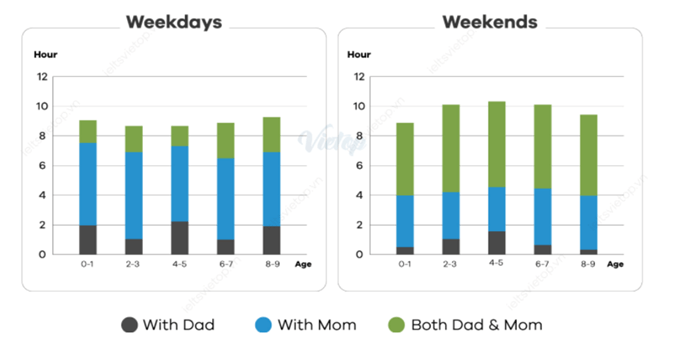
..................................................................................................................................................
..................................................................................................................................................
..................................................................................................................................................
Part 2. Write an essay of about 250 words on the following topic. (30 points)
Some people think that a sense of competition in children should be encouraged. Others believe that children who are taught to cooperate rather than compete become more useful adults.
Give reasons to support your opinion and include any relevant examples from your own experience or knowledge.
..................................................................................................................................................
..................................................................................................................................................
..................................................................................................................................................
THE END
................................
................................
................................
Xem thêm đề thi học sinh giỏi Tiếng Anh lớp 10 hay khác:
Đề thi học sinh giỏi Tiếng Anh 10 trường THPT Chuyên Hoàng Văn Thụ (Hòa Bình) năm 2023-2024
Đề thi học sinh giỏi Tiếng Anh 10 trường THPT Chuyên Quốc học - Huế (Thừa Thiên - Huế) năm 2023-2024
Đề thi học sinh giỏi Tiếng Anh 10 trường THPT Chuyên Lào Cai (Lào Cai) năm 2024
Đề thi học sinh giỏi Tiếng Anh 10 trường THPT Chuyên Lam Sơn (Thanh Hóa) năm 2024
Đề thi học sinh giỏi Tiếng Anh 10 trường THPT Chuyên Lê Hồng Phong (Nam Định) năm 2024
TÀI LIỆU CLC DÀNH CHO GIÁO VIÊN VÀ PHỤ HUYNH LỚP 9
Bộ giáo án, bài giảng powerpoint, đề thi file word có đáp án 2026 tại https://tailieugiaovien.com.vn/
Hỗ trợ zalo: VietJack Official
Tổng đài hỗ trợ đăng ký: 084 283 45 85
 Đề thi vào 10 các sở Hà Nội, Tp. Hồ Chí Minh...
41 tài liệu
Đề thi vào 10 các sở Hà Nội, Tp. Hồ Chí Minh...
41 tài liệu
 Giáo án Word 9
95 tài liệu
Giáo án Word 9
95 tài liệu
 Đề thi giữa kì, cuối kì 9
254 tài liệu
Đề thi giữa kì, cuối kì 9
254 tài liệu
 Chuyên đề dạy thêm Toán, Lí, Hóa... 9
71 tài liệu
Chuyên đề dạy thêm Toán, Lí, Hóa... 9
71 tài liệu
 Đề thi HSG 9
8 tài liệu
Đề thi HSG 9
8 tài liệu
 Bài giảng Powerpoint 9
42 tài liệu
Bài giảng Powerpoint 9
42 tài liệu
Công cụ giáo viên (2048.VN)
Tạo- trộn đề thi miễn phí từ file PDF, Word, Giao bài nhanh chóng, Hoàn toàn Free
Bộ đề thi các lớp các môn học được Giáo viên nhiều năm kinh nghiệm tổng hợp và biên soạn theo Thông tư mới nhất của Bộ Giáo dục và Đào tạo, được chọn lọc từ đề thi của các trường trên cả nước.
- Đề thi lớp 1 (các môn học)
- Đề thi lớp 2 (các môn học)
- Đề thi lớp 3 (các môn học)
- Đề thi lớp 4 (các môn học)
- Đề thi lớp 5 (các môn học)
- Đề thi lớp 6 (các môn học)
- Đề thi lớp 7 (các môn học)
- Đề thi lớp 8 (các môn học)
- Đề thi lớp 9 (các môn học)
- Đề thi lớp 10 (các môn học)
- Đề thi lớp 11 (các môn học)
- Đề thi lớp 12 (các môn học)
- Giáo án lớp 1 (các môn học)
- Giáo án lớp 2 (các môn học)
- Giáo án lớp 3 (các môn học)
- Giáo án lớp 4 (các môn học)
- Giáo án lớp 5 (các môn học)
- Giáo án lớp 6 (các môn học)
- Giáo án lớp 7 (các môn học)
- Giáo án lớp 8 (các môn học)
- Giáo án lớp 9 (các môn học)
- Giáo án lớp 10 (các môn học)
- Giáo án lớp 11 (các môn học)
- Giáo án lớp 12 (các môn học)