Đề thi HSG Tiếng Anh 10 trường THPT Chuyên Hoàng Văn Thụ (Hòa Bình) năm 2023-2024
Bài viết Đề thi học sinh giỏi Tiếng Anh 10 trường THPT Chuyên Hoàng Văn Thụ, tỉnh Hòa Bình năm 2023-2024 đề xuất cho kì thi HSG Tiếng Anh 10 các trường THPT Chuyên khu vực Đồng bằng Duyên hải Bắc Bộ. Mời các bạn đón đọc:
Đề thi HSG Tiếng Anh 10 trường THPT Chuyên Hoàng Văn Thụ (Hòa Bình) năm 2023-2024
Chỉ từ 200k mua trọn bộ Đề thi học sinh giỏi Tiếng Anh 10 theo cấu trúc mới bản word có lời giải chi tiết:
- B1: gửi phí vào tk:
1133836868- CT TNHH DAU TU VA DV GD VIETJACK - Ngân hàng MB (QR) - B2: Nhắn tin tới Zalo VietJack Official - nhấn vào đây để thông báo và nhận đề thi
|
TRƯỜNG THPT CHUYÊN HOÀNG VĂN THỤ TỈNH HOÀ BÌNH ĐỀ THI ĐỀ XUẤT - Anh 10 |
KỲ THI CHỌN HỌC SINH GIỎI CÁC TRƯỜNG THPT CHUYÊN KHU VỰC ĐỒNG BẰNG DUYÊN HẢI BẮC BỘ Năm học: 2023 – 2024 Thời gian làm bài: 180 phút (không kể thời gian giao đề) |
A. LISTENING (50 points)
Part 1: You will listen to a short conversation about job vacancies in restaurants. For questions 1-5, complete the table using NO MORE THAN TWO WORDS AND/ OR A NUMBER for each answer. (10 points)
Bài nghe:
Location |
Job title |
Responsibilities |
Pay and conditions |
Wivenhoe Street |
Breakfast supervisor |
Checking (1) __________ Making sure equipment is clean |
Starting salary 9.50 per hour Start work at (2) __________ |
(3) __________ |
Junior chef |
Supporting the senior staff and (4) __________ Maintaining stock and arranging deliveries |
Annual salary £23,000 No work on every (5) __________ |
Part 2. For questions 6-10, listen to a talk about how to keep calm under pressure and decide whether these statements are True (T), False (F). Write your answers in the corresponding numbered boxes provided. (10 points)
Bài nghe:
6. A repeated breathing exercise will help you feel calmer.
7. If you are going to speak in public, it’s helpful to breathe quickly.
8. When you feel panic, a deep breathing through your nose will do you good.
9. Researches have shown that humming cannot stimulate heart rate.
10. Sports trainers always use “process thinking” to help athletes focus.
Part 3. For questions 11-15, listen to an interview with the head of an employment agency about job expectations and choose the best answer (A, B, C or D) which fits best according to what you hear. Write your answers in the corresponding numbered boxes provided. (10 points)
Bài nghe:
11. How does Diane Webber view ‘jobs for life’?
A. She regrets the fact that this situation is no longer the norm.
B. She feels that many long-serving employees failed to make a useful contribution.
C. She believes that people should have challenged their employers’ motives more.
D. She wishes the workplace had been more secure in the past.
12. According to Diane, younger workers in today’s workplace __________.
A. learn all the skills they need early on.
B. accept lateral moves if they are attractive.
C. expect to receive benefits right from the start.
D. change jobs regularly to achieve a higher level.
13. What does Diane say about staff continuity in companies?
A. It is desirable in both junior and senior management.
B. It is impossible to achieve in today’s more competitive environment.
C. It is unimportant, due to the greater emphasis on teamwork.
D. It is necessary, but only up to a point.
14. According to Diane, what is the actual benefit of higher levels of personnel movement?
A. higher levels of output
B. better problem-solving
C. more creativity
D. greater efficiency
15. Diane considers that nowadays, companies are at most risk from __________.
A. run-of-the-mill employees who play safe.
B. successful high-fliers who quickly move on.
C. unreliable staff who lack commitment.
D. external advisors who have undue power.
Part 4. You will listen to a recording about Koalas. For questions 16-25, complete the summary by writing NO MORE THAN THREE WORDS in each gap. Write your answers in the corresponding numbered boxes provided. (20 points)
Bài nghe:
Koalas are being particularly (16)__________ in New South Wales as their habitats are being destroyed.
Koala seems to be (17)__________and probably quite hungry.
It is estimated that hundreds of koalas have died in (18)__________raging in Eastern Australia since September.
(19) __________koalas have been admitted by the region's Port Macquarie Koala Hospital so far this year.
While the disaster has inflicted serious damage on the animal, the support from the public has been (20)__________.
The number of visitors coming to the Koala Hospital over the last 5-6 weeks has been (21) __________.
A large amount of money has been set aside to help (22)__________koalas.
There are concerns that a new heat wave could further (23) __________infernos.
Very little would actually survive in there (24) __________.
Rising temperatures, which dry out their habitats, deforestation and disease are (25)__________.
II. LEXICO-GRAMMAR (40 points)
Part 1: Choose the correct answer (A,B,C or D) to complete each of the following sentences. Write your answers in the corresponding numbered boxes provided. (30 points)
1. The foot __________diligently searched the area for signs of the enemy.
A. squad
B. force
C. party
D. patrol
2. Being a __________entrepreneur, you will have to make a special effort for people to take you seriously.
A. successful
B. budding
C. blossoming
D. flowering
3. I wanted to resign, but my boss __________with me to stay.
A. pleaded
B. parted
C. argued
D. bargained
4. His explanation was so __________that it left everyone more confused than before.
A. convoluted
B. precise
C. lucid
D. coherent
5. The artist's latest exhibition was __________received by critics.
A. passionately
B. indifferently
C. warmly
D. coldly
6. The manager's new policy __________unnecessary expenditures.
A. cut off
B. cut back
C. cut down
D. cut out
7. After months of investigation, the committee __________the director from all allegations of fraud.
A. liberated
B. exonerated
C. emancipated
D. discharged
8. The CEO is known for his __________to innovative ideas and approaches.
A. hostility
B. openness
C. reservation
D. opposition
9. The __________light of the setting sun cast long shadows on the ground.
A. glaring
B. dimming
C. fading
D. blinding
10. The film was not just a box office success; it was __________acclaimed.
A. critically
B. uncritically
C. ironically
D. skeptically
11. To the __________of the committee, the proposal was rejected outright.
A. dismay
B. delight
C. amusement
D. apathy
12. The solution to the problem was __________in its simplicity.
A. ingenious
B. naïve
C. complex
D. baffling
13. Despite the hype, the new restaurant did not __________our expectations.
A. come up to
B. fall short of
C. live up to
D. get around to
14. The detective's keen eye for detail helped him __________the truth.
A. uncover
B. discover
C. recover
D. unearth
15. The scientist's theory was __________at the conference.
A. widely discredited
B. widely accepted
C. narrowly rejected
D. eagerly anticipated
16. The company decided to __________the old equipment to make way for new technology.
A. discard
B. preserve
C. abandon
D. retain
17. The novel's plot is __________with unexpected twists and turns.
A. replete
B. devoid
C. scarce
D. wanting
18. The chairman's remarks were seen as a __________to the opposition.
A. challenge
B. concession
C. retreat
D. surrender
19. The hotel room was __________and offered a stunning view of the city skyline.
A. cramped
B. spacious
C. confined
D. narrow
20. The teacher's __________approach made even the most difficult subjects seem easy.
A. pedagogical
B. didactic
C. pedagogic
D. instructional
21. Was it really necessary that I __________there watching you the entire time you were rehearsing for the play? It was really boring watching you repeat the scenes over and over again.
A. sits
B. am sitting
C. be sitting
D. To sit
22. __________as taste is really a composite sense made up of both taste and smell.
A. That we refer to
B. What we refer to
C. To which we refer
D. What do we refer to
23. ______ the increasing depletion of the Earth resources, it’s vital to recycle on a wider scale than we do at present.
A. Given
B. In spite of
C. Irrespective of
D. Providing
24. On the island _______ the only representation of the island’s handicraft.
A. remain
B. does it remain
C. did it remain
D. remains
25. _________, the balcony chairs will be ruined in this weather.
A. Leaving uncovered
B. Having left uncovered
C. Left uncovered
D. Been left uncovered
26. I __________with the performances but I got flu the day before.
A. had helped
B. helped
C. was to help
D. was to have helped
27. She said that she would be punctual for the opening speech, __________she were late?
A. but what if
B. how about
C. and what about
D. so if
28. In her time, Isadora Duncan was __________today a liberated woman.
A. what calling we would
B. who would be calling
C. what we would call
D. she would call her
29. Our projects are funded through the Private Finance Initiative, the costs __________spread over ten years.
A. are
B. being
C. have been
D. will be
30. Only when more stringent traffic laws are passed __________on the national highway decrease.
A. is the number of accidents
B. the number of accidents is
C. the number of accidents will
D. will the number of accidents
Part 2: For questions 1-10, write the correct form of each bracketed word in each sentence. Write your answers in the corresponding numbered boxes provided. (10 points)
1. Democracy died after a period of __________(cease) wars, imperial expansion abroad, and the rise of demagoguery at home.
2. The consequences of __________(compel) gambling are comparable to those of any other addictive disease and are not simply those of financial loss.
3. The prison service has the twin goals of punishment and __________(habit).
4. The first __________(conceive) is that legal study at university is exclusively for students who intend becoming solicitors or advocates.
5. The __________(intricate) of the design required exceptional skill and attention to detail.
6. The __________(contend) issue in the debate was how to allocate the funding fairly.
7. The __________(intuitive) of her solution demonstrated her deep understanding of the problem.
8. The __________(presume) of the young scientist in challenging established theories was both daring and admirable.
9. The __________(elude) of the criminal made the investigation particularly challenging for the police.
10. The __________(transcend) nature of the experience left everyone in awe.
III. READING (60 points)
Part 1: Read the following passage and decide which answer (A, B, C, or D) best fits each gap. (15 points)
Many artefacts of (1) __________cultural significance from the last century were made from plastic. It was always confidently assumed that this rather (2) __________material was virtually indestructible. Now that some of these artefacts have become museum (3) __________, we have discovered that this (4) __________was sadly mistaken.
The degradation of plastics is worrying both scientists and historians, who are racing against time to save our plastic heritage before it (5) __________into dust. Our love affair with plastics (6) __________in large part from the fact they can be (7) __________into just about any shape imaginable. When it comes to longevity, however, they have a serious (8) __________their chemical structure breaks down when they are exposed to air and sunlight.
Many now argue that we must consider the cultural (9) __________we will be leaving future generations. Without urgent (10) __________many artefacts will be lost forever. But developing effective conservation strategies is difficult because what works to preserve one type of plastic can have a catastrophic effect on the lifespan of another.
1.
A. enduring
B. lingering
C. unceasing
D. perennial
2.
A. trivial
B. routine
C. customary
D. mundane
3.
A. items
B. articles
C. pieces
D. objects
4.
A. concept
B. premise
C. notion
D. proposition
5.
A. crumbles
B. shatters
C. erodes
D. shrivels
6.
A. starts
B. sparks
C. stems
D. sprouts
7.
A. cast
B. moulded
C. engraved
D. dissected
8.
A. fault
B. snag
C. stigma
D. flaw
9.
A. bequest
B. legacy
C. endowment
D. heirloom
10.
A. intervention
B. interception
C. interference
D. intercession
Part 2. For questions 1-10, read the text below and think of a word which best fits each space. Use only ONE word in each space. Write your answers in the corresponding numbered boxes provided. (15 points)
Advancements in artificial intelligence (AI) have (1) __________transformative changes across various sectors, from healthcare to finance and beyond. AI systems are (2) __________capable of processing vast amounts of data and performing complex tasks with unprecedented accuracy. This technological revolution has sparked debates about the ethical implications of AI and its (3) __________impact on society.
One area where AI has shown remarkable promise is in healthcare. AI-powered diagnostic tools can (4) __________early signs of diseases with high accuracy, potentially saving lives through early intervention. However, concerns (5) __________privacy and data security have emerged, as these systems rely heavily on personal health information.
In the realm of business, AI algorithms are (6) __________used to streamline operations and enhance productivity. By automating repetitive tasks, companies can allocate human resources more efficiently and (7) __________on strategic initiatives. Nevertheless, there is apprehension about the impact of AI on employment, with fears that automation may (8) __________jobs traditionally performed by humans.
Ethically, the development of AI raises questions about accountability and transparency. As AI systems make decisions autonomously, ensuring they operate ethically and (9) __________bias becomes paramount. Moreover, there is a need for international collaboration to establish (10) __________guidelines that govern the ethical use of AI across borders.
Part 3: Read the passage and choose the best option A, B, C, or D to answer the questions. (15 points)
BIOLOGICAL PATENTS
The patenting on biological matter has become particularly awkward and publicly controversial in recent times. The reason for this is that scientists are patenting life itself, though we should be careful about what we mean by 'life'. Many countries have allowed people to own and register plant varieties for decades. America took the lead, starting with the 1930 Plant Patent Act, followed by Germany and other European countries. Britain passed its Plant Varieties and Seeds Act in 1964, when it awarded a full monopoly right to the owner of any plant that can be shown to be novel, distinct, uniform and stable. The test of novelty is much looser than that required for an industrial patent (who knows what plants may be growing in the wild?). So, a plant qualifies for protection even if it has a history of growing wild as long as it has not been sold commercially for more than four years.
At the same time, patenting a seed or a plant for agricultural purposes was regarded as being no different from patenting a chemical or biological recipe for pharmaceutical purposes. This notion was particularly welcome for Western farmers and horticulturalists who were eager to increase yields as their own costs grew (especially farm wages) and foreign imports from low-wage countries undercut their prices. They were also keen to grow new varieties that could be harvested and brought to market a few weeks earlier. So, the huge investments in faster-growing and more disease-resistant seeds over the past fifty years might not have been made if the seed companies had not been able to protect their work.
Over that period the number of applications for plant and genetic patents has increased rapidly. Technological advances in biotechnology have extended scientists' ability to exploit biological matter from whole plants into their various components; from whole animals to parts of animals; and from animals to humans. Developments in DNA and in cell technology have allowed scientists to identify, nurture and remix cells so that they can create living material. The identification of the human genome, which contains the genes that control the 'design' of each human, will also require a property contract.
But should the genome be public property in the same way as the knowledge of blood types is? Or should it be private property? In 1952, the American Supreme Court famously said, 'Anything under the sun that is made by man is patentable.' Since then, its position has shifted. In Diamond v. Chakrabarty in 1980, it was asked to rule on a patent application by Anand Chakrabarty for a genetically modified bacterial microorganism designed to gobble up oil spills at sea. It decided to shift the dividing line to between the product of nature, whether living or not, and human-made inventions which may, of course, be living, and it approved the patent. In 1987, the US Patent Office issued new guidelines which stated that all bio-organisms except humans could be patented.
The Patent Office later issued a patent to Harvard University for an experimental mouse known as Oncomouse, into which an oncogene had been inserted for the purpose of medical research. The European Patent Office, after initially demurring, did likewise. It said Oncomouse was such a considerable manipulation of genetic material as to be new and unique. It was protested on ethical grounds that the mice would suffer during the research, but the EPO decided that the benefit to society outweighed the loss to the mouse; a neat variation on the 'property contract' that balances the creator's reward against the social gain. This rapid shift over seven years was a breath-taking expansion of private property and a massive change in attitude towards the ownership of life.
Another odd case that reinterpreted the property contract against our common instincts occurred when a Californian University medical centre managed to own and patent the cell line found in a spleen taken from a patient John Moore, who had hairy-cell leukaemia. The doctors had discovered that Moore's T-lymphocytes were extremely rare and of great medical value. Without informing him, they carried out intensive tests that ended with the removal of his spleen. The cells were indeed as valuable as expected, generating products worth hundreds of millions of dollars. When Moore discovered how the university had privatised his cells, and made huge profits, he sued, but he lost. The Supreme Court of California decided that we do not have an exclusive right to ownership of our cells after they have left our body.
1. Under the 1964 Act, one requirement that qualified a plant for a patent was that it __________.
A. had been developed as a result of commercial exploitation.
B. had been discovered in the wild fewer than four years earlier.
C. exhibited characteristics that distinguished it from other plants.
D. had no prior history of being used in an industrial process.
2. The word horticulturalists refers to those who __________.
A. grow flowers
B. study cultures
C. import seeds
D. grow organic foods
3. Why were Western farmers keen to raise production levels in the 1960s?
A. Their overheads were making them less competitive.
B. The market price of their products had been reduced.
C. Disease that could destroy their crops was becoming rife.
D. Fast-growing weeds were making their harvest less lucrative.
4. The writer suggests that advances in biotechnology__________.
A. have allowed scientists to conduct their experiments more precisely.
B. are dependent on the financial rewards they can generate.
C. will ultimately lead to the introduction of designer babies.
D. may be considered unethical if they involve exploitation.
5. The phrase gobble up mostly means __________.
A. consuming
B. supplying
C. spreading
D. destroying
6. The shift in position of the US Supreme Court in 1980 meant that__________.
A. any biological organism could be patented.
B. knowledge of how DNA functions was patentable.
C. patents were no longer restricted to inanimate things.
D. tinkering with cells from living creatures was immoral.
7. The word demurring mostly means__________.
A. advocating
B. objecting
C. reinforcing
D. investigating
8. The European Patent Office ruling on Oncomouse__________.
A. was never in doubt because Harvard University was involved.
B. became open to interpretation by experts in property laws.
C. totally disregarded the moral issues related to the case.
D. highlighted the emphasis on the greater good in legal decisions.
9. Which saying is most appropriate to the verdict handed down in the case involving John Moore?
A. Property has its duties as well as its rights.
B. No person's property is safe while legislature is in session.
C. If something is worth money, it is worth possessing.
D. Possession is nine-tenths of the law.
10. Which of the following is NOT true, according to the passage?
A. Patenting Oncomouse met with some disapprovals concerning ethical matters.
B. The USA blazed a trailed in patenting kinds of plants.
C. The doctors removed Moore’s spleen unbeknownst to him.
D. Companies’ patenting their seeds provided an incentive for agricultural breakthroughs.
Part 4: Read the text below carefully and then do the following exercises. (15 points)
RISING SEA
Paragraph 1 - INCREASED TEMPERATURES
The average air temperature at the surface of the earth has risen this century, as has the temperature of ocean surface waters. Because water expands as it heats, a warmer ocean means higher sea levels. We cannot say definitely that the temperature rises are due to the greenhouse effect; the heating may be part of a ‘natural’ variability over a long time - scale that we have not yet recognized in our short 100 years of recording. However, assuming the buildup of greenhouse gases is responsible, and that the warming will continue, scientists – and inhabitants of low-lying coastal areas – would like to know the extent of future sea level rises.
Paragraph 2
Calculating this is not easy. Models used for the purpose have treated the ocean as passive, stationary and one -dimensional. Scientists have assumed that heat simply diffused into the sea from the atmosphere. Using basic physical laws, they then predict how much a known volume of water would expand for a given increase in temperature. But the oceans are not one -dimensional, and recent work by oceanographers, using a new model which takes into account a number of subtle facets of the sea –including vast and complex ocean currents –suggests that the rise in sea level may be less than some earlier estimates had predicted.
Paragraph 3
An international forum on climate change, in 1986, produced figures for likely sea-level rises of 20 cms and 1.4 m, corresponding to atmospheric temperature increases of 1.5 and 4.5C respectively. Some scientists estimate that the ocean warming resulting from those temperature increases by the year 2050 would raise the sea level by between 10 cms and 40 cms. This model only takes into account the temperature effect on the oceans; it does not consider changes in sea level brought about by the melting of ice sheets and glaciers, and changes in groundwater storage. When we add on estimates of these, we arrive at figures for total sea-level rises of 15 cm and 70 cm respectively.
Paragraph 4
It’s not easy trying to model accurately the enormous complexities of the ever-changing oceans, with their great volume, massive currents and sensitively to the influence of land masses and the atmosphere. For example, consider how heat enters the ocean. Does it just ‘diffuse’ from the warmer air vertically into the water, and heat only the surface layer of the sea? (Warm water is less dense than cold, so it would not spread downwards). Conventional models of sea-level rise have considered that this the only method, but measurements have shown that the rate of heat transfer into the ocean by vertical diffusion is far lower in practice than the figures that many modelers have adopted.
Paragraph 5
Much of the early work, for simplicity, ignored the fact that water in the oceans moves in three dimensions. By movement, of course, scientists don’t mean waves, which are too small individually to consider, but rather movement of vast volumes of water in huge currents. To understand the importance of this, we now need to consider another process – advection. Imagine smoke rising from a chimney. On a still day it will slowly spread out in all directions by means of diffusion. With a strong directional wind, however, it will all shift downwind, this process is advection – the transport of properties (notably heat and salinity in the ocean) by the movement of bodies of air or water, rather than by conduction or diffusion.
Paragraph 6.
Massive ocean currents called gyres do the moving. These currents have far more capacity to store heat than does the atmosphere. Indeed, just the top 3 m of the ocean contains more heat than the whole of the atmosphere. The origin of gyres lies in the fact that more heat from the Sun reaches the Equator than the Poles, and naturally heat tends to move from the former to the latter. Warm air rises at the Equator, and draws more air beneath it in the form of winds (the “Trade Winds”) that, together with other air movements, provide the main force driving the ocean currents.
Paragraph 7
Water itself is heated at the Equator and moves poleward, twisted by the Earth’s rotation and affected by the positions of the continents. The resultant broadly circular movements between about 10 and 40 North and South are clockwise in the Southern Hemisphere. They flow towards the east at mid latitudes in the equatorial region. They then flow towards the Poles, along the eastern sides of continents, as warm currents. When two different masses of water meet, one will move beneath the other, depending on their relative densities in the subduction process.The densities are determined by temperature and salinity. the convergence of water of different densities from the Equator and the Poles deep in the oceans causes continuous subduction. This means that water moves vertically as well as horizontally. Cold water from the Poles travels as depth – it is denser than warm water –until it emerges at the surface in another part of the world in the form of a cold current.
Paragraph 8 - HOW THE GREEN HOUSE EFFECT WILL CHANGE OCEAN TEMPERATURES
Ocean currents, in three dimensions, form a giant ‘conveyor belt’, distributing heat from the thin surface layer into the interior of the oceans and around the globe. Water may take decades to circulate in these 3-D gyres in the lop kilometer of the ocean, and centuries in the deep water. With the increased atmospheric temperatures due to the greenhouse effect, the oceans conveyor belt will carry more heat into the interior. This subduction moves heat around far more effectively than simple diffusion. Because warm water expands more than cold when it is heated, scientists had presumed that the sea level would rise unevenly around the globe. It is now believed that these inequalities cannot persist, as winds will act to continuously spread out the water expansion. Of course, of global warming changes the strength and distribution of the winds, then this ‘evening-out’ process may not occur, and the sea level could rise more in some areas than others.
Questions 1 - 6
There are 8 paragraphs numbered 1 - 8 in Reading Passage. The first paragraph and the last paragraph have been given headings.
From the list below numbered A - I, choose a suitable heading for the remaining 6 paragraphs.
There are more headings than paragraphs, so you will not use all the headings.
List of headings
A . THE GYRE PRINCIPLE
B. THE GREENHOUSE EFFECT
C. HOW OCEAN WATERS MOVE
D. STATISTICAL EVIDENCE
E. THE ADVECTION PRINCIPLE
F. DIFFUSION VERSUS ADVECTION
G. FIGURING THE SEA LEVEL CHANGES
H. ESTIMATED FIGURES
I. THE DIFFUSION MODEL
J. FUTURE OF THE OCEAN CURRENTS
1. Paragraph 2__________
2. Paragraph 3__________
3. Paragraph 4__________
4. Paragraph 5__________
5. Paragraph 6__________
6. Paragraph 7__________
Question 7-10
Read each of the following statements, according to the information in the reading passage.
Write:
T If it is true
F If it is false
NG If there is no information about the statement in the reading passage.
7. The surface layer of the oceans is warmed by the atmosphere.
8. Advection of water changes heat and salt levels.
9. A gyre holds less heat than there is in the atmosphere.
10. The sea level is expected to rise evenly over the Earth's surface.
IV. WRITING (50 points)
Part 1. Graph Description (20 points)
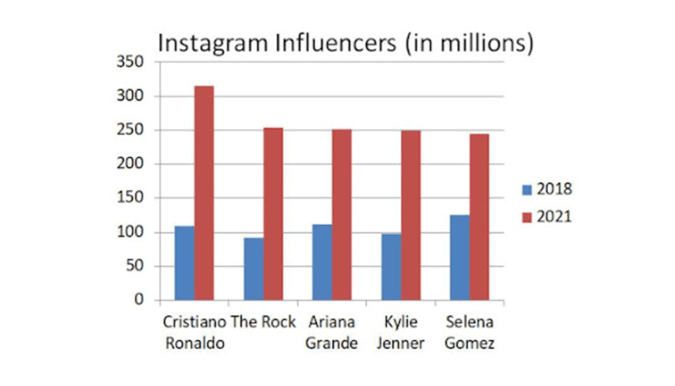
The bar chart below shows the popularity of well-known Instagram accounts in 2011 and 2021.
Summarise the information by selecting and reporting the main features, and make comparisons where relevant. (20pts)
..................................................................................................................................................
..................................................................................................................................................
..................................................................................................................................................
Part 2. Write an essay of about 250 words on the following topic. (30 points)
Some people think that a sense of competition in children should be encouraged. Others believe that children who are taught to cooperate rather than compete become more useful adults.
Give reasons to support your opinion and include any relevant examples from your own experience or knowledge.
..................................................................................................................................................
..................................................................................................................................................
..................................................................................................................................................
_______ THE END_______
................................
................................
................................
Xem thêm đề thi học sinh giỏi Tiếng Anh lớp 10 hay khác:
Đề thi học sinh giỏi Tiếng Anh 10 trường THPT Chuyên Lê Quý Đôn (Bình Định) năm 2024
Đề thi học sinh giỏi Tiếng Anh 10 trường THPT Chuyên Quốc học - Huế (Thừa Thiên - Huế) năm 2023-2024
Đề thi học sinh giỏi Tiếng Anh 10 trường THPT Chuyên Lào Cai (Lào Cai) năm 2024
Đề thi học sinh giỏi Tiếng Anh 10 trường THPT Chuyên Lam Sơn (Thanh Hóa) năm 2024
Đề thi học sinh giỏi Tiếng Anh 10 trường THPT Chuyên Lê Hồng Phong (Nam Định) năm 2024
Đề thi học sinh giỏi Tiếng Anh 10 trường THPT Chuyên Hùng Vương (Bình Dương) năm 2024
TÀI LIỆU CLC DÀNH CHO GIÁO VIÊN VÀ PHỤ HUYNH LỚP 9
Bộ giáo án, bài giảng powerpoint, đề thi file word có đáp án 2026 tại https://tailieugiaovien.com.vn/
Hỗ trợ zalo: VietJack Official
Tổng đài hỗ trợ đăng ký: 084 283 45 85
 Đề thi vào 10 các sở Hà Nội, Tp. Hồ Chí Minh...
41 tài liệu
Đề thi vào 10 các sở Hà Nội, Tp. Hồ Chí Minh...
41 tài liệu
 Giáo án Word 9
95 tài liệu
Giáo án Word 9
95 tài liệu
 Đề thi giữa kì, cuối kì 9
254 tài liệu
Đề thi giữa kì, cuối kì 9
254 tài liệu
 Chuyên đề dạy thêm Toán, Lí, Hóa... 9
71 tài liệu
Chuyên đề dạy thêm Toán, Lí, Hóa... 9
71 tài liệu
 Đề thi HSG 9
8 tài liệu
Đề thi HSG 9
8 tài liệu
 Bài giảng Powerpoint 9
42 tài liệu
Bài giảng Powerpoint 9
42 tài liệu
Công cụ giáo viên (2048.VN)
Tạo- trộn đề thi miễn phí từ file PDF, Word, Giao bài nhanh chóng, Hoàn toàn Free
Bộ đề thi các lớp các môn học được Giáo viên nhiều năm kinh nghiệm tổng hợp và biên soạn theo Thông tư mới nhất của Bộ Giáo dục và Đào tạo, được chọn lọc từ đề thi của các trường trên cả nước.
- Đề thi lớp 1 (các môn học)
- Đề thi lớp 2 (các môn học)
- Đề thi lớp 3 (các môn học)
- Đề thi lớp 4 (các môn học)
- Đề thi lớp 5 (các môn học)
- Đề thi lớp 6 (các môn học)
- Đề thi lớp 7 (các môn học)
- Đề thi lớp 8 (các môn học)
- Đề thi lớp 9 (các môn học)
- Đề thi lớp 10 (các môn học)
- Đề thi lớp 11 (các môn học)
- Đề thi lớp 12 (các môn học)
- Giáo án lớp 1 (các môn học)
- Giáo án lớp 2 (các môn học)
- Giáo án lớp 3 (các môn học)
- Giáo án lớp 4 (các môn học)
- Giáo án lớp 5 (các môn học)
- Giáo án lớp 6 (các môn học)
- Giáo án lớp 7 (các môn học)
- Giáo án lớp 8 (các môn học)
- Giáo án lớp 9 (các môn học)
- Giáo án lớp 10 (các môn học)
- Giáo án lớp 11 (các môn học)
- Giáo án lớp 12 (các môn học)