Đề thi HSG Tiếng Anh 10 trường THPT Chuyên Quốc học - Huế (Thừa Thiên - Huế) năm 2023-2024
Bài viết Đề thi học sinh giỏi Tiếng Anh 10 trường THPT Chuyên Quốc học - Huế, tỉnh Thừa Thiên - Huế năm 2024 đề xuất cho kì thi HSG Tiếng Anh 10 các trường THPT Chuyên khu vực Duyên hải và Đồng bằng Bắc Bộ. Mời các bạn đón đọc:
Đề thi HSG Tiếng Anh 10 trường THPT Chuyên Quốc học - Huế (Thừa Thiên - Huế) năm 2023-2024
Chỉ từ 200k mua trọn bộ Đề thi học sinh giỏi Tiếng Anh 10 theo cấu trúc mới bản word có lời giải chi tiết:
- B1: gửi phí vào tk:
1133836868- CT TNHH DAU TU VA DV GD VIETJACK - Ngân hàng MB (QR) - B2: Nhắn tin tới Zalo VietJack Official - nhấn vào đây để thông báo và nhận đề thi
|
CHUYÊN QUỐC HỌC - HUẾ ĐỀ THI ĐỀ XUẤT (Đề thi gồm 15 trang) |
KỲ THI HỌC SINH GIỎI CÁC TRƯỜNG THPT CHUYÊN KHU VỰC DUYÊN HẢI VÀ ĐỒNG BẰNG BẮC BỘ LẦN THỨ XV, NĂM HỌC 2023 - 2024 ĐỀ THI MÔN: TIẾNG ANH - LỚP 10 Thời gian: 180 phút (Không kể thời gian giao đề) |
I. LISTENING (50 POINTS)
Part 1. You will hear a man talking to teenagers about archery and do the following tasks. (10 points)
Bài nghe:
Questions 1-3: Complete the flow chart below.
Use NO MORE THAN THREE WORDS for each answer.
A BRIEF HISTORY OF ARCHERY
Archery first used to hunt and in warfare - bows were straight
String removed from curved bows when (1) __________
↓
All cultures had bows and arrows - (2) __________ best-known for using them
↓
Advent of (3) __________ saw a decline in use of bows and arrows
↓
Archery as recreational activity grew in popularity
Questions 4-5: Complete the summary below.
Use NO MORE THAN TWO WORDS for each answer.
SAFETY PROCEDURES
All equipment must be used properly and safely. Archers must not think of the bows and arrows as (4) __________. Nobody is allowed to enter the (5) __________ until told to do so by the group supervisor. Each participant must use their weapon only when instructed to do so.
Part 2. You will hear a podcast about how to make better decisions. For questions 1-5, decide whether the following statements are True (T) or False (F). (10 points)
Bài nghe:
1. Barack Obama eliminated wardrobe choices to save mental energy for more critical decisions.
2. Research shows that all decisions, regardless of their size, consume different amounts of energy.
3. Scientists have found that staying well-hydrated and consuming a breakfast with slow-release carbohydrates can help improve decision-making.
4. Daniel Kahneman's research indicates that people are generally more motivated by potential gains than by the fear of loss in big decisions.
5. When making an important decision, it is beneficial to seek advice from an objective friend.
Part 3. You will hear a radio interview in which two ecologists, called Jack Benson and Trisha Roberts, are talking about sand. For questions 1-5, choose the correct answer (A, B, C or D) which fits best according to what you hear. (10 points)
Bài nghe:
1. Jack thinks the main reason people are attracted to beaches is because ___________.
A. we enjoy a feeling of timelessness there.
B. we find breathing the fresh salty air invigorating.
C. the sound of the waves is hypnotic.
D. the quality of the light is special.
2. What was Trisha’s reaction when she read an article about ‘pop-up’ beaches?
A. She was surprised the topic hadn’t been explored before.
B. She wanted to research the phenomenon more.
C. She was ashamed at having visited one.
D. She questioned the advice in the article.
3. Jack and Trisha agree that the practice of adding fresh sand to beaches ___________.
A. is less effective against coastal erosion than building a seawall.
B. can only be a short-term solution to coastal erosion.
C. interferes with the normal movement of the sea.
D. must be harmful to the wildlife there.
4. Why does Jack mention the fact that more people live in cities nowadays?
A. to criticise people’s lack of awareness of environmental issues
B. to illustrate that natural resources are becoming scarce
C. to suggest society’s major concern is making money
D. to explain why the demand for sand is so high
5. What does Jack hope will solve the problem of taking sand from beaches?
A. Scientists will develop a new form of sand.
B. Architects will rethink the design of buildings.
C. Governments will impose stricter regulations.
D. The public will become better informed.
Part 4. You will hear a podcast about the history of the color pink. For questions 1-5, complete the sentences with NO MORE THAN THREE WORDS. (20 points)
Bài nghe:
In 1927, Time Magazine surveyed major (1) __________ for girls' clothing colors, with varied results.
A 1918 catalog suggested that (2) __________ blue was suitable for young girls.
Pink gained its current (3) __________ after World War II.
In 1953, Mamie Eisenhower's appearance in a (4) __________ pink ballgown marked a significant moment for pink's history.
Mamie Eisenhower was known for her love of the color pink, which she believed complemented her blue eyes and (5) __________, leading to the term "Mamie pink" frequently appearing in newspaper headlines. This is humorously captured in the song "Think Pink" from "Funny Face," where the (6) __________ editor, inspired by Diana Vreeland, encourages women to embrace pink and abandon the wartime colors of (7) __________ and __________.
Pink gained popularity in fashion and (8) __________ decor.
While many women embraced this trend, others like Diana Vreeland resisted returning to (9) __________, and pink started to represent unconventional and empowered women.
Examples include racecar driver Donna Mae Mims with her pink gear, the Pink Ladies in "Grease," the Plastics in "Mean Girls," and Hillary Clinton on the cover of People magazine in a pink jacket advocating for breaking the highest (10) __________.
This shift challenged norms, revealing pink's influence on shaping personalities and abilities.
II. LEXICO AND GRAMMAR (40 POINTS)
Part 1. Choose the correct answer (A, B, C or D) that best completes each sentence. (30 points)
1. Her __________ remarks about the seriousness of the situation offended those who were genuinely concerned.
A. flippant
B. scrawny
C. arrogant
D. assertive
2. The journalist managed to __________ out the information by going through all the old files.
A. beetle
B. cow
C. ferret
D. badger
3. Joanna has a real __________ for interior design - her home stunning!
A. likeness
B. flair
C. prospect
D. popularity
4. If the warning light should come on, turn the red __________ to off.
A. button
B. dial
C. knob
D. lever
5. He has a morbid fear of going outside his home, known to doctors as __________.
A. agoraphobia
B. arachnophobia
C. claustrophobia
D. xenophobia
6. The peach pie was so delicious that we __________ the whole thing.
A. coughed up
B. polished off
C. wound up
D. sponged off
7. She could talk the hind legs off a __________ with her endless anecdotes and stories.
A. dog
B. donkey
C. cow
D. snake
8. It was a __________ moment when I realized that there were other people who watched the show.
A. lowly
B. scholastic
C. righteous
D. revelatory
9. A(n) __________ shift in the global oil market is under way.
A. epochal
B. transient
C. fleeting
D. mundane
10. The singer wished it to be known that he had left the band out of his own __________.
A. accord
B. eagerness
C. volition
D. willingness
11. Since the coup, the country has sunk deeper into a(n) __________ of violence and lawlessness.
A. resolution
B. extrication
C. quagmire
D. fluidity
12. Deadlines are getting closer and everyone is rushed off their __________ at the moment!
A. feet
B. eyes
C. hands
D. knees
13. It was such a(n) __________ novel that I couldn't put it down.
A. fictitious
B. riveting
C. zealous
D. endowed
14. The rain __________ down slowly under his coat collar, making him feel thoroughly damp and miserable.
A. crept
B. waded
C. trickled
D. teemed
15. A price war looks likely now that a leading supermarket has __________ to its competitors.
A. thrown down the gauntlet
B. turned a blind eye
C. taken with a grain of salt
D. been a wolf in sheep's clothing
16. I don't really believe all that - I was just __________ devil's advocate.
A. getting
B. doing
C. playing
D. turning
17. You can tell her to clean her room until you are __________ in the face, but she won’t do it.
A. red
B. orange
C. blue
D. green
18. I hate the way Tony __________ around looking so self- important.
A. struts
B. scampers
C. slithers
D. slinks
19. Environmentalists have no political axe to __________ - they just want to save the planet.
A. cut
B. sharpen
C. grind
D. trim
20. I always clean the flat before my mum comes round, but she always finds at least one __________ of dust and says it's filthy!
A. scrap
B. gust
C. speck
D. blade
21. Almost __________ person I've asked says they're going on the anti-war demonstration next Saturday.
A. every
B. each
C. all the
D. the entire
22. __________ hundreds of people dead during the evacuation from the war-torn area in the Middle East.
A. It is estimated to be
B. There is estimated to be
C. There are estimated to be
D. It is estimated that
23. She had spent hours browsing through various stores, trying on countless outfits; __________, she left the mall empty-handed, undecided about her purchase.
A. moreover
B. nonetheless
C. consequently
D. whereas
24. Formerly close friends, they had been estranged __________ each other for many years.
A. from
B. with
C. over
D. in
25. We heard of a __________ country that was the first to discover this.
A. certain Middle Eastern small
B. small Middle Eastern certain
C. Middle Eastern certain small
D. certain small Middle Eastern
26. This delicious __________ is high in protein and suitable for any vegetarian diet.
A. goats cheese
B. goats' cheese
C. cheese of goat
D. goat's cheese
27. It isn't a big difference, but it is a difference __________.
A. for example
B. in addition
C. above all
D. all the same
28. __________ train.
A. There goes the
B. Goes there the
C. There goes
D. There go the
29. __________ at the University of London, she has written several books on the history of graphic design.
A. If a professor
B. Now is a professor
C. Now a professor
D. Whether a professor
30. I'm __________ my brother is.
A. nowhere like so ambitious
B. nothing near as ambitious as
C. nothing as ambitious than
D. nowhere near as ambitious as
Part 2. Give the correct form of the words in the brackets to complete the following sentences. (10 points)
1. He was the (PERSON) ___________ of courage with all the illnesses he went through.
2. The unions were opposed to the (PRIVATE) ___________ of water, rail and electricity.
3. An odd (JUXTAPOSE) ___________ of talents worked exceedingly well on the project.
4. The politician's explanation for the budget deficit was completely (SENSE) ___________, lacking any coherentreasoning or factual basis.
5. Many people gave (STINT) ___________ of their time and energy to reduce the difficulties experienced by the refugees.
6. The country's great influence in the world is (PROPORTION) ___________ to its relatively small size.
7. She decided to have a more (RELAX) ___________ attitude towards her work-life balance, prioritizing her well-being over constant stress.
8. Despite his outward charm, he behaved (DESPISE) ___________ towards his colleagues, betraying their trust for personal gain.
9. An (DETERMINE) ___________ number of workers have already been exposed to the danger.
10. The Barnstaple Herald has managed to (LIVE) ___________ all of its rivals, none of which survived the last recession.
III. READING (60 POINTS)
Part 1. Read the following text and decide which answer (A, B, C or D) best fits each gap. (15 points)
A BLACK DAY FOR SPORT
Appeals were being made last night for Corsicans to come (1) __________ and donate blood following the collapse of the football stadium in Bastia. The tragedy (2) __________ 26 fans dead; the number of injured has been put at 700.
(3) __________ to eyewitnesses, workers were still tightening bolts on the temporary scaffolding only an hour and a half (4) __________ the match was (5) __________ to begin, and as fans passed into the stadium, the structure, which holds up to 10,000, swayed violently and (6) __________ collapsed.
Many of the (7) __________ were given emergency treatment on the pitch while more serious cases were (8) __________ to hospitals on the mainland.
A spokesman from the firm responsible for the stand's construction could only (9) __________ horrified disbelief. According to him, although some of the bars had collapsed, others should have (10) __________ the structure, thus preventing it from falling down.
1.
A. across
B. over
C. up to
D. forward
2.
A. did
B. left
C. made
D. remained
3.
A. With a view
B. As far as
C. According
D. Referring
4.
A. before
B. until
C. since
D. after
5.
A. up
B. about
C. bound
D. due
6.
A. gradually
B. actually
C. eventually
D. definitely
7.
A. injured
B. wounded
C. damaged
D. wrecked
8.
A. delivered
B. trafficked
C. travelled
D. transferred
9.
A. speak
B. express
C. say
D. tell
10.
A. supported
B. held
C. defended
D. carried
Part 2. Read the following text and think of the word that best fits each space. Use only ONE WORD in each space. (15 points)
THE CUCKOO ROLLER OF MADAGASCAR
This bird is about the same size as the European roller, and has many features in common with its near relatives. (1) __________ the European family, however, the cuckoo roller can reverse its outer toes, allowing it to perch (2) __________ gripping a branch with two toes forward and two back. Its eating habits are also quite different. While nearly all other rollers take food on the wing or pluck reptiles or large insects from the ground, the cuckoo roller stays high up in the forest canopy, (3) __________ on caterpillars, stick insects and, (4) __________ important of all, chameleons.
Subtly blending its colours to the forest backcloth, and (5) __________ leaving the safety of the branches except to cross from one tree to another, the chameleon is an elusive prey. (6) __________ on open ground, (7) __________ myriad dangers it normally avoids, the chameleon's slow, swaying walk makes it difficult to see against the leaves. (8) __________ good is its camouflage that the cuckoo roller has to put up with long periods of watching and waiting, (9) __________ a tell-tale movement betrays its victim's presence. At least, experts assume this is what happens, because despite the fact that this bird is widespread throughout Madagascar, no observer has yet seen it in the (10) __________ of catching its prey.
Part 3. Read the following text and choose the best option (A, B, C or D) to answer the question. (15 points)
THERMOREGULATION
Mammals and birds generally maintain body temperature within a narrow range (36-38°C for most mammals and 39-42°C for most birds) that is usually considerably warmer than the environment. Because heat always flows from a warm object to cooler surroundings, birds and mammals must counteract the constant heat loss. This maintenance of warm body temperature depends on several key adaptations. The most basic mechanism is the high metabolic rate of endothermy itself. Endotherms can produce large amounts of metabolic heat that replace the flow of heat to the environment, and they can vary heat production to match changing rates of heat loss. Heat production is increased by such muscle activity as moving or shivering. In some mammals, certain hormones can cause mitochondria to increase their metabolic activity and produce heat instead of ATP. This nonshivering thermogenesis (NST) takes place throughout the body, but some mammals also have a tissue called brown fat in the neck and between the shoulders that is specialized for rapid heat production. Through shivering and NST, mammals and birds in cold environments can increase their metabolic heat production by as much as 5 to 10 times above the minimal levels that occur in warm conditions.
Another major thermoregulatory adaptation that evolved in mammals and birds is insulation (hair, feathers, and fat layers), which reduces the flow of heat and lowers the energy cost of keeping warm. Most land mammals and birds react to cold by raising their fur or feathers, thereby trapping a thicker layer of air. [A] Humans rely more on a layer of fat just beneath the skin as insulation; goose bumps are a vestige of hair-raising left over from our furry ancestors. [B] Vasodilation and vasoconstriction also regulate heat exchange and may contribute to regional temperature differences within the animal. [C] For example, heat loss from a human is reduced when arms and legs cool to several degrees below the temperature of the body core, where most vital organs are located. [D]
Hair loses most of its insulating power when wet. Marine mammals such as whales and seals have a very thick layer of insulation fat called blubber, just under the skin. Marine mammals swim in water colder than their body core temperature, and many species spend at least part of the year in nearly freezing polar seas. The loss of heat to water occurs 50 to 100 times more rapidly than heat loss to air, and the skin temperature of a marine mammal is close to water temperature. Even so, the blubber insulation is so effective that marine mammals maintain body core temperatures of about 36-38°C with metabolic rates about the same as those of land mammals of similar size. The flippers or tail of a whale or seal lack insulating blubber, but countercurrent heat exchangers greatly reduce heat loss in these extremities, as they do in the legs of many birds.
Through metabolic heat production, insulation, and vascular adjustments, birds and mammals are capable of astonishing feats of thermoregulation. For example, small birds called chickadees, which weigh only 20 grams, can remain active and hold body temperature nearly constant at 40°C in environmental temperatures as low as -40ºC - as long as they have enough food to supply the large amount of energy necessary for heat production.
Many mammals and birds live in places where thermoregulation requires cooling off as well as warming. For example, when a marine mammal moves into warm seas, as many whales do when they reproduce, excess metabolic heat is removed by vasodilation of numerous blood vessels in the outer layer of the skin. In hot climates or when vigorous exercise adds large amounts of metabolic heat to the body, many terrestrial mammals and birds may allow body temperature to rise by several degrees, which enhances heat loss by increasing the temperature gradient between the body and a warm environment.
Evaporative cooling often plays a key role in dissipating the body heat. If environmental temperature is above body temperature, animals gain heat from the environment as well as from metabolism, and evaporation is the only way to keep body temperature from rising rapidly. Panting is important in birds and many mammals. Some birds have a pouch richly supplied with blood vessels in the floor of the mouth; fluttering the pouch increases evaporation. Pigeons can use evaporative cooling to keep body temperature close to 40°C in air temperatures as high as 60°C, as long as they have sufficient water. Many terrestrial mammals have sweat glands controlled by the nervous system. Other mechanisms that promote evaporative cooling include spreading saliva on body surfaces, an adaptation of some kangaroos and rodents for combating severe heat stress. Some bats use both saliva and urine to enhance evaporative cooling.
ATP: energy that drives certain reactions in cells
mitochondria: a membrane of ATP
1. According to paragraph 1, the most fundamental adaptation to maintain body temperature is ___________.
A. the heat generated by the metabolism
B. a shivering reflex in the muscles
C. migration to a warmer environment
D. higher caloric intake to match heat loss
2. Based on information in paragraph 1, which of the following best explains the term “thermogenesis”?
A. Heat loss that must be reversed
B. The adaptation of brown fat tissue in the neck
C. The maintenance of healthy environmental conditions
D. Conditions that affect the metabolism
3. Which of the sentences below best expresses the information in the highlighted statement in the paragraph 1? The other choices change the meaning or leave out important information.
A. An increase in heat production causes muscle activity such as moving or shivering.
B. Muscle activity like moving and shivering will increase heat production.
C. Moving and shivering are muscle activities that increase with heat.
D. When heat increases, the production of muscle activity also increases
4. The word “minimal” in the paragraph 1 is closest in meaning to ___________.
A. most recent
B. most active
C. newest
D. smallest
5. In paragraph 2, the author explains the concept of vasodilation and vasoconstriction by ___________.
A. describing the evolution in our ancestors
B. giving an example of heat loss in the extremities
C. comparing the process in humans and animals
D. identifying various types of insulation
6. According to paragraph 3, why do many marine animals require a layer of blubber?
A. Because marine animals have lost their hair during evolution
B. Because heat is lost in water much faster than it is in air
C. Because dry hair does not insulate marine animals
D. Because they are so large that they require more insulation
7. The word “those” in the passage 3 refers to ___________.
A. marine animals
B. core temperatures
C. land mammals
D. metabolic rates
8. Why does the author mention “chickadees” in paragraph 4?
A. To discuss an animal that regulates heat very well
B. To demonstrate why chickadees have to eat so much
C. To mention an exception to the rules of thermoregulation
D. To give a reason for heat production in small animals
9. In paragraph 6, the author states that evaporative cooling is often accomplished by all of the following methods EXCEPT ___________.
A. by spreading saliva over the area
B. by urinating on the body
C. by panting or fluttering a pouch
D. by immersing themselves in water
10. Which of the following square brackets [A], [B], [C], or [D] best indicates where in the paragraph the sentence ‘The insulating power of a layer of fur or feathers mainly depends on how much still air the layer traps.’ can be inserted?
A. [A]
B. [B]
C. [C]
D. [D]
Part 4. Read the text below and do the following tasks. (15 points)
HOW HUMAN LANGUAGE COULD HAVE EVOLVED FROM BIRDSONG
Linguistics and biology researchers propose a new theory on the deep roots of human speech.
'The sounds uttered by birds offer in several respects the nearest analogy to language,' Charles Darwin wrote in The Descent of Man (1871), while contemplating how humans learned to speak. Language, he speculated, might have had its origins in singing, which 'might have given rise to words expressive of various complex emotions.'
Now researchers from MIT, along with a scholar from the University of Tokyo, say that Darwin was on the right path. The balance of evidence, they believe, suggests that human language is a grafting of two communication forms found elsewhere in the animal kingdom: first, the elaborate songs of birds, and second, the more utilitarian, information bearing types of expression seen in a diversity of other animals. 'It's this adventitious combination that triggered human language,' says Shigeru Miyagawa, a professor of linguistics in MIT's Department of Linguistics and Philosophy, and co-author of a new paper published in the journal Frontiers in Psychology.
The idea builds upon Miyagawa's conclusion, detailed in his previous work, that there are two 'layers' in all human languages: an 'expression' layer, which involves the changeable organisation of sentences, and a 'lexical' layer, which relates to the core content of a sentence. His conclusion is based on earlier work by linguists including Noam Chomsky, Kenneth Hale and Samuel Jay Keyser. Based on an analysis of animal communication, and using Miyagawa's framework, the authors say that birdsong closely resembles the expression layer of human sentences, whereas the communicative waggles of bees or the short, audible messages of primates are more like the lexical layer. At some point, between 50,000 and 80,000 years ago, humans may have merged these two types of expression into a uniquely sophisticated form of language.
'There were these two pre-existing systems,' Miyagawa says, 'like apples and oranges that just happened to be put together.' These kinds of adaptations of existing structures are common in natural history, notes Robert Berwick, a co-author of the paper, who is a professor of computational linguistics in MIT's Laboratory for Information and Decision Systems, in the Department of Electrical Engineering and Computer Science. 'When something new evolves, it is often built out of old parts,' he says. 'We see this over and over again in evolution. Old structures can change just a little bit, and acquire radically new functions.'
The new paper, 'The Emergence of Hierarchical Structure in Human Language,' was co-written by Miyagawa, Berwick and Kazuo Okanoya, a bio-psychologist and expert on animal communication. To consider the difference between the expression layer and the lexical layer, take a simple sentence: 'Todd saw a condor.' We can easily create variations of this, such as, 'When did Todd see a condor?' This rearranging of elements takes place in the expression layer and allows us to add complexity and ask questions. But the lexical layer remains the same, since it involves the same core elements: the subject, 'Todd,' the verb, 'to see,' and the object, 'condor.'
Birdsong lacks a lexical structure. Instead, birds sing learned melodies with what Berwick calls a 'holistic' structure; the entire song has one meaning, whether about mating, territory or other things. The Bengalese finch, as the authors note, can loop back to parts of previous melodies, allowing for greater variation and communication of more things; a nightingale may be able to recite from 100 to 200 different melodies.
By contrast, other types of animals have bare-bones modes of expression without the same melodic capacity. Bees communicate visually, using precise waggles to indicate sources of foods to their peers; other primates can make a range of sounds, comprising warnings about predators and other messages.
Humans, according to Miyagawa, Berwick and Okanoya, fruitfully combined these systems. We can communicate essential information, like bees or primates, but like birds, we also have a melodic capacity and an ability to recombine parts of our uttered language. For this reason, our finite vocabularies can generate a seemingly infinite string of words. Indeed, the researchers suggest that humans first had the ability to sing, as Darwin conjectured, and then managed to integrate specific lexical elements into those songs. 'It's not a very long step to say that what got joined together was the ability to construct these complex patterns, like a song, but with words,' Berwick says.
As they note in the paper, some of the 'striking parallels' between language acquisition in birds and humans include the phase of life when each is best at picking up languages, and the part of the brain used for language. Another similarity as Berwick puts it is that 'all human languages have a finite number of stress patterns, a certain number of beat patterns. Well, in birdsong, there is also this limited number of beat patterns.'
Norbert Hornstein, a professor of linguistics at the University of Maryland, says the paper has been 'very well received' among linguists, and 'perhaps will be the standard go-to paper for language-birdsong comparison for the next five years.' He adds that he would like to see further comparison of birdsong and sound production in human language, as well as more neuroscientific research, pertaining to both birds and humans, to see how brains are structured for making sounds.
The researchers acknowledge that further empirical studies on the subject would be desirable. 'It's just a hypothesis,' Berwick says. 'But it's a way to make explicit what Darwin was talking about very vaguely, because we know more about language now.' Miyagawa, for his part, asserts it is a viable idea in part because it could be subject to more scrutiny, as the communication patterns of other species are examined in further detail. 'If this is right, then human language has a precursor in nature, in evolution, that we can actually test today,' he says, adding that bees, birds and other primates could all be sources of further research insight.
MIT-based research in linguistics has largely been characterised by the search for universal aspects of all human languages. With this paper, Miyagawa, Berwick and Okanoya hope to spur others to think of the universality of language in evolutionary terms. It is not just a random cultural construct, they say, but based in part on capacities humans share with other species. At the same time, Miyagawa notes, human language is unique, in that two independent systems in nature merged, in our species, to allow us to generate unbounded linguistic possibilities, albeit within a constrained system. 'Human language is not just freeform, it's rule-based,' Miyagawa says. 'If we are right, human language has a very heavy constraint on what it can and cannot do, based on its antecedents in nature.'
Questions 1-2: Answer the questions. Use NO MORE THAN TWO WORDS for each answer.
1. Who initially identified similarities between human language and birdsong?
2. Which word in the second paragraph is used to emphasise that the development of human language probably happened by chance?
Questions 3-6: Complete each sentence with the correct ending A-H from the box below.
3. The waggle of bees
4. Human language
5. The expression layer of human language
6. The lexical layer of human language
|
A. is as complex as human language. B. is characterised by form changes that express different meaning. C. is principally used to indicate danger. D. conveys simple but clear messages. E. consists of relatively few components. F. conveys both emotional and practical concepts. G. existed before birdsong. H. is less well understood than other forms of communication. |
Questions 7-8: Complete the summary. Use ONE WORD ONLY from the passage for each answer.
Norbert Hornstein admits that (7) __________ are complimentary about the paper but would like to see more investigation. He would especially like to know more about the formation of both bird and human brains.
Miyagawa, Berwick and Okanoya agree that further research now needs to be (8) __________ rather than theoretical.
Questions 9-10: Choose the correct letter A, B, C or D.
9. Miyagawa, Berwick and Okanoya want their research to ___________.
A. give people the confidence to challenge theories of evolution.
B. persuade people that early humans imitated birds.
C. help people appreciate the achievements of mankind.
D. encourage people to understand more about how language has evolved in humans and animals.
10. What is the conclusion that can be drawn from reading this passage?
A. Birdsong is more complex than most people would imagine.
B. Humans probably sang before they talked.
C. Human language is less sophisticated than we tend to believe.
D. Insufficient research has been conducted into the origins of human language.
IV. WRITING (50 POINTS)
Part 1. (20 points)
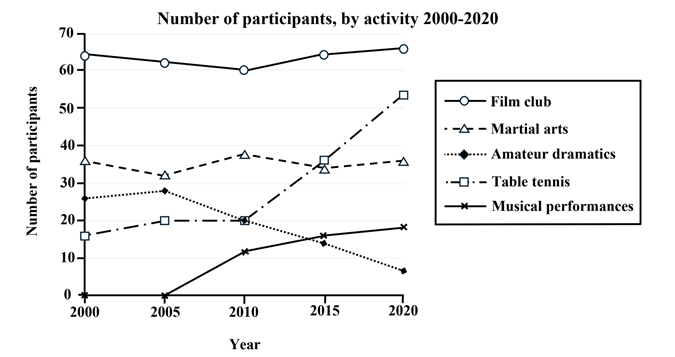
The graph below gives information on the number of participants for different activities at one social centre in Melbourne, Australia for the period 2000 to 2020.
Summarise the information by selecting and reporting the main features, and make comparisons where relevant. Write at least 150 words.
..................................................................................................................................................
..................................................................................................................................................
..................................................................................................................................................
Part 2. Write an essay of about 250 words on the following topic. (30 points)
It is important for everyone, including young people, to save money for their future.
To what extent do you agree or disagree with this statement?
Support your arguments with reasons and/or examples from your experience and observations.
..................................................................................................................................................
..................................................................................................................................................
..................................................................................................................................................
THE END
................................
................................
................................
Xem thêm đề thi học sinh giỏi Tiếng Anh lớp 10 hay khác:
Đề thi học sinh giỏi Tiếng Anh 10 trường THPT Chuyên Hoàng Văn Thụ (Hòa Bình) năm 2023-2024
Đề thi học sinh giỏi Tiếng Anh 10 trường THPT Chuyên Lào Cai (Lào Cai) năm 2024
Đề thi học sinh giỏi Tiếng Anh 10 trường THPT Chuyên Lam Sơn (Thanh Hóa) năm 2024
Đề thi học sinh giỏi Tiếng Anh 10 trường THPT Chuyên Lê Hồng Phong (Nam Định) năm 2024
Đề thi học sinh giỏi Tiếng Anh 10 trường THPT Chuyên Hùng Vương (Bình Dương) năm 2024
Đề thi học sinh giỏi Tiếng Anh 10 trường THPT Chuyên Hưng Yên (Hưng Yên) năm 2024
ĐỀ THI, GIÁO ÁN, SÁCH ĐỀ THI DÀNH CHO GIÁO VIÊN VÀ PHỤ HUYNH LỚP 9
Bộ giáo án, bài giảng powerpoint, đề thi dành cho giáo viên và sách dành cho phụ huynh tại https://tailieugiaovien.com.vn/ . Hỗ trợ zalo VietJack Official
Tổng đài hỗ trợ đăng ký : 084 283 45 85



Đã có app VietJack trên điện thoại, giải bài tập SGK, SBT Soạn văn, Văn mẫu, Thi online, Bài giảng....miễn phí. Tải ngay ứng dụng trên Android và iOS.


Bộ đề thi các lớp các môn học được Giáo viên nhiều năm kinh nghiệm tổng hợp và biên soạn theo Thông tư mới nhất của Bộ Giáo dục và Đào tạo, được chọn lọc từ đề thi của các trường trên cả nước.
Nếu thấy hay, hãy động viên và chia sẻ nhé! Các bình luận không phù hợp với nội quy bình luận trang web sẽ bị cấm bình luận vĩnh viễn.
- Đề thi lớp 1 (các môn học)
- Đề thi lớp 2 (các môn học)
- Đề thi lớp 3 (các môn học)
- Đề thi lớp 4 (các môn học)
- Đề thi lớp 5 (các môn học)
- Đề thi lớp 6 (các môn học)
- Đề thi lớp 7 (các môn học)
- Đề thi lớp 8 (các môn học)
- Đề thi lớp 9 (các môn học)
- Đề thi lớp 10 (các môn học)
- Đề thi lớp 11 (các môn học)
- Đề thi lớp 12 (các môn học)
- Giáo án lớp 1 (các môn học)
- Giáo án lớp 2 (các môn học)
- Giáo án lớp 3 (các môn học)
- Giáo án lớp 4 (các môn học)
- Giáo án lớp 5 (các môn học)
- Giáo án lớp 6 (các môn học)
- Giáo án lớp 7 (các môn học)
- Giáo án lớp 8 (các môn học)
- Giáo án lớp 9 (các môn học)
- Giáo án lớp 10 (các môn học)
- Giáo án lớp 11 (các môn học)
- Giáo án lớp 12 (các môn học)



 Giải bài tập SGK & SBT
 Tài liệu giáo viên
 Sách
Sách
 Khóa học
 Thi online
 Hỏi đáp