Đề thi HSG Tiếng Anh 11 trường THPT Chuyên Hùng Vương (Bình Dương) 2023-2024
Bài viết Đề thi học sinh giỏi Tiếng Anh 11 trường THPT Chuyên Hùng Vương, tỉnh Bình Dương năm 2023-2024 đề xuất cho kì thi HSG Tiếng Anh 11 các trường THPT Chuyên khu vực Duyên hải và Đồng bằng Bắc Bộ. Mời các bạn đón đọc:
Đề thi HSG Tiếng Anh 11 trường THPT Chuyên Hùng Vương (Bình Dương) 2023-2024
Chỉ từ 200k mua trọn bộ Đề thi học sinh giỏi Tiếng Anh 11 bản word có lời giải chi tiết:
- B1: gửi phí vào tk:
1133836868- CT TNHH DAU TU VA DV GD VIETJACK - Ngân hàng MB (QR) - B2: Nhắn tin tới Zalo VietJack Official - nhấn vào đây để thông báo và nhận đề thi
|
SỞ GIÁO DỤC & ĐÀO TẠO TỈNH BÌNH DƯƠNG TRƯỜNG THPT CHUYÊN HÙNG VƯƠNG (Đề thi gồm có 20 trang) |
KỲ THI HỌC SINH GIỎI CÁC TRƯỜNG THPT CHUYÊN KHU VỰC DUYÊN HẢI VÀ ĐỒNG BẰNG BẮC BỘ NĂM HỌC 2023-2024 MÔN: TIẾNG ANH – KHỐI 11 |
SECTION A. LISTENING (50 POINTS)
Part 1. You will hear an interview in which two filmmakers, Tilly Woodford and Lee Davies, are talking about a documentary they have made about animals. For questions 1-5, select the best answer A, B, C or D. Read the questions carefully before playing the audio. In the exam, you will have the opportunity to listen to each recording TWICE.
Bài nghe:
1. Tilly says the initial inspiration for the documentary came from:
A. experiencing an intense emotional bond with an animal
B. wanting to encourage her own children to appreciate
C. realising her understanding of animals was quite limited
D. thinking about her childhood memories of keeping animals
2. How did Lee originally feel about working on the documentary?
A. Curious about whether he would work with Tilly
B. Guilty about having to abandon his other project
C. Anxious about working in a different way
D. Doubtful about the level of interest in the subject
3. What does Tilly suggest about the man she interviewed?
A. He found it hard to take care of his pets
B. He didn’t take his pets’ needs into consideration
C. He disagreed with Tilly’s suggestions about pet nutrition
D. He only focused on the fun sides of pet ownership
4. What discovery surprised Lee and Tilly most during their research?
A. How far some people go to project wild animals
B. How little is known about animal communication
C. How much society’s attitudes to pets have changed
D. How important the pet sector is to the economy
5. When reflecting on the documentary, they express regrets that:
A. they had to cut several stories from the final version
B. the documentary contained few of their own insights
C. they focused on the least controversial issues
D. their small budget limited what they could do
Part 2. For questions 6-10, listen to the recording and decide whether the following statements are True (T) or False (F).
Bài nghe:
6. In the past, science fiction fans imagined that jetpack would become a part of everyday life.
7. The Rocket Belt developed by Wendell Moore was too slow.
8. The thing which causes most difficulty for a pilot of a jetpack is the terrible heat.
9. The main advantage of the EFV over a jetpack is flying much further.
10. The company that makes the EFV also makes a type of helicopter.
Part 3. For questions 11-15, listen to the recording and answer the questions. Write NO MORE THAN TWO WORDS for each answer.
Bài nghe:
11. What human activity generates around 15% of the greenhouse gas emissions contributed by people?
12. As well as cutting down on meat consumption, what else should we endeavour to reduce?
13. Which important ecosystem is beef farming contributing to the loss of on a large scale?
14. There can be benefits to biodiversity from long-established farming practices of what?
15. Large volumes of water are needed for the cultivation of which type of nut?
Part 4. For questions 16-25, listen to a talk and write NO MORE THAN THREE WORDS taken from the recording in each blank.
Bài nghe:
16. The heart of California is _____________ by drought.
17. Farmers and water managers capture the water to store in _____________.
18. A 15-acre _____________surrounded by orchards and cornfields was built to capture a flood.
19. People who grow lots of vegetables and fruit and nuts no longer consider winter floods a _____________.
20. When the rivers rise, gates are opened and water is sent surging through _____________into giant basins
21. The water seeps slowly into the ground to a groundwater _____________.
22. If people _____________, they can legally pump more during the dry years.
23. The water a farmer stores might be more valuable than the raisins he grows because he can pump more water during a future drought to _____________his other fields.
24. During a winter with lots of rain, Don Cameron decided to flood some of his _____________, which increased the water levels underground.
25. The biggest _____________available to store all the water is underground.
SECTION B: LEXICO-GRAMMAR (30 POINTS)
Part 1. Select the best option to complete each sentence. Write your answers in the corresponding numbered boxes on your answer sheet. (20 points)
1. After the fraud scandal, the famous singer had to make great efforts to _____________his reputation.
A. reinforce
B. leverage
C. retrieve
D. salvage
2. We _____________deny that we have ever cheated or tampered illegally with any match ball in any game during our careers.
A. categorically
B. allegedly
C. distinctly
D. highly
3. Because he was an _____________criminal, he was sentenced to life imprisonment.
A. ilegible
B. impenetrable
C. impermeable
D. incorregible
4. The summer months are the best, apart from the really hot _____________we usually get in August.
A. term
B. interval
C. wave
D. spell
5. This theme park attracts more visitors than _____________any other in Europe.
A. practically
B. really
C. utterly
D. actually
6. She had made a firm decision and wasn’t _____________by anything I said against it.
A. detracted
B. prevailed
C. induced
D. swayed
7. She’s so _____________; you really have to watch you say or she’ll walk out of the room.
A. high and dry
B. prim and proper
C. rough and ready
D. sick and tired
8. Mr. Smith ate his breakfast in great _____________so as not to miss the bus to Liverpool.
A. speed
B. pace
C. rush
D. haste
9. Hundreds of people have visited our clinic over the years and found that the expert help and advice they have received have given them a new _____________of life.
A. extension
B. period
C. lease
D. length
10. She rocked the baby in her arms and watched his little face as he _____________to sleep.
A. drifted off
B. carried off
C. slipped off
D. popped off
11. Losing my job was _____________I never would have found this one if it hadn’t happened.
A. a bone to pick with
B. a breath of fresh air
C. a bleeding heart
D. a blessing in disguise
12. I was in a _____________as to what to do. If I told the truth, he would get into trouble, but if I said nothing I would be more in trouble.
A. doubt
B. quandary
C. hitch
D. complexity
13. My older brother is extremely fond of astronomy; he seems to _____________a lot of pleasure from observing the stars.
A. derive
B. possess
C. seize
D. reach
14. The whole situation is getting out of _____________. Let’s do something before it turns into a bitter row.
A. capacity
B. charge
C. hand
D. discipline
15. She should have been here but she’s _____________flu.
A. gone through with
B. gone down with
C. come in for
D. come up against
16. I’ll say _____________for him – he never leaves a piece of work unfinished.
A. as much
B. a bit much
C. this much
D. too much
17. _____________Naples being such a busy city, I was surprised to find a hotel room so easily.
A. What if
B. In accord with
C. What with
D. In contrast to
18. The government is to end the system _____________farmers make more money from leaving land unplanted than from growing wheat.
A. where
B. whereby
C. when
D. why
19. It’s good I got interested in that bottle. Granny _____________the poison taking it for her asthma medicine because the bottle was unmarked.
A. could swallow
B. had swallowed
C. might have swallowed
D. was able to swallow
20. This campaign is believed _____________in this region two months ago.
A. to launch
B. being launched
C. to have been launched
D. having been launched
Part 2. Supply the correct form of the words in brackets. Write your answers in the corresponding numbered boxes on your answer sheet. (10 points)
1. The judge ruled that the evidence was _____________as there was no proof it had come from the crime. (ADMIT)
2. They found it _____________amusing that this hot-shot chef couldn’t even use a tomato slicer. (ROAR)
3. There is a strong smell of _____________in the hospital. (INFECT)
4. The film proceeds _____________, with each scene adding a wrinkle to the characters’ motives. (DIALECT)
5. It can take three months after exposure for the bloodstream to accumulate enough antibodies to test positive for human _____________virus, or H.I.V. (DEFICIT)
6. Charles Mingus was stubborn, _____________and open to just about anything. (RIGHT)
7. Everything they did was illegal as they hadn’t received any official _____________for excavating this land. (AUTHOR)
8. _____________hydrogen is kept in insulated storage tanks. (LIQUID)
9. What most of us remember from history books are the _____________events. (CLIMAX)
10. The prison service has the twin goals of punishment and _____________. (HABIT)
SECTION C. READING (60 POINTS)
Part 1. Read the text below and think of ONE word that best fits each space. Write your answers in the corresponding numbered boxes on your answer sheet. (15 points)
BUYING ART ON THE INTERNET
Spending on art has trebled to more than £3 billion in the past year, as Britons abandon art galleries and rush to snap (1) _____________bargains on the Internet.
Recent research (2) _____________domestic art buying has revealed that 31 per cent of people have (3) _____________one and five (4) _____________of art in their home and it also suggests that people are now spending larger (5) _____________on fewer items. No longer do the middle classes merely buy art for its own (6) _____________, but as a means of investing their ever growing surplus income.
However, purchasing on the Internet is a relatively new concept and (7) _____________which some find unnatural and unacceptable. It is viewed cautiously by art purists as they (8) _____________would never consider acquiring a painting without having seen it in (9) _____________beforehand or knowing the pedigree of the artist. To many, though, buying art on the Internet is a far less daunting prospect than having to face gallery owners, whose knowledge of the subject is far superior to the purchaser’s and who often adopt a condescending manner towards the (10) _____________knowledgeable prospective buyer.
Part 2. Read the following passage and choose the best answer. Write your answers in the corresponding numbered boxes. (10 points)
SMART ENERGY
The next few decades will see great changes in the way energy is supplied and used. In some major oil producing nations, 'peak oil' has already been reached, and there are increasing fears of global warming. Consequently, many countries are focusing on the switch to a low carbon economy. This transition will lead to major changes in the supply and use of electricity. [A] Firstly, there will be an increase in overall demand, as consumers switch from oil and gas to electricity to power their homes and vehicles. [B] Secondly, there will be an increase in power generation, not only in terms of how much is generated, but also how it is generated, as there is growing electricity generation from renewable sources. [C] To meet these challenges, countries are investing in Smart Grid technology. [D] This system aims to provide the electricity industry with a better understanding of power generation and demand, and to use this information to create a more efficient power network.
Smart Grid technology basically involves the application of a computer system to the electricity network. The computer system can be used to collect information about supply and demand and improve engineer's ability to manage the system. With better information about electricity demand, the network will be able to increase the amount of electricity delivered per unit generated, leading to the prospect for reductions in fuel needs and carbon emissions. Moreover, the computer system will assist in reducing operational and maintenance costs.
Smart Grid technology offers benefits to the consumer too. They will be able to collect real-time information on their energy use for each appliance. Varying tariffs throughout the day will give customers the incentive to use appliances at times when supply greatly exceeds demand, leading to great reductions in bills. For example, they may use their washing machines at night. Smart meters can also be connected to the internet or telephone system, allowing customers to switch appliances on or off remotely. Furthermore, if houses are fitted with the apparatus to generate their own power, appliances can be set to run directly from the on-site power source, and any excess can be sold to the grid.
With these changes comes a range of challenges. The first involves managing the supply and demand. Sources of renewable energy, such as wind, wave and solar, are notoriously unpredictable, and nuclear power, which is also set to increase as nations switch to alternative energy sources, is inflexible. With oil and gas, it is relatively simple to increase the supply of energy to match the increasing demand during peak times of the day or year. With alternative sources, this is far more difficult, and may lead to blackouts or system collapse. Potential solutions include investigating new and efficient ways to store energy and encouraging consumers to use electricity at off-peak times.
A second problem is the fact that many renewable power generation sources are located in remote areas, such as windy uplands and coastal regions, where there is currently a lack of electrical infrastructure. New infrastructures therefore must be built. Thankfully, with improved smart technology, this can be done more efficiently by reducing the reinforcement or construction costs.
Although Smart Technology is still in its infancy, pilot schemes to promote and test it are already underway. Consumers are currently testing the new smart meters which can be used in their homes to manage electricity use. There are also a number of demonstrations being planned to show how the smart technology could practically work, and trials are in place to test the new electrical infrastructure. It is likely that technology will be added in 'layers', starting with 'quick win' methods which will provide initial carbon savings, to be followed by more advanced systems at a later date. Cities are prime candidates for investment into smart energy, due to the high population density and high energy use. It is here where Smart Technology is likely to be promoted first, utilising a range of sustainable power sources, transport solutions and an infrastructure for charging electrically powered vehicles. The infrastructure is already changing fast. By the year 2050, changes in the energy supply will have transformed our homes, our roads and our behaviour.
1. According to paragraph 1, what has happened in some oil producing countries?
A. They are unwilling to sell their oil any more.
B. They are not producing as much oil as they used to.
C. The supply of oil is unpredictable.
D. Global warming is more sever here than in other countries.
2. Where in paragraph 1 can the following sentence be placed?
There is also likely more electricity generation centres, as households and communities take up the opportunity to install photovoltaic cells and small scale wind turbines.
A. [A]
B. [B]
C. [C]
D. [D]
3. Which of the following is NOT a benefit of Smart Grid technology to consumers?
A. It can reduce their electricity bills.
B. It can tell them how much energy each appliance is using.
C. It can allow them to turn appliances on and off when they are not at home.
D. It can reduce the amount of energy needed to power appliances.
4. The word “prospect” in paragraph 2 could be best replaced by _____________.
A. possibility
B. expectation
C. sustainability
D. durability
5. According to paragraph 4, what is the problem with using renewable sources of power?
A. They do not provide much energy.
B. They often cause system failure and blackouts.
C. They do not supply a continuous flow of energy.
D. They can't be used at off-peak times.
6. In paragraph 6, what can be inferred about cities in the future?
A. More people will be living in cities in the future than nowadays.
B. People in cities will be using cars and buses powered by electricity.
C. All buildings will generate their own electricity.
D. Smart Grid technology will only be available in cities.
7. The word “remote” in paragraph 5 could be best replaced by _____________.
A. isolated
B. crowded
C. attractive
D. alone
8. The word 'underway' in paragraph 6 is closest in meaning to _____________.
A. permanent
B. complete
C. beneficial
D. in progress
9. What is the main idea of the final paragraph?
A. To describe who will benefit from Smart Grid technology first.
B. To outline the advantages of Smart Grid technology.
C. To summarise the main ideas in the previous paragraphs.
D. To describe how, where and when Smart Technology will be introduced.
10. In paragraph 6, what can be inferred about the introduction of Smart Grid Technology?
A. The technologies which produce most benefits will be introduced first.
B. The cheapest technologies will be introduced first.
C. The technologies which are most difficult to put into place will be introduced first.
D. Technologically advanced systems will be introduced first.
Part 3. Read the following passage and do the tasks that follow. (13 points)
THE EFFECTS OF LIGHT ON PLANT AND ANIMAL SPECIES
Light is important to organisms for two different reasons. Firstly, it is used as a cue for the timing of daily and seasonal rhythms in both plants and animals, and secondly it is used to assist growth in plants.
Breeding in most organisms occurs during a part of the year only, and so a reliable cue is needed to trigger breeding behaviour. Day length is an excellent cue, because it provides a perfectly predictable pattern of change within the year. In the temperate zone in spring, temperatures fluctuate greatly from day to day, but day length increases steadily by a predictable amount. The seasonal impact of day length on physiological responses is called photoperiodism, and the amount of experimental evidence for this phenomenon is considerable. For example, some species of birds’ breeding can be induced even in midwinter simply by increasing day length artificially (Wolfson 1964). Other examples of photoperiodism occur in plants. A short-day plant flowers when the day is less than a certain critical length. A long-day plant flowers after a certain critical day length is exceeded. In both cases the critical day length differs from species to species. Plants which flower after a period of vegetative growth, regardless of photoperiod, are known as day- neutral plants.
Breeding seasons in animals such as birds have evolved to occupy the part of the year in which offspring have the greatest chances of survival. Before the breeding season begins, food reserves must be built up to support the energy cost of reproduction, and to provide for young birds both when they are in the nest and after fledging. Thus many temperate- zone birds use the increasing day lengths in spring as a cue to begin the nesting cycle, because this is a point when adequate food resources will be assured.
The adaptive significance of photoperiodism in plants is also clear. Short-day plants that flower in spring in the temperate zone are adapted to maximising seedling growth during the growing season. Long-day plants are adapted for situations that require fertilization by insects, or a long period of seed ripening. Short-day plants that flower in the autumn in the temperate zone are able to build up food reserves over the growing season and over winter as seeds. Day-neutral plants have an evolutionary advantage when the connection between the favourable period for reproduction and day length is much less certain. For example, desert annuals germinate, flower and seed whenever suitable rainfall occurs, regardless of the day length.
The breeding season of some plants can be delayed to extraordinary lengths. Bamboos are perennial grasses that remain in a vegetative state for many years and then suddenly flower, fruit and die (Evans 1976). Every bamboo of the species Chusquea abietifolio on the island of Jamaica flowered, set seed and died during 1884. The next generation of bamboo flowered and died between 1916 and 1918, which suggests a vegetative cycle of about 31 years. The climatic trigger for this flowering cycle is not yet known, but the adaptive significance is clear. The simultaneous production of masses of bamboo seeds (in some cases lying 12 to 15 centimetres deep on the ground) is more than all the seed- eating animals can cope with at the time, so that some seeds escape being eaten and grow up to form the next generation (Evans 1976).
The second reason light is important to organisms is that it is essential for photosynthesis. This is the process by which plants use energy from the sun to convert carbon from soil or water into organic material for growth. The rate of photosynthesis in a plant can be measured by calculating the rate of its uptake of carbon. There is a wide range of photosynthetic responses of plants to variations in light intensity. Some plants reach maximal photosynthesis at one-quarter full sunlight, and others, like sugarcane, never reach a maximum, but continue to increase photosynthesis rate as light intensity rises.
Plants in general can be divided into two groups: shade-tolerant species and shade- intolerant species. This classification is commonly used in forestry and horticulture. Shade- tolerant plants have lower photosynthetic rates and hence have lower growth rates than those of shade-intolerant species. Plant species become adapted to living in a certain kind of habitat, and in the process evolve a series of characteristics that prevent them from occupying other habitats. Grime (1966) suggests that light may be one of the major components directing these adaptations. For example, eastern hemlock seedlings are shade-tolerant. They can survive in the forest understorey under very low light levels because they have a low photosynthetic rate.
Questions 1-7: Do the following statements agree with the information given in Reading Passage? In boxes 1-7 on your answer sheet, write
TRUE if the statement agrees with the information
FALSE if the statement contradicts the information
NOT GIVEN if there is no information on this
1. There is plenty of scientific evidence to support photoperiodism.
2. Some types of bird can be encouraged to breed out of season.
3. Photoperiodism is restricted to certain geographic areas.
4. Desert annuals are examples of long-day plants.
5. Bamboos flower several times during their life cycle.
6. Scientists have yet to determine the cue for Chusquea abietifolia's seasonal rhythm.
7. Eastern hemlock is a fast-growing plant.
Questions 8-13: Complete the sentences.
Choose NO MORE THAN THREE WORDS from the passage for each answer. Write your answers in boxes 8-13 on your answer sheet.
8. Day length is a useful cue for breeding in areas where _____________are unpredictable.
9. Plants which do not respond to light levels are referred to as _____________.
10. Plants that flower when days are long often depend on _____________to help them reproduce.
11. Desert annuals respond to _____________as a signal for reproduction.
12. There is no limit to the photosynthetic rate in plants such as _____________.
13. Tolerance to shade is one criterion for the _____________of plants in forestry and horticulture.
Part 4. In the passage below, seven paragraphs have been removed. For questions 1-7, read the passage and choose from paragraphs A-H the one which fits each gap. There is ONE extra paragraph which you do not need to use. Write your answers in the corresponding numbered boxes provided. (7 points)
AT THE CUTTING EDGE
Some years ago, scientists at Cornell University released photographs of a guitar no larger than a human blood cell, its strings just one hundred atoms thick. This Lilliputian instrument was sculpted from crystalline silicon, using an etching technique involving a beam of electrons. The implications of being able to develop machines that are too small to be seen with the naked eye are breath-taking, but we should not lose sight of the fact that nature got there first. The world is already full of nanomachines: they are called living cells. Each cell is packed with tiny structures that might have come straight out of an engineer’s manual. Minuscule tweezers, scissors, pumps, motors, levers, valves, pipes, chains and even vehicles abound.
1 |
Individually, atoms can only jostle their neighbours and bond to them if the circumstances are right. Yet collectively, they accomplish ingenious marvels of construction and control, unmatched by any human engineering. Somehow nature discovered how to build the intricate machine we call the living cell, using only the raw materials to hand, all jumbled up. Even more remarkable is that nature built the first cell from scratch.
2 |
Like any urban environment, there is much commuting going on. Molecules have to travel across the cell to meet others at the right place and the right time in order to carry out their jobs properly. No overseer supervises their activities – they simply do what they have to do. While at the level of individual atoms life is anarchy, at this higher level, the dance of life is performed with exquisite precision.
3 |
Even nowadays, some people flatly deny that science alone can give a convincing explanation for the origin of life, believing that living cell is just too elaborate, too contrived, to be the product of blind physical forces alone. Science may give a good account of this or that individual feature, they say, but it will never explain how the original cell was assembled in the first place.
4 |
It would be wrong, however, to suppose this is all there is to life. To use the cliché, the whole is more than the sum of its parts. The very word ‘organism implies cooperation at a global level that cannot be captured in the study of the components alone. Without understanding its collective activity, the job of explaining life is only partly done.
5 |
With the discovery of DNA, however, this mystery was finally solved. Its structure is the famous double helix, discovered by Crick and Watson in the early 1950s. The two helical strands are attached by cross-links and we can imagine the whole shape unwound and laid out to make a ladder, where the handrails are the two unwound helices and the rungs the cross-links.
6 |
Each rung is actually a pair of bases joined end to end and it is here that geometry comes in. A is tailor-made to butt neatly with T, while C and G similarly slot together snugly, though the forces that bind these base pairs in the lock-and-key fit are in fact rather weak. Imagine the two handrails being pulled apart, breaking all the base pairs, as if the ladder had been sawn up the middle. Each would be left with a row of complementary projecting arms.
7 |
So long as the base-pairing rules work correctly, this is guaranteed to be identical to the original. However, no copy process is perfect, and it is inevitable that errors will creep in from time to time, altering the sequence of bases – scrambling up the letters. If the message gets a bit gargled during replication, the resulting organism may suffer a mutation. Viewed like this, life is just a string of four-letter words, for we are defined as individuals by these minuscule variations in DNA.
Missing paragraphs:
A. Can such a magnificently self-orchestrating process be explained or might the mystery of life be, in the end, impenetrable? In 1933, the physicist Niels Bohr, one of the founders of quantum mechanics, concluded that life hides its secrets from us in the same way as an atom does.
B. It is this templating that is the basis for the replication process and ultimately, the recipe for life. If a DNA molecule is pulled apart and if there is a supply of free base molecules – As, Gs, Cs and Ts – floating around, they will tend to slot in and stick to these exposed stumps and thereby automatically reconstruct a new strand.
C. Near the top of my list of its defining properties is reproduction. Without it, and in the absence of immortality, all life would sooner or later cease. For a long time, scientists had very little idea how organisms reproduce themselves. Vague notions of invisible genes conveying biological messages from one generation to the next revealed little.
D. Of course, there’s more to it than just a bag of gadgets. The various components fit together to form a smoothly functioning whole, like an elaborate factory production line. The miracle of life is not that it is made of nanotools, but that these tiny diverse parts are integrated in a highly organised way.
E. Boiled down to its essentials, this secret can in fact be explained by molecular replication. The idea of a molecule making a copy of itself may seem rather magical, but it actually turns out to be quite straightforward. The underlying principle is in fact an exercise in elementary geometry.
F. I beg to differ. Over the past few decades, molecular biology has made gigantic strides in determining which molecules do what to which. Always it is found that nature’s nanomachines operate according to perfectly ordinary physical forces and laws. No weird goings-on have been discovered.
G. The former perform a purely scaffolding role, holding the molecule together. The business part of DNA lies with the latter, which are constructed from four different varieties of molecules or bases, with the chemical names adenine, guanine, cytosine and thiamine – let’s use their initials for simplicity’s sake.
H. As a simple-minded physicist, when I think about life at the molecular level, the question I keep asking is: How do all these mindless atoms know what to do? The complexity of the living cell is immense, resembling a city in the degree of its elaborate activity. Each molecule has a specified function and a designated place in the overall scheme so that the correct objects get manufactured.
Part 5: Read the text below and answer questions (15 points).
For questions 1–10, identify which section A–D each of the following is mentioned. Write ONE letter A–D in the space provided. Each letter may be used more than once.
The Fast Track to Burnout
An increasing number of young executives are giving up their corporate positions after experiencing an overload of pressure and dissatisfaction with what they imagined would be a dream career. Kate Martins talks to four young people who turned their backs on high salaries and even higher expectations. Here's how to beat it.
A. Tanya Burrows bears no grudge towards the corporation that rewarded her with five promotions within the same number of years. “At twenty-seven, I was able to buy my own luxury apartment,” she says. “For that reason I'll always be grateful to them”. Tanya admits that the high salary that came with each promotion was irresistible. “We weren't poor but I don't think my parents ever bought anything that wasn't secondhand. That definitely played a role in my motivation. When someone's saying you can negotiate your own salary, it's hard to say no”. So what changed for Tanya? “Honestly, got sick of the materialism. I got sucked in too at first-you'd make sure other people knew what designer labels you were wearing that they could see your cell phone was top of the range but it just wore thin for me”. Tanya decided to quit and pursue her real passion for photography. “It doesn't offer much financial security as you don't know. when you'll get your next contract, but I get to work in far more inspiring environments,” she says.
B. Lily Tan left university with an MBA distinction and was quickly snapped up by a major retail chain. In just five years she achieved a senior management position and after receiving news of the promotion she was elated. “I rang round just about everyone I could think of,” she laughs. “But the next day I felt nothing. I had no inclination to get out of bed and face the constant pressure”. Despite her sudden disillusionment, she continued to persevere and was the brains behind a new strategy. “Everyone seemed to be in favor of it at the planning stage,” she says. But during the implementation stage, unforeseen problems arose, and eventually the strategy was abandoned. Lily's next performance appraisal gave her a really low rating which she found devastating. “The whole experience was quite traumatizing and I was too emotionally immature to deal with it”. It wasn't long before Lily left and set up her own recruitment company which is now flourishing. She still regrets her discovery that there is no such thing as team spirit when one of the members makes a mistake.
C. Jane Dawson graduated top of her class in a Bachelor of Business (Finance) degree and was offered a contract by three major investment companies. She accepted the one that was offering perks such as free tickets to major sporting events and a flash company car. Just like the three other young high-flyers in these Interviews, Jane's potential for leadership was quickly noted and she found herself promoted to team leader within six months. But, exceptionally, in her case, she had already been looking for an escape route. “Sure it was good money but the hours were ridiculous. I felt I should have been carefree at that age but the burden of responsibility was enormous. I feel trapped.” Despite the fact that she'd been elevated to senior analyst, Jans still felt anonymous within the plant corporation. “It was a real feeling of being the small cog in a big machine. Nothing I did really mattered.” She forced herself to stay on for another year, but then nervously asked for a sabbatical. To her amazement, her department head agreed. “I guess they knew I'd reached burnout and didn't want to lose me altogether – but there were plenty of workmates perfectly able to step into my shoes,” she admits. She spent the year traveling and working on community projects in developing countries. By the time Jane was due to return, she knew she was in the wrong job. She applied to work for an aid organization, where she says “At last I feel I'm doing something worthwhile."
D. Natalie Copeland was signed up to work for a leading PR consultancy. She admits to being a perfectionist, an attribute which saw her rise through the ranks in no time. "It's a weakness, too,” she says. “It can mean that you're reluctant to delegate and end up with the pressure of doing it all yourself.” For the first few years, however, she had no problem with overtime and her performance appraisals were almost always flawless. But Natalie feels she committed 'career-suicide' by opting to getting married and have a child at twenty-five. “My colleagues seemed utterly mystified and tried to talk me out of it.” And on her return to work Natalle felt instant resentment towards her. “I had to leave promptly at the end of the working day to take care of my daughter Anita but would come in an hour early and work through my lunch hour. It made no difference,” she explains. They simply alienated me: By this she means that workmates were reluctant to update her on recent development and withheld vital information on new projects. With little support from her seniors either, and refusing to compromise her time with her family, Natalie handed in her notice and now works for a smaller PR company offering flex-time.
Of which young executive is the following true?
1. A project that she was working on did not turn out the way she expected.
2. She accepted the job because of the benefits that were additional to the salary
3. She suggests that her young age meant she was unable to cope with a stressful situation.
4. The people she worked with could not relate to a decision she had made.
5. She suggests a lack of money in her childhood made a high salary more desirable.
6. She believes that other people could have done her job equally well.
7. She does not have any negative feelings towards the company she worked for.
8. The feelings she had towards her promotion quickly changed.
9. One of her qualities also disadvantaged her in a certain way.
10. She wanted more freedom while she was still at a young age.
SECTION D. WRITING (60 points)
Part 1. Summary (15 points)
Read the following extract and use your own words to summarize it. Your summary should be about 140 words. You MUST NOT copy the original.
FOOD MILES: IS BUYING LOCAL FOOD ALWAYS BETTER?
Recently, campaigners have encouraged us to buy local food. This reduces ‘food miles’, that is, the distance food travels to get from the producer to the retailer. They reason that the higher the food miles, the more carbon emissions. Buying local food, therefore, has a lower carbon footprint and is more environmentally friendly.
However, the real story is not as simple as that. If our aim is to reduce carbon emissions, we must look at the whole farming process, not just transportation. According to a 2008 study, only 11% of carbon emissions in the food production process result from transportation, and only 4% originated from the final delivery of the product from the producer to the retailer. Other processes, including fertilisation, storage, heating and irrigation, contribute much more.
In fact, imported food often has a lower carbon footprint than locally grown food. Take apples, for example. In autumn, when apples are harvested, the best option for a British resident is to buy British apples. However, the apples we buy in winter or spring have been kept refrigerated for months, and this uses up a lot of energy. In spring, therefore, it is more energy-efficient to import them from New Zealand, where they are in season. Heating also uses a lot of energy, which is why growing tomatoes in heated greenhouses in the UK is less environmentally friendly than importing them from Spain, where the crop grows well in the local climate.
We must also take into account the type of transport. Transporting food by air creates about 50 times more emissions than shipping it. However, only a small proportion of goods are flown to the consumer country, and these are usually high value, perishable items which we cannot produce locally, such as seafood and out-of-season berries. Even then, these foods may not have a higher carbon footprint than locally grown food. For example, beans flown in from Kenya are grown in sunny fields using manual labour and natural fertilisers, unlike in Britain, where we use oil-based fertilisers and diesel machinery. Therefore, the total carbon footprint is still lower.
It’s also worth remembering that a product’s journey does not end at the supermarket. The distance consumers travel to buy their food, and the kind of transport they use will also add to its carbon footprint. So driving a long way to shop for food will negate any environmental benefits of buying locally grown produce. Furthermore, choosing local over imported food can also badly affect people in developing countries. Many of them work in agriculture because they have no other choice. If they are unable to sell produce overseas, they will have less income to buy food, clothes, medicine and to educate their children.
Recently, some supermarkets have been trying to raise awareness of food miles by labelling foods with stickers that show it has been imported by air. But ultimately, the message this gives is too simple. Lots of different factors contribute to a food’s carbon footprint besides the distance it has travelled. And even if we only buy local food which is currently in season, there are ethical implications. What’s more, our diets would be more limited.
...................................................................................................................................................
...................................................................................................................................................
...................................................................................................................................................
Part 2. Graph (15 points)
The bar chart shows the relative electricity consumption and cost per year of various household devices. Summarize the information by selecting and reporting the main features and make comparisons where relevant.
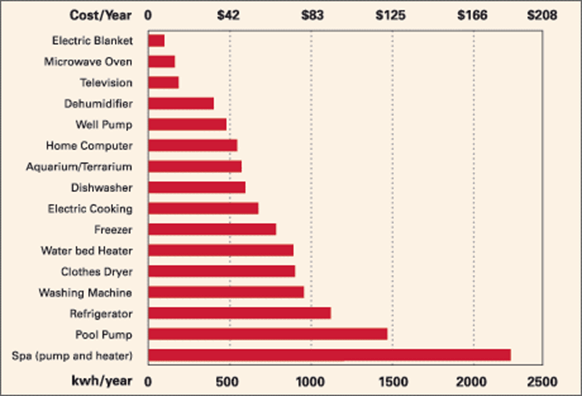
...................................................................................................................................................
...................................................................................................................................................
...................................................................................................................................................
Part 3. Essay writing (30 points)
Many small, local shops are closing as they are unable to compete with large supermarkets in the area. How does this affect local communities? How could this situation be improved?
Give reasons for your answer and include any relevant examples from your own knowledge or experience. You should write about 350 words.
...................................................................................................................................................
...................................................................................................................................................
...................................................................................................................................................
THE END
................................
................................
................................
Xem thêm đề thi học sinh giỏi Tiếng Anh lớp 11 hay khác:
Đề thi học sinh giỏi Tiếng Anh 11 trường THPT Chuyên Bảo Lộc (Lâm Đồng) năm 2024
Đề thi học sinh giỏi Tiếng Anh 11 trường THPT Chuyên Lào Cai (Lào Cai) năm 2023-2024
Đề thi học sinh giỏi Tiếng Anh 11 trường THPT Chuyên Lê Hồng Phong (Nam Định) năm 2024
Đề thi học sinh giỏi Tiếng Anh 11 trường THPT Chuyên Lam Sơn (Thanh Hóa) năm 2024
Đề thi học sinh giỏi Tiếng Anh 11 trường THPT Chuyên Lê Khiết (Quảng Ngãi) năm 2024
Đề thi học sinh giỏi Tiếng Anh 11 trường THPT Chuyên Thái Nguyên (Thái Nguyên) năm 2024
TÀI LIỆU CLC DÀNH CHO GIÁO VIÊN VÀ PHỤ HUYNH LỚP 9
Bộ giáo án, bài giảng powerpoint, đề thi file word có đáp án 2026 tại https://tailieugiaovien.com.vn/
Hỗ trợ zalo: VietJack Official
Tổng đài hỗ trợ đăng ký: 084 283 45 85
 Đề thi vào 10 các sở Hà Nội, Tp. Hồ Chí Minh...
41 tài liệu
Đề thi vào 10 các sở Hà Nội, Tp. Hồ Chí Minh...
41 tài liệu
 Giáo án Word 9
95 tài liệu
Giáo án Word 9
95 tài liệu
 Đề thi giữa kì, cuối kì 9
254 tài liệu
Đề thi giữa kì, cuối kì 9
254 tài liệu
 Chuyên đề dạy thêm Toán, Lí, Hóa... 9
71 tài liệu
Chuyên đề dạy thêm Toán, Lí, Hóa... 9
71 tài liệu
 Đề thi HSG 9
8 tài liệu
Đề thi HSG 9
8 tài liệu
 Bài giảng Powerpoint 9
42 tài liệu
Bài giảng Powerpoint 9
42 tài liệu
Công cụ giáo viên (2048.VN)
Tạo- trộn đề thi miễn phí từ file PDF, Word, Giao bài nhanh chóng, Hoàn toàn Free
Bộ đề thi các lớp các môn học được Giáo viên nhiều năm kinh nghiệm tổng hợp và biên soạn theo Thông tư mới nhất của Bộ Giáo dục và Đào tạo, được chọn lọc từ đề thi của các trường trên cả nước.
- Đề thi lớp 1 (các môn học)
- Đề thi lớp 2 (các môn học)
- Đề thi lớp 3 (các môn học)
- Đề thi lớp 4 (các môn học)
- Đề thi lớp 5 (các môn học)
- Đề thi lớp 6 (các môn học)
- Đề thi lớp 7 (các môn học)
- Đề thi lớp 8 (các môn học)
- Đề thi lớp 9 (các môn học)
- Đề thi lớp 10 (các môn học)
- Đề thi lớp 11 (các môn học)
- Đề thi lớp 12 (các môn học)
- Giáo án lớp 1 (các môn học)
- Giáo án lớp 2 (các môn học)
- Giáo án lớp 3 (các môn học)
- Giáo án lớp 4 (các môn học)
- Giáo án lớp 5 (các môn học)
- Giáo án lớp 6 (các môn học)
- Giáo án lớp 7 (các môn học)
- Giáo án lớp 8 (các môn học)
- Giáo án lớp 9 (các môn học)
- Giáo án lớp 10 (các môn học)
- Giáo án lớp 11 (các môn học)
- Giáo án lớp 12 (các môn học)