(Ôn thi ĐGNL, ĐGTD) Chuyên đề: Câu tường thuật (Reported speech)
Chuyên đề Tiếng Anh Câu tường thuật (Reported speech) đầy đủ lý thuyết trọng tâm, các dạng bài & bài tập đa dạng từ cơ bản đến nâng cao giúp Giáo viên & học sinh có thêm tài liệu ôn thi ĐGNL, ĐGTD đạt kết quả cao.
(Ôn thi ĐGNL, ĐGTD) Chuyên đề: Câu tường thuật (Reported speech)
Giáo viên & Phụ huynh quan tâm Đề thi & Chuyên đề ôn thi ĐGNL - ĐGTD (các trường) bản word có lời giải chi tiết, dễ dàng chỉnh sửa và cập nhật hàng năm mời Xem thử.
A. LÝ THUYẾT
I. NHỮNG THAY ĐỔI KHI CHUYỂN SANG CÂU TƯỜNG THUẬT
1. Thay đổi đại từ và tính từ sở hữu
|
Loại từ |
Ví dụ |
||
|
Câu trực tiếp |
Câu gián tiếp |
Ghi chú |
|
|
Đại từ nhân xưng |
“I need your help,” she told Tom. |
She told Tom she needed his help. |
I → she |
|
Đại từ phản thân |
“I’ll do it myself,” Jane said. |
Jane said she would do it herself. |
myself → herself |
|
Đại từ sở hữu |
“That phone is mine,” he said. |
He said that phone was his. |
mine → his |
|
Tính từ sở hữu |
“That is my laptop,” she said. |
She said that was her laptop. |
my → her |
2. Thay đổi thời gian, địa điểm và các từ chỉ định
|
Câu trực tiếp |
Câu gián tiếp |
|
now |
then/at that time |
|
today |
that day |
|
yesterday |
the day before/the previous day |
|
the day before yesterday |
two days before |
|
tomorrow |
the day after/the next day/the following day |
|
the day after tomorrow |
two days after |
|
this week |
that week |
|
these days |
those days |
|
last year |
the year before/the previous year |
|
next month |
the month after/the following month |
|
here |
there |
|
ago |
before / earlier |
|
tonight |
that night |
Ví dụ:
“I'll see you tomorrow,” he said.
→ He said he would see me the next day.
“It's hot here,” she said.
→ She said it was hot there.
3. Thay đổi thì của động từ
3.1. Trường hợp PHẢI lùi thì
Khi động từ tường thuật (say, tell, ask, ...) ở thì quá khứ (said, told, asked, ...), động từ trong câu gián tiếp phải lùi về một thì so với câu trực tiếp.
|
Câu trực tiếp |
Câu gián tiếp |
|
Thì động từ |
|
|
Thì hiện tại đơn |
Thì quá khứ đơn |
|
Thì hiện tại tiếp diễn |
Thì quá khứ tiếp diễn |
|
Thì quá khứ đơn |
Thì quá khứ hoàn thành |
|
Thì hiện tại hoàn thành |
Thì quá khứ hoàn thành |
|
Thì tương lai đơn |
Thì tương lai đơn trong quá khứ (Would) |
|
Thì tương lai gần |
Thì tương lai gần trong quá khứ (Was/Were going to) |
|
Động từ khuyết thiếu |
|
|
can |
could |
|
may |
might |
|
must |
had to |
3.2. Các trường hợp không phải thay đổi thì
|
Trường hợp |
Giải thích |
Ví dụ |
|
a. Động từ tường thuật ở hiện tại/hoàn thành |
Không cần lùi thì |
He says, “I play tennis.” → He says he plays tennis. |
|
b. Sự thật hiển nhiên/chân lý |
Không lùi thì dù tường thuật ở quá khứ |
“Water boils at 100°C,” the teacher said. → The teacher said water boils at 100°C. |
|
c. Câu trực tiếp đã dùng thì quá khứ hoàn thành hoặc các modal verb đã ở quá khứ |
Giữ nguyên thì |
“I had finished my work,” she said. → She said she had finished her work. |
|
d. Câu điều kiện loại 2, 3, câu điều ước, giả định |
Không đổi cấu trúc |
“If I were you, I would go,” he said. → He said if he were me, he would go. |
II. CÁC LOẠI CÂU TƯỜNG THUẬT
1. Câu trần thuật (Statement)
Cách chuyển:
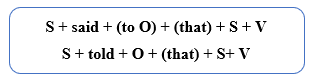
- Dùng said (to) hoặc told (cần tân ngữ trực tiếp).
- Thay đổi đại từ, thì của động từ, từ chỉ thời gian/địa điểm, nếu cần.
Cấu trúc:
Ví dụ:
- “I bought a new phone yesterday,” Mark said to Emma.
→ Mark said to Emma that he had bought a new phone the day before.
→ Mark told Emma that he had bought a new phone the day before.
- Olivia said, “I’m learning French this semester.”
→ Olivia said that she was learning French that semester.
2. Câu hỏi (Questions)
a. Câu hỏi Yes/No (không có từ để hỏi)
- Dùng: ask, wonder, want to know,...
- Thêm: if hoặc whether sau động từ.
- Không đảo ngữ như câu hỏi trực tiếp.
Cấu trúc:

Ví dụ:
- Liam asked, “Are you free this evening?”
→ Liam asked if I was free that evening.
- “Did Anna receive my email?” he wondered.
→ He wondered whether Anna had received his email.
Lưu ý:
- Câu hỏi đuôi được chuyển như câu Yes/No → bỏ phần đuôi.
Ví dụ:
She asked, “You will help me, won't you?”
→ She asked me if/whether I would help her.
- Câu trả lời Yes/No chuyển thành mệnh đề khẳng định/phủ định.
Ví dụ:
“Can you drive?” → He asked if I could drive.
“Yes.” → I said I could.
b. Câu hỏi có từ để hỏi (Wh-questions)
- Dùng: ask, wonder, want to know,...
- Giữ nguyên từ để hỏi: what, where, when, why, how,...
- Thay đổi: đại từ, tính từ sở hữu, thì động từ và các trạng từ chỉ thời gian, nơi chốn.
Cấu trúc:

Ví dụ:
- She asked, “Where did you park your car?”
→ She asked where I had parked my car.
- “Why is the project delayed?” Tom wondered.
→ Tom wondered why the project was delayed.
- Lucas said, “How much does this cost?”
→ Lucas wanted to know how much that cost.
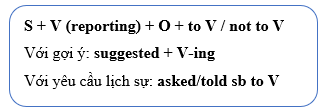
3. Câu mệnh lệnh, yêu cầu, đề nghị, lời khuyên (Commands/Requests/Suggestions)
Cấu trúc chung:
|
Mục đích |
Động từ tường thuật |
Ví dụ |
Câu tường thuật |
|
Nhắc nhở |
reminded sb to do sth |
“Don’t forget to water the plants,” she said. |
She reminded me to water the plants. |
|
Ra lệnh |
ordered sb to do sth |
“Close the gate immediately!” the guard said. |
The guard ordered me to close the gate immediately. |
|
Hứa |
promised to do sth |
“I’ll pay you back on Friday,” he said. |
He promised to pay me back on Friday. |
|
Khuyên |
advised sb to do sth |
“You should drink more water,” Mom said. |
Mom advised me to drink more water. |
|
Mời |
invited sb to do sth |
“Would you like to visit our farm?” they said. |
They invited us to visit their farm. |
|
Đề nghị làm giúp |
offered to do sth |
“Shall I carry those bags for you?” she asked. |
She offered to carry the bags for me. |
|
Đe dọa |
threatened to do sth |
“I'll report this to your manager!” the customer said. |
The customer threatened to report it. |
|
Từ chối |
refused to do sth |
“I won't sign the contract,” the actor said. |
The actor refused to sign the contract. |
|
Thuyết phục |
persuaded sb to do sth |
“You should really apply for this scholarship,” he said. |
He persuaded me to apply for the scholarship. |
|
Khuyến khích |
encouraged sb to do sth |
“Keep trying until you succeed,” she said. |
She encouraged me to keep trying. |
|
Nài nỉ |
begged / implored sb to do sth |
“Please don’t leave me here alone,” she said. |
She begged me not to leave her alone. |
|
Gợi ý (Let's...) |
suggested + V-ing |
“Let’s organize a fundraiser,” the student said. |
The student suggested organizing a fundraiser. |
................................
................................
................................
Giáo viên & Phụ huynh quan tâm Đề thi & Chuyên đề ôn thi ĐGNL - ĐGTD (các trường) bản word có lời giải chi tiết, dễ dàng chỉnh sửa và cập nhật hàng năm mời Xem thử.
Xem thêm các Chuyên đề Tiếng Anh ôn thi ĐGNL-ĐGTD hay khác
- (Ôn thi ĐGNL, ĐGTD) Chuyên đề: Mệnh đề quan hệ (Relative clauses)
- (Ôn thi ĐGNL, ĐGTD) Chuyên đề: Thức giả định (The subjunctive mood)
- (Ôn thi ĐGNL, ĐGTD) Chuyên đề: Đảo ngữ (Inversion)
- (Ôn thi ĐGNL, ĐGTD) Chuyên đề: Mệnh đề danh từ (Noun clauses)
- (Ôn thi ĐGNL, ĐGTD) Chuyên đề: Sự hòa hợp giữa chủ ngữ và động từ (Subject – Verb agreement)
- (Ôn thi ĐGNL, ĐGTD) Chuyên đề: Cấu tạo từ và trật tự từ (Word formation – word order)
TÀI LIỆU CLC DÀNH CHO GIÁO VIÊN VÀ PHỤ HUYNH LỚP 12
Bộ giáo án, bài giảng powerpoint, đề thi file word có đáp án 2026 tại https://tailieugiaovien.com.vn/
Hỗ trợ zalo: VietJack Official
Tổng đài hỗ trợ đăng ký: 084 283 45 85
 500+ đề thi thử tốt nghiệp THPT Quốc gia form 2026
41 tài liệu
500+ đề thi thử tốt nghiệp THPT Quốc gia form 2026
41 tài liệu
 100+ đề thi HSA,TSA,V-ACT,BCA,BQP...2026
95 tài liệu
100+ đề thi HSA,TSA,V-ACT,BCA,BQP...2026
95 tài liệu
 Đề thi giữa kì, cuối kì 12
254 tài liệu
Đề thi giữa kì, cuối kì 12
254 tài liệu
 Chuyên đề dạy thêm Toán, Lí, Hóa... 12
71 tài liệu
Chuyên đề dạy thêm Toán, Lí, Hóa... 12
71 tài liệu
 Đề thi HSG 12
8 tài liệu
Đề thi HSG 12
8 tài liệu
 Bài giảng Powerpoint 12
42 tài liệu
Bài giảng Powerpoint 12
42 tài liệu
Công cụ giáo viên (2048.VN)
Tạo- trộn đề thi miễn phí từ file PDF, Word, Giao bài nhanh chóng, Hoàn toàn Free
- Soạn văn 12 (hay nhất)
- Soạn văn 12 (ngắn nhất)
- Soạn văn 12 (siêu ngắn)
- Giải sgk Toán 12
- Giải Tiếng Anh 12 Global Success
- Giải sgk Vật Lí 12
- Giải sgk Hóa học 12
- Giải sgk Sinh học 12
- Giải sgk Lịch Sử 12
- Giải sgk Địa Lí 12
- Giải sgk Giáo dục KTPL 12
- Giải sgk Tin học 12
- Giải sgk Công nghệ 12
- Giải sgk Hoạt động trải nghiệm 12
- Giải sgk Giáo dục quốc phòng 12
- Giải sgk Âm nhạc 12
- Giải sgk Mĩ thuật 12