Đề thi HSG Tiếng Anh 11 trường THPT Chuyên Huỳnh Mẫn Đạt (Kiên Giang) năm 2024
Bài viết Đề thi học sinh giỏi Tiếng Anh 11 trường THPT Chuyên Huỳnh Mẫn Đạt, tỉnh Kiên Giang năm 2024 đề xuất cho kì thi HSG Tiếng Anh 11 các trường THPT Chuyên khu vực Duyên hải và Đồng bằng Bắc Bộ. Mời các bạn đón đọc:
Đề thi HSG Tiếng Anh 11 trường THPT Chuyên Huỳnh Mẫn Đạt (Kiên Giang) năm 2024
Chỉ từ 200k mua trọn bộ Đề thi học sinh giỏi Tiếng Anh 11 bản word có lời giải chi tiết:
- B1: gửi phí vào tk:
1133836868- CT TNHH DAU TU VA DV GD VIETJACK - Ngân hàng MB (QR) - B2: Nhắn tin tới Zalo VietJack Official - nhấn vào đây để thông báo và nhận đề thi
TRƯỜNG THPT CHUYÊN HUỲNH MẪN ĐẠT
ĐỀ THI ĐỀ XUẤT DUYÊN HẢI VÀ ĐỒNG BẰNG BẮC BỘ LẦN THỨ XV
MÔN: TIẾNG ANH 11
(Đề thi gồm 22 trang)
_________________________________________
HƯỚNG DẪN PHẦN THI NGHE HIỂU
• Bài nghe gồm 4 phần, mỗi phần được nghe 2 lần, mỗi lần cách nhau 30 giây, mở đầu và kết thúc mỗi phần nghe có tín hiệu.
• Mở đầu và kết thúc bài nghe có tín hiệu nhạc. Thí sinh có 3 phút để hoàn chỉnh bài trước tín hiệu nhạc kết thúc bài nghe.
• Mọi hướng dẫn cho thí sinh (bằng tiếng Anh) đã có trong bài nghe.
I. LISTENING (50 points)
Part 1: For questions 1-5, listen to a talk about office life and decide whether these statements are True (T), False (F) or Not Given (NG). Write your answers in the corresponding numbered boxes provided. (10 points)
Bài nghe:
1. Antony Slumbers believed that employee productivity was the reason for the establishment of the office.
2. Open-plan offices were characterized by constant distraction and work inefficiency.
3. Unexpected meetings have yet to be proven to foster sudden inspiration or recognition.
4. Lack of monitoring from bosses is assumed to obstruct straightforward exchange.
5. Some research has pointed out that firms opting out of rigidity tend to draw the best workforce.
Part 2: For question 6-10, you will hear a student called Mara Barnes giving a presentation about the language of the Piraha people who live in the Amazon basin. Answer the following questions with NO MORE THAN FIVE WORDS. Write your answers in the space provided. (10 points)
Bài nghe:
6. According to Mara, why isn’t the language of the Piraha under imminent threat?
………………………………………………………………………………………………
7. According to Professor Everrett, what idea does the Piraha language have no words for?
………………………………………………………………………………………………
8. What part of speech of the Piraha language is thought to have originated in another local language?
………………………………………………………………………………………………
9. According to Mara, what does the Piraha language sound like?
………………………………………………………………………………………………
10. What expression does Mara use to describe her attitude towards Professor Everett’s theory of language?
………………………………………………………………………………………………
Part 3: For questions 10-15, listen to a radio interview with a chef about the process of eating and choose the correct answer A, B, C or D which fits best according to what you hear. Write your answers in the corresponding numbered boxes provided. (10 points)
Bài nghe:
11. Heston mentions eating fish from a paper plate with a plastic knife and fork ____________.
A. because it is something listeners may have done.
B. because doing so made him think about the process of eating.
C. as an example of an unpleasant eating experience.
D. as an example of what influences the eating experience.
12. What does Heston say about taste?
A. Fat should be considered a taste.
B. Taste and flavor are separate from each other.
C. The sense of smell is involved in it.
D. The number of taste buds gradually decreases.
13. The experiment involving salt and other food shows that ____________.
A. it is possible to taste something that you can't smell.
B. the sense of smell is not as powerful as other senses.
C. food can taste better when you can't smell it.
D. the flavor of food can change as you eat it.
14. The story about the trainee waiters illustrates that ____________.
A. certain colors are more appealing than others.
B. something can seem to taste good because of its appearance.
C. one sense can strongly influence another.
D. some people can perceive taste better than others.
15. What does Heston say about bitterness?
A. It can give a false impression that something is harmful.
B. It can become the main reason why people like something.
C. Reactions to it can change over time.
D. Its function is widely misunderstood.
Part 4: For questions 16-25, listen to a discussion on gender pay gap and supply the blanks with the missing information. Write NO MORE THAN THREE WORDS taken from the recording for each answer in the space provided. (20 points)
Bài nghe:
In response to the PM’s proposal on gender pay gap, several skeptics hold the conviction that her point is mistaken since the 16 ____________ recorded merely indicates an upsurge in maternity leave. Psychologist Jordan Peterson, when asked what his 17 ____________ was to the PM’s motion, referred to the egalitarian 18 ____________ between males and females. According to him, a minority of men who have remunerative jobs can substantially 19 ____________, which is the rationale behind such a misapprehension about gender pay gap. One barrier limiting women’s access to top occupations is the fixed 20 ____________ involved. One obvious example is the predominance of males in a 21 ____________, which requires employees to work 22 ____________ of more than 10 hours per day. The comprehensive explanation is women’s greater responsibility in childcare, yet it is still impossible to 23 ____________ such burden. Mr. Jordan believed this could hardly be considered gender stereotypes, as reducing 24 ____________, including 25 ____________, to solely one variable can be highly problematic.
II. LEXICO - GRAMMAR (30 points)
Part 1: Choose the best option to complete each of the following sentences. (20 points)
26. Most frequently, the earthquake lasts 30 to 60 seconds, so usually there is no time to avert the mortal ________ once the shaking starts.
A. upkeep
B. upturn
C. upshot
D. upswing
27. I was all set to take the job in Tokyo, but at the last minute I________ and decided to stay in Britain.
A. held my horses
B. called it a day
C. pulled my finger out
D. got cold feet
28. You will have to learn to face up to a few________, my boy, before it’s too late.
A. home truths
B. odd jobs
C. second thoughts
D. kid gloves
29. I'm not surprised that Tina showed up with purple hair today —she loves________with her hair color.
A. kicking the bucket
B. getting the ball rolling
C. drawing straws
D. ringing the changes
30. Tell the bullies that your father is a policeman, that will put the________ up them.
A. chill
B. wind
C. fright
D. frostbite
31. The immigrants from this country will not be given the right of________ in Britain when the new legislation comes into force.
A. abode
B. abbess
C. baptism
D. lodging
32. Kids, please hold your________, let’s sing the birthday song before we starteating the cake!
A. tatters
B. horses
C. brake
D. tongue
33. The green protest is expected to________ steam after the minister allows the construction of a shopping center in place of the park.
A. pick up
B. take up
C. carve up
D. clock up
34. The small-scale demonstration later escalated into a________ battle with the police, involving more than 800 protesters and causing serious traffic congestion across the city.
A. pitched
B. racked
C. heaped
D. scrap
35. Poor Mary, all her colleagues teased her; she was the________ of all their jokes.
A. hubbub
B. butt
C. bulk
D. brunt
36. Both the favourite and then the second favourite pulled out. Naturally, we thought we were________ a chance.
A. in with
B. up for
C. in for
D. up with
37. I have received many warnings about my studies recently and was threatened to be grounded by my parents, another low grade this time will be________ to me.
A. the last straw
B. the final nail in the coffin
C. the parting shot
D. the drop in the bucket
38. Marlene is quite ________ - I don't know she manages to fit everything in.
A. inexhaustible
B. tiresome
C. inexorable
D. indefatigable
39. I didn't have time to organize my thoughts, so I just spoke________ .
A. beyond the pale
B. in deep water
C. off the cuff
D. on the hop
40. The American runner came within________ distance of winning the cup but the Chinese competitor suddenly surpassed him at the last minute.
A. adjoining
B. spitting
C. abutting
D. neighbouring
41. Henry Ford did not start his operations by opening hundreds of factories in his first year but mighty________ from tiny acorns grow.
A. spruces
B. pines
C. oaks
D. willows
42. The government is walking a difficult________ in wanting to control the pandemic without hampering economic growth.
A. footpath
B. fenland
C. tightrope
D. boulevard
43. Even if the authorities want to develop this area, it is unjustifiable that they________ over the concerns of the local community.
A. lock horns
B. pour cold water
C. ride roughshod
D. spike their guns
44. She tried to ________ Tom’s importance to the company in order to gain a promotion for herself.
A. diminish
B. swindle
C. reduce
D. shrink
45. Unfortunately, his report doesn't ________ with what we've learnt from other sources.
A. pally
B. rally
C. tally
D. ally
Part 2: For questions 21 - 30, fill each gap with the correct form of the words in brackets. Write your answer in the boxes provided. (10 points)
46. The first ____________ (conceive) is that legal study at university is exclusively for students who intend becoming solicitors or advocates.
47. They were now faced with seemingly ____________ (mount) technical problems.
48. When you come down on him too hard, you may only intensify his own ____________ (critic).
49. The teachers are fair and avoid ____________ (favour) and scapegoating.
50. As women we tend to be ____________ (face) and make light of what we have achieved.
51. The judge found that in her case there were____________ mitigate) circumstances.
52. He was in the ____________ (envy) position of having to choose between imprisonment or exile.
53. It encouraged experimenters to propose ____________ (beat) or novel approaches to problems.
54. ____________ (similar) is consequently difficult, particularly as the minority groups experience considerable hostility.
55. She unveiled the picture with a(n) ____________ (ceremony) gesture.
III. READING (60 POINTS)
Part 1: For questions 56 - 65, fill each of the following numbered blanks with ONE suitable word and write your answers in the corresponding numbered boxes provided. (15 points)
The accepted concept of a career (56) ____________ followed a similar pattern for decades. After completing their education, people would enter the adult world of work, (57) ____________ down on to a job which they would likely remain from that point (58) ____________. Not only would this occupation provide their income for their entire working life, it would also allow them a healthy pension when they retired and moved into (59) ____________ age. Over the past twenty years, (60) ____________, the relationship between a wage earner and their chosen profession has changed enormously. Today, the idea of a ‘job-for-life’ has all (61) ____________ disappeared, to be replaced by an unforgiving world of unstable employment. Some observers even argue that current society to pit old (62) ____________ young in a constant battle to find work of some description, all against a (63) ____________ of increasing debt and economic difficulties.
At the same time, the government regularly releases figures that suggest the economy is prospering, evidencing this claim with the fact that the unemployment rate continues to fall annually. There are indeed more jobs available. However, a huge number of these are casual, temporary or short-term positions, all of (64) ____________ are low-paid and create little in the way of tax income for the government. This has a number of debilitating long-term effects, not (65) ____________ because this assurance of a growing economy is based more in myth than fact.
Part 2: For questions 66 - 70, read the following passage and do the tasks that follow. (13 points)
THE DEVELOPMENT OF MUSEUMS
A. The conviction that historical relics provide infallible testimony about the past is rooted in the nineteenth and early twentieth centuries, when science was regarded as objective and value free. As one writer observes: ‘Although it is now evident that artefacts are as easily altered as chronicles, public faith in their veracity endures: a tangible relic seems ipso facto real.’ Such conviction was, until recently, reflected in museum displays. Museums used to look - and some still do - much like storage rooms of objects packed together in showcases: good for scholars who wanted to study the subtle differences in design, but not for the ordinary visitor, to whom it all looked alike. Similarly, the information accompanying the objects often made little sense to the lay visitor. The content and format of explanations dated back to a time when the museum was the exclusive domain of the scientific researcher.
B. Recently, however, attitudes towards history and the way it should be presented have altered. The key word in heritage display is now ‘experience’, the more exciting the better and, if possible, involving all the senses. Good examples of this approach in the UK are the Jorvik Centre in York; the National Museum of Photography, Film and Television in Bradford; and the Imperial War Museum in London. In the US the trend emerged much earlier: Williamsburg has been a prototype for many heritage developments in other parts of the world. No one can predict where the process will end. On so-called heritage sites the re-enactment of historical events is increasingly popular, and computers will soon provide virtual reality experiences, which will present visitors with a vivid image of the period of their choice, in which they themselves can act as if part of the historical environment. Such developments have been criticised as an intolerable vulgarisation, but the success of many historical theme parks and similar locations suggests that the majority of the public does not share this opinion.
C. In a related development, the sharp distinction between museum and heritage sites on the one hand, and theme parks on the other, is gradually evaporating. They already borrow ideas and concepts from one another. For example, museums have adopted story lines for exhibitions, sites have accepted ‘theming’as a relevant tool, and theme parks are moving towards more authenticity and research-based presentations. In zoos, animals are no longer kept in cages, but in great spaces, either in the open air or in enormous greenhouses, such as the jungle and desert environments in Burgers’Zoo in Holland. This particular trend is regarded as one of the major developments in the presentation of natural history in the twentieth century.
D. Theme parks are undergoing other changes, too, as they try to present more serious social and cultural issues, and move away from fantasy. This development is a response to market forces and, although museums and heritage sites have a special, rather distinct, role to fulfil, they are also operating in a very competitive environment, where visitors make choices on how and where to spend their free time. Heritage and museum experts do not have to invent stories and recreate historical environments to attract their visitors: their assets are already in place. However, exhibits must be both based on artefacts and facts as we know them, and attractively presented. Those who are professionally engaged in the art of interpreting history are thus in a difficult position, as they must steer a narrow course between the demands of ‘evidence’ and ‘attractiveness’, especially given the increasing need in the heritage industry for income-generating activities.
E. It could be claimed that in order to make everything in heritage more ‘real’, historical accuracy must be increasingly altered. For example, Pithecanthropus erectus is depicted in an Indonesian museum with Malay facial features, because this corresponds to public perceptions. Similarly, in the Museum of Natural History in Washington, Neanderthal man is shown making a dominant gesture to his wife. Such presentations tell us more about contemporary perceptions of the world than about our ancestors. There is one compensation, however, for the professionals who make these interpretations: if they did not provide the interpretation, visitors would do it for themselves, based on their own ideas, misconceptions and prejudices. And no matter how exciting the result, it would contain a lot more bias than the presentations provided by experts.
F. Human bias is inevitable, but another source of bias in the representation of history has to do with the transitory nature of the materials themselves. The simple fact is that not everything from history survives the historical process. Castles, palaces and cathedrals have a longer lifespan than the dwellings of ordinary people. The same applies to the furnishings and other contents of the premises. In a town like Leyden in Holland, which in the seventeenth century was occupied by approximately the same number of inhabitants as today, people lived within the walled town, an area more than five times smaller than modern Leyden. In most of the houses several families lived together in circumstances beyond our imagination. Yet in museums, fine period rooms give only an image of the lifestyle of the upper class of that era. No wonder that people who stroll around exhibitions are filled with nostalgia; the evidence in museums indicates that life was so much better in the past. This notion is induced by the bias in its representation in museums and heritage centres.
Questions 66 - 70
The reading passage has six paragraphs, A-F.
Choose the correct heading for Paragraphs A-E from the list of headings
List of Headings
i Commercial pressures on people in charge
ii Mixed views on current changes to museums
iii Interpreting the facts to meet visitor expectations
iv The international dimension
v Collections of factual evidence
vi Fewer differences between public attractions
vii Current reviews and suggestions
Write the correct number, i-vii, for each answer
66. Paragraph A ____________
67. Paragraph B ____________
68. Paragraph C ____________
69. Paragraph D ____________
70. Paragraph E ____________
Questions 71 – 78
Do the following statements agree with the information given in Reading Passage?
In boxes 70 - 78, write
TRUE if the statement agrees with the information
FALSE if the statement contradicts the information
NOT GIVEN if there is no information on this
71. Compared with today’s museums, those of the past were more intended for the public.
72. Current trends in the heritage industry emphasise personal involvement.
73. Museums, heritage sites and theme parks often work in close partnership.
74. In preparing exhibits for museums, experts have to balance conflicting priorities.
75. Some museum exhibits reveal more about present beliefs than about the past.
76. Our view of history is biased because even durable objects fail to remain from the past.
77. The boundaries of Leyden have changed little since the seventeenth century.
78. Museums can give a false impression of how life used to be.
Part 3: In the passage below, seven paragraphs have been removed. For questions 78 - 84, read the passage and choose from the paragraphs A-H the one which fits each gap. There is ONE extra paragraph which you do not need to use. Write your answers in the corresponding numbered boxes provided. (7 points)
HELP GUIDE US THROUGH THE UNIVERSE
Sir Martin Rees, Astronomer Royal, launches this year’s Young Science Writer competition.
If you ask scientists what they’re doing, the answer won’t be ‘Finding the origin of the universe’, ‘Seeking the cure for cancer’ or suchlike. It will involve something very specialised, a small piece of the jigsaw that builds up the big picture.
79. ____________
So, unless they are cranks or geniuses, scientists don’t shoot directly for a grand goal - they focus on bite-sized problems that seem timely and tractable. But this strategy (though prudent) carries an occupational risk: they may forget they’re wearing blinkers and fail to see their own work in its proper perspective.
80. ____________
I would personally derive far less satisfaction from my research if it interested only a few other academics. But presenting one’s work to non-socialists isn’t easy. We scientists often do it badly, although the experience helps us to see our work in a broader context. Journalists can do it better, and their efforts can put a key discovery in perspective, converting an arcane paper published in an obscure journal into a tale that can inspire others.
81. ____________
On such occasions, people often raise general concerns about the way science is going and the impact it may have; they wonder whether taxpayers get value for money from the research they support. More intellectual audiences wonder about the basic nature of science: how objective can we be? And how creative? Is science genuinely a progressive enterprise? What are its limits and are we anywhere near them? It is hard to explain, in simple language, even a scientific concept that you understand well. My own (not always effective) attempts have deepened my respect for science reporters, who have to assimilate quickly, with a looming deadline, a topic they may be quite unfamiliar with.
82. ____________
It’s unusual for science to earn newspaper headlines. Coverage that has to be restricted to crisp newsworthy breakthroughs in any case distorts the way science develops. Scientific advances are usually gradual and cumulative, and better suited to feature articles, or documentaries - or even books, for which the latent demand is surprisingly strong. For example, millions bought A Brief History of Time, which caught the public imagination.
83. ____________
Nevertheless, serious books do find a ready market. That’s the good news for anyone who wants to enter this competition. But books on pyramidology, visitations by aliens, and suchlike do even better: a symptom of a fascination with the paranormal and ‘New Age’ concepts. It is depressing that these are often featured uncritically in the media, distracting attention from more genuine advances.
84. ____________
Most scientists are quite ordinary, and their lives unremarkable. But occasionally they exemplify the link between genius and madness; these ‘eccentrics’ are more enticing biographees.
85. ____________
There seems, gratifyingly, to be no single ‘formula’ for science writing - many themes are still under-exploited. Turning out even 700 words seems a daunting task if you’re faced with a clean sheet of paper or a blank screen, but less so if you have done enough reading and interviewing on a subject to become inspired. For research students who enter the competition, science (and how you do it) is probably more interesting than personal autobiography. But if, in later life, you become both brilliant and crazy, you can hope that someone else writes a best-seller about you.
Missing paragraphs:
A However, over-sensational claims are a hazard for them. Some researchers themselves ‘hype up’ new discoveries to attract press interest. Maybe it matters little what people believe about Darwinism or cosmology. But we should be more concerned that misleading or over-confident claims on any topic of practical import don’t gain wide currency. Hopes of miracle cures can be raised; risks can be either exaggerated, or else glossed over for commercial pressures. Science popularisers - perhaps even those who enter this competition - have to be as sceptical of some scientific claims as journalists
B Despite this, there’s a tendency in recent science writing to be chatty, laced with gossip and biographical detail. But are scientists as interesting as their science? The lives of Albert Einstein and Richard Feyman are of interest, but is that true of the routine practitioner?
C Two mathematicians have been treated as such in recent books: Paul Erdos, the obsessive itinerant Hungarian (who described himself as ‘a machine for turning coffee into theorems’) and John Nash, a pioneer of game theory, who resurfaced in his sixties, after 30 years of insanity, to receive a Nobel Prize.
D For example, the American physicist Robert Wilson spent months carrying out meticulous measurements with a microwave antenna which eventually revealed the ‘afterglow of creation’ - the ‘echo’ of the Big Bang with which our universe began. Wilson was one of the rare scientists with the luck and talent to make a really great discovery, but afterwards he acknowledged that its importance didn’t sink in until he read a ‘popular’ description of it in the New York Times.
E More surprising was the commercial success of Sir Roger Penrose’s The Emperor’s New Mind. This is a fascinating romp through Penrose’s eclectic enthusiasms - enjoyable and enlightening. But it was a surprising best seller, as much of it is heavy going. The sales pitch ‘great scientist says mind is more than a mere machine’ was plainly alluring. Many who bought it must have got a nasty surprise when they opened it.
F But if they have judged right, it won’t be a trivial problem - indeed it will be the most difficult that they are likely to make progress on. The great zoologist Sir Peter Medawar famously described scientific work as ‘the art of the soluble’. ‘Scientists,’ he wrote, ‘get no credit for failing to solve a problem beyond their capacities. They earn at best the kindly contempt reserved for utopian politicians.’
G This may be because, for non-specialists, it is tricky to demarcate well-based ideas from flaky speculation. But it’s crucially important not to blur this distinction when writing articles for a general readership. Otherwise credulous readers may take too much on trust, whereas hard- nosed sceptics may reject all scientific claims, without appreciating that some have firm empirical support.
H Such a possibility is one reason why this competition to encourage young people to take up science writing is so important and why I am helping to launch it today. Another is that popular science writing can address wider issues. When I give talks about astronomy and cosmology, the questions that interest people most are the truly ‘fundamental’ ones that I can’t answer: ‘Is there life in space?’, ‘Is the universe infinite?’ or ‘Why didn’t the Big Bang happen sooner?’
Part 4: For questions 86-95, read an extract from an article and choose the answer A, B, C or D that fits best according to the text. Write your answers in the corresponding numbered boxes provided. (10 points)
SPEECH AND WRITING
One of the basic assumptions of modern linguistics is that speech is primary and writing is secondary. The most immediate manifestation of language is speech and not writing. Writing is simply the representation of speech in another physical medium. Spoken language encodes thought into a physically transmittable form, while writing, in turn, encodes spoken language into a physically preservable form. Writing is a three-stage process: thinking of an idea, expressing it in mental grammar, and then transferring it to written form. All units of writing, whether letters or characters, are based on units of speech, i.e., words, sounds, or syllables. When linguists study language, therefore, they take the spoken language as their best source of data and their object of description except in instances of languages like Latin for which there are no longer any speakers.
You may think that with the advent of so many “instant messaging” programs, writing can now be as immediate as speech. But it is important to remember that even though the written form can be nearly immediate these days, there is still an extra step between conceptualizing the message you want to communicate and the reception of that idea, if you have to write it -regardless of whether you do so longhand or type it into a computer.
There are several reasons for maintaining that speech is primary and writing is secondary. [A] Writing is a later historical development than spoken language. [B] Archeological evidence indicates that writing was first utilized in Sumer, that is, modern-day Iraq, about 6,000 years ago. [C] As far as physical and cultural anthropologists can tell, spoken language has probably been used by humans for hundreds of thousands of years. [D]
Writing does not exist everywhere that spoken language does. This seems hard to imagine in our highly literate society, but the fact is that there are still many communities in the world where a written form of language is not used. Even in those cultures using a writing system, there are individuals who fail to learn the written form of their language. In fact, the majority of the Earth’s inhabitants are illiterate, though quite capable of spoken communication. However, no society uses only a written language with no spoken form.
Writing must be taught, whereas spoken language is acquired automatically. All children, except children with serious learning disabilities, naturally learn to speak the language of the community in which they are brought up. They acquire the basics of their native language before they enter school, and even if they never attend school, they become fully competent speakers. Writing systems vary in complexity, but regardless of their level of sophistication, they must all be taught.
Neurolinguistic evidence (studies of the brain in action during language use) demonstrates that the processing and production of written language is overlaid on the spoken language centers in the brain. Spoken language involves several distinct areas of the brain; writing uses these areas and others as well.
Despite all this evidence, it is a widely held misconception that writing is more perfect than speech. To many people, writing somehow seems more correct and more stable, whereas speech can be careless, corrupted, and susceptible to change. Some people even go so far as to identify “language” with writing and to regard speech as a secondary form of language used imperfectly to approximate the ideals of the written language.
What gives rise to the misconception that writing is more perfect than speech? There are several reasons. Writing can be edited, and so the product of writing is usually more aptly worded and better organized, containing fewer errors, hesitations, and incomplete sentences than are found in speech. This “perfection of writing” can be explained by the fact that writing is the result of deliberation, correction, and revision, while speech is the spontaneous and simultaneous formulation of ideas; writing is therefore less subject to the constraint of time than speech is. Writing must be taught and is therefore ultimately associated with education and educated speech. Since the speech of the educated is more often than not set up as the “standard language,” writing is associated indirectly with the varieties of language that people tend to view as “correct.” However, the association of writing with the standard variety is not a necessary one, as evidenced by the attempts of writers to transcribe faithfully the speech of their characters. Mark Twain’s Huckleberr Finn and John Steinbeck’s Of Mice and Men contain examples of this. Writing is more physically stable than spoken language, which consists of nothing more than sound waves traveling through the air, and is therefore ephemeral and transient. Writing tends to last, because of its physical medium (characters on some surface), and can be preserved for a very long time. Spelling does not seem to vary from individual to individual or from place to place as easily as pronunciation does. Thus, writing has the appearance of being more stable especially in the modern era. Of course, spelling does vary, as exemplified by the differences between the American ways of spelling gray and words with the suffixes -ize and -ization as compared with the British spelling of grey and -ise and -isation. Writing could also change if it were made to follow the changes of speech. The fact that people at various times try to carry out spelling reforms amply illustrates this possibility.
86. According to paragraph 1, what can be inferred about linguistic research?
A. Linguists do not usually study Latin.
B. Research on writing is much easier.
C. Studies always require several sources.
D. Researchers prefer speech samples.
87. Look at the four squares [A], [B], [C], [D] that show where the following sentence could be inserted in the passage.
The Sumerians probably devised written characters for the purpose of maintaining inventories of livestock and merchandise.
Where could the sentence best be added?
A. [A]
B. [B]
C. [C]
D. [D]
88. According to paragraph 4, what is true about literacy?
A. Only a minority of the world’s population can read and write.
B. Literate populations are more capable than other groups.
C. The modern world has a very highly literate population.
D. Many people fail to become literate because it is difficult.
89. Which of the sentences below best expresses the information in the highlighted statement in the passage?
A. Writing that has a very complex system must be learned.
B. All writing has to be taught because the systems are variable.
C. In spite of complex features in writing systems, people can learn them.
D. Both simple and complex writing systems require direct instruction.
90. Why does the author mention “Mark Twain” and “John Steinbeck” in paragraph 8?
A. To demonstrate that speech cannot be transcribed
B. To provide examples of two good writing styles
C. To prove that a nonstandard variety can be written
D. To contrast varieties of speech for their characters
91. According to paragraph 8, what is true about spelling?
A. Spelling does not change from one geographical region to another.
B. British and American spellings are more similar than pronunciation.
C. Pronunciation in English is not related to spelling changes.
D. Changes in spelling are occasionally initiated because of speech.
92. The words ‘this possibility’ in the passage refer to _______.
A. writing could also change
B. the changes of speech
C. people try to carry out
D. spelling reforms illustrate
93. Which of the following statements most closely represents the author’s opinion?
A. Speech and writing have historical similarities.
B. Standard speech is the best model for writing.
C. Writing is not more perfect than speech.
D. Writing should not change like speech does.
94. How does the author organize the passage?
A. Cause and effect
B. Chronological narrative
C. Persuasive argument
D. Contrastive analysis
95. Which characteristic does not relate to writing?
A. A three-stage process
B. Associated with education
C. Contain fewer errors
D. Not observable in brain activity
Part 5: The passage below consists of four paragraphs marked A, B, C and D. For questions 96 -105, read the passage and do the task that follows. Write your answers in the corresponding numbered boxes provided. (15 points)
AGAINST THE GRAIN
(A) The LSE
In Against the Grain, A Deep History of the Earliest States, James C. Scott contributes to his longstanding intellectual project of re-evaluating the role of the state in political thought by looking at the development of the early agrarian states to challenge narratives of progress founded on state formation. While acknowledging that a number of objections can be raised against the historical claims of the book, Alex Sager praises it for encouraging vital critical interrogation of the supposed inevitability and neutrality of state institutions today. He is not a primitivist, advocating a return to hunting and gathering. And given that these objections are obvious, he must be up to something else. Against the Grain invites us to critically appraise our institutions. The rise of the state and its appetite for natural resources - central to fuelling state-centric conceptions of development or progress - continues to be devastating for indigenous peoples and uncontacted tribes. The continued bias toward sedentary lifestyles parallels the ‘determined resistance by mobile peoples everywhere to permanent settlement, even under relatively favorable circumstance’. State persecution of nomads continues today, targeting mobile groups such as the Roma and the UK traveller community as well as refugees and other migrants. Against the Grain does not call for the rejection of the state, but rather its re-examination. In this, it brilliantly succeeds.
(B) Good Reads
In Against the Grain: A Deep History of the Earliest States, James C. Scott, a professor of political science at Yale, presents a plausible contender for the most important piece of technology in the history of man. It is a technology so old that it predates Homo sapiens and instead should be credited to our ancestor Homo erectus. That technology is fire. We have used it in two crucial, defining ways. The first and the most obvious of these is cooking. As Richard Wrangham has argued in his book Catching Fire, our ability to cook allows us to extract more energy from the food we eat, and also to eat a far wider range of foods. Our closest animal relative, the chimpanzee, has a colon three times as large as ours, because its diet of raw food is so much harder to digest. The extra caloric value we get from cooked food allowed us to develop our big brains, something that was not believed to be the case till recent research, which absorb roughly a fifth of the energy we consume, as opposed to less than a tenth for most mammals’ brains. That difference is what has made us the dominant species on the planet.
(C) London Book Review
When our ancestors began to control fire, most likely somewhere in Africa around 400,000 years ago, the planet was set on a new course. We have little idea and even less evidence of how early humans made fire, but perhaps they carried around smouldering bundles of leaves from forest fires, or captured the sparks thrown off when chipping stone or rubbing sticks together. However it happened, the human control of fire made an indelible mark on the earth’s ecosystems, and marked the beginning of the Anthropocene - the epoch in which humans have had a significant impact on the planet. According to Scott in Against the Grain, the period of early states was the Golden Age for the barbarians. They could prey on a state as if it were just another resource for hunting or harvesting. In Scott’s picture, the barbarians and the city-states were entirely dependent on each other for their existence. They rose and fell together: the Huns and the Romans; the ‘Sea People’ and the Egyptians. And for the vast part of recorded history the majority of people lived in the barbarian world. Scott’s view is that the barbarian Golden Age ended as recently as four hundred years ago, when the power of the state finally became overwhelming, partly due to the invention of durable gunpowder. Which is, of course, a means to make fire sparked by flint - a return to the ‘moment’ 400,000 years earlier which marked the beginning not of the steady rise of civilisation, but rather the muddled and messy affair that is the human past.
(D) Yale University Press
An account of all the new and surprising evidence now available for the beginnings of the earliest civilizations that contradict the standard narrative ’Why did humans abandon hunting and gathering for sedentary communities dependent on livestock and cereal grains, and governed by precursors of today’s states?’ Most people believe that plant and animal domestication allowed humans, finally, to settle down and form agricultural villages, towns, and states, which made possible civilization, law, public order, and a presumably secure way of living. But archaeological and historical evidence challenges this narrative. The first agrarian states, says James C. Scott in Against the Grain, were born of accumulations of domestications: first fire, then plants, livestock, subjects of the state, captives, and finally women in the patriarchal family; all of which can be viewed as a way of gaining control over reproduction. Scott explores why we avoided sedentism and plow agriculture, the advantages of mobile subsistence, the unforeseeable disease epidemics arising from crowding plants, animals, and grain, and why all early states are based on millets and cereal grains and unfree labor. He also discusses the ‘barbarians’ who long evaded state control, as a way of understanding continuing tension between states and non-subject peoples.
Which text
96. negates mentioning the effect new evidence has on previously held convictions?
97. says that the book welcomes an evaluation of established systems?
98. indicates that recently discovered evidence had been unexpected?
99. gives an approximation as to the dissolution of nomadism?
100. gives examples of a symbiotic relationship between tribes?
101. speculates as to the creation of a natural element?
102. tells of an ongoing reassessment?
103. relates Scotts assertion that nomadic peoples flourished amongst early established communities?
104. speaks of modern-day ill-treatment?
105. compares a part of human anatomy with that of a close cousin?
WRITING (60 points)
Part 1: Read the following text about work and use your own words to summarize it. Your summary should be between 100 and 120 words. (15 points)
The British are notorious for working the longest hours in Europe. For many of us, long hours are a form of addiction. For some, it’s about proving your dedication. For others, it is just part of the culture. But Britain’s long hours’ culture is not necessarily achieving a great deal; British companies are 25% less productive than their continental counterparts.
When the BBC’s Money programme asked office staff at one large company to try to keep their set hours for a week (some of them work up to 60 hours a week), they were unwilling to try. But management was keen to reduce stress by improving the balance between employees’ home and work life, and thought the experiment might be a good way to get everyone thinking about their working hours and how they might be able to reduce them.
As the week progressed, staff found it hard to cope with the pressure of leaving work undone. They felt they were letting people down and worried about the effect on the business. By the middle of the week, the pressure was bringing some of them to breaking point. With the help of work/life specialist Lynne Copp, the stressed workers were encouraged to try delegation, reorganising priorities and making meetings more focused. Did the company suffer? Despite some catching up the following week, the running of the company as a whole did not seem to be greatly affected. In fact it had caused a reappraisal of the whole attitude to staying late.
Having lived and worked in the Netherlands for nearly five years, I know what a wonderfully comfortable place it is. There is full employment and everyone goes home at 5:30 pm. But despite this enviable life style, an average of 90,000 Dutch employees fail to turn up for work each year on the grounds of suffering ‘overspannen’ (work-related stress) - a condition which allows them to take a year off on full pay and then, if they are not cured, to enter into the benefits system for the rest of their lives.
Worried about an upcoming merger? Teased or ignored by your colleagues? Don’t like your desk? Faced with a long commute? Overworked? Underworked? Feel like a break? Simply get a doctor to agree that you are under a little stress, and a year off work on full pay can be yours.
So obsessed are the Dutch with the idea of stress that there is even a ministry for its study and regulation. As far as it is concerned, stress is never caused by weakness or incompetence: instead, it is a fact of modern life, caused by a working environment that is less than perfect. It distributes leaflets concerning the management of stress within the workplace, encourages companies to set up “internal steering groups to define structures for stress management’’ and says that the best solution is “listening and talking”. The condition is, essentially no different from the ‘stress’ imagined by rich New Yorkers, except that in the Netherlands it is employers and taxpayers who pick up the bill.
...................................................................................................................................................
...................................................................................................................................................
...................................................................................................................................................
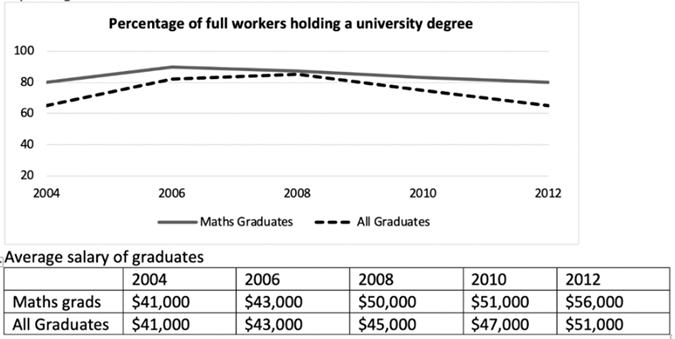
Part 2: The graphs below show the percentage of Maths graduates and all graduates who got full time job after graduating from a university in Australia and also show the average salary of both these types of graduates, from 2004 to 2012. Summarize the information by selecting and reporting the main features, and make comparisons where relevant. You should write about 150 words. (15 points)
...................................................................................................................................................
...................................................................................................................................................
...................................................................................................................................................
Part 3: (30 points) Write an essay of about 350 words about the following topic:
“Information about current affairs in newspapers and in the media is often biased or inaccurate, with the result that we have difficulty identifying the truth.
How much do you agree with this statement? Do you think people should be trained to use critical thinking when reading or listening to the news?”
Give reasons for your answer and include any relevant examples from your knowledge or experience.
...................................................................................................................................................
...................................................................................................................................................
...................................................................................................................................................
THE END
................................
................................
................................
Xem thêm đề thi học sinh giỏi Tiếng Anh lớp 11 hay khác:
Đề thi học sinh giỏi Tiếng Anh 11 trường THPT Chuyên Lê Quý Đôn (Điện Biên) năm 2023-2024
Đề thi học sinh giỏi Tiếng Anh 11 trường THPT Chuyên Bảo Lộc (Lâm Đồng) năm 2024
Đề thi học sinh giỏi Tiếng Anh 11 trường THPT Chuyên Lào Cai (Lào Cai) năm 2023-2024
Đề thi học sinh giỏi Tiếng Anh 11 trường THPT Chuyên Lê Hồng Phong (Nam Định) năm 2024
Đề thi học sinh giỏi Tiếng Anh 11 trường THPT Chuyên Lam Sơn (Thanh Hóa) năm 2024
Đề thi học sinh giỏi Tiếng Anh 11 trường THPT Chuyên Lê Khiết (Quảng Ngãi) năm 2024
TÀI LIỆU CLC DÀNH CHO GIÁO VIÊN VÀ PHỤ HUYNH LỚP 9
Bộ giáo án, bài giảng powerpoint, đề thi file word có đáp án 2026 tại https://tailieugiaovien.com.vn/
Hỗ trợ zalo: VietJack Official
Tổng đài hỗ trợ đăng ký: 084 283 45 85
 Đề thi vào 10 các sở Hà Nội, Tp. Hồ Chí Minh...
41 tài liệu
Đề thi vào 10 các sở Hà Nội, Tp. Hồ Chí Minh...
41 tài liệu
 Giáo án Word 9
95 tài liệu
Giáo án Word 9
95 tài liệu
 Đề thi giữa kì, cuối kì 9
254 tài liệu
Đề thi giữa kì, cuối kì 9
254 tài liệu
 Chuyên đề dạy thêm Toán, Lí, Hóa... 9
71 tài liệu
Chuyên đề dạy thêm Toán, Lí, Hóa... 9
71 tài liệu
 Đề thi HSG 9
8 tài liệu
Đề thi HSG 9
8 tài liệu
 Bài giảng Powerpoint 9
42 tài liệu
Bài giảng Powerpoint 9
42 tài liệu
Công cụ giáo viên (2048.VN)
Tạo- trộn đề thi miễn phí từ file PDF, Word, Giao bài nhanh chóng, Hoàn toàn Free
Bộ đề thi các lớp các môn học được Giáo viên nhiều năm kinh nghiệm tổng hợp và biên soạn theo Thông tư mới nhất của Bộ Giáo dục và Đào tạo, được chọn lọc từ đề thi của các trường trên cả nước.
- Đề thi lớp 1 (các môn học)
- Đề thi lớp 2 (các môn học)
- Đề thi lớp 3 (các môn học)
- Đề thi lớp 4 (các môn học)
- Đề thi lớp 5 (các môn học)
- Đề thi lớp 6 (các môn học)
- Đề thi lớp 7 (các môn học)
- Đề thi lớp 8 (các môn học)
- Đề thi lớp 9 (các môn học)
- Đề thi lớp 10 (các môn học)
- Đề thi lớp 11 (các môn học)
- Đề thi lớp 12 (các môn học)
- Giáo án lớp 1 (các môn học)
- Giáo án lớp 2 (các môn học)
- Giáo án lớp 3 (các môn học)
- Giáo án lớp 4 (các môn học)
- Giáo án lớp 5 (các môn học)
- Giáo án lớp 6 (các môn học)
- Giáo án lớp 7 (các môn học)
- Giáo án lớp 8 (các môn học)
- Giáo án lớp 9 (các môn học)
- Giáo án lớp 10 (các môn học)
- Giáo án lớp 11 (các môn học)
- Giáo án lớp 12 (các môn học)