Đề thi HSG Tiếng Anh 11 trường THPT Chuyên Lê Quý Đôn (Điện Biên) năm 2023-2024
Bài viết Đề thi học sinh giỏi Tiếng Anh 11 trường THPT Chuyên Lê Quý Đôn, tỉnh Điện Biên năm 2023-2024 đề xuất cho kì thi HSG Tiếng Anh 11 các trường THPT Chuyên khu vực Duyên hải và Đồng bằng Bắc Bộ. Mời các bạn đón đọc:
Đề thi HSG Tiếng Anh 11 trường THPT Chuyên Lê Quý Đôn (Điện Biên) năm 2023-2024
Chỉ từ 200k mua trọn bộ Đề thi học sinh giỏi Tiếng Anh 11 bản word có lời giải chi tiết:
- B1: gửi phí vào tk:
1133836868- CT TNHH DAU TU VA DV GD VIETJACK - Ngân hàng MB (QR) - B2: Nhắn tin tới Zalo VietJack Official - nhấn vào đây để thông báo và nhận đề thi
|
TRƯỜNG THPT CHUYÊN LÊ QUÝ ĐÔN - ĐIỆN BIÊN Đề đề xuất (Đề thi gồm 20 trang) |
ĐỀ THI CHỌN HỌC SINH GIỎI KHU VỰC DUYÊN HẢI VÀ ĐỒNG BẰNG BẮC BỘ Năm học 2023 – 2024 MÔN TIẾNG ANH- LỚP 11 Thời gian làm bài: 180 phút |
I. LISTENING (50 POINTS)
HƯỚNG DẪN PHẦN THI NGHE HIỂU
• Bài nghe gồm 4 phần; mỗi phần được nghe 2 lần, mỗi lần cách nhau 10 giây; mở đầu và kết thúc mỗi phần nghe có tín hiệu.
• Mở đầu và kết thúc bài nghe có nhạc hiệu. Thí sinh có 2 phút để hoàn chỉnh bài trước nhạc hiệu kết thúc bài nghe.
• Mọi hướng dẫn cho thí sinh đã có trong bài nghe.
Part 1: For questions 16-20, listen to a lecture about a science experiment and decide whether the following statements are True (T) or False (F) according to what your hear. (10 points)
Bài nghe:
1. The pitch drop experiment is the oldest experiment that is still running today.
2. The creator of the experiment wanted to show that common substances have extraordinary properties.
3. Pitch is a substance that looks liquid but is actually solid.
4. The first time a drop of pitch fell was three years after the experiment began.
5. In the year 2000, an electricity failure meant the pitch drop was not filmed.
Part 2. For questions 6 – 10, listen to a radio program about the importance of morning light to our health and answer the questions. Write NO MORE THAN THREE WORDS taken from the recording for each answer. Write your answers in the corresponding numbered boxes provided. (10 pts)
Bài nghe:
6. What kind of news did the man see that made him decide to start his business?
7. What is the name of the industry the man is in?
8. How much air can you buy for $115?
9. Where does the entrepreneur live now?
10. What does the man sometimes have to go to the bottom of to get air?
Part 3. For questions 11 – 15, listen to a conversation between two students, who are planning an oral report for the History class and choose the correct answer A, B, C, or D which fits best according to what you hear. Write your answers in the corresponding numbered boxes provided. (10 pts)
Bài nghe:
11. How is the programme designed to help youngsters?
A. By getting them to talk about their feelings
B. By encouraging them to loosen up
C. By enabling them to convey their thoughts
D. By giving them a way to entertain themselves
12. When talking about the nature of communication, Alice reveals that______.
A. teenagers are quick to react to a number of emotions
B. people who learn to show how they feel can articulate better
C. shy youngsters find the programme more useful than others
D. young people have a lot of pent-up negative emotions
13. What aspect of the programme encourages teenagers to face their troubles?
A. The social side of dance
B. The freedom of the movement
C. The obligation to interact
D. The release of feelings
14. Alice contrasts professional and amateur dancers in order to ______.
A. highlight the usefulness of the programme
B. emphasise the use of emotions in dance
C. illustrate the difference between teaching styles
D. explain the ability to recognise feelings
15. What point does Alice make about the study into a person’s personality?
A. It found that certain types of people dance better than others.
B. Personality has a bearing on people’s willingness to participate.
C. Who people are can be recognised through their movements.
D. It revealed that most people try to hide their true nature.
Part 4. For questions 16 – 25, listen to a programme about James Webb Space Telescope and complete the following sentences. Write NO MORE THAN THREE WORDS taken from the recording for each blank. Write your answers in the corresponding numbered boxes provided. (20 pts)
Bài nghe:
Over the last 30 years, Hubble has (16) _____________ our view of the universe. This space telescope allows us to see the formations of the (17)____________ like our own Milky Way and other (18) __________ will also come into view, revealing the life on other planets.
Scientists believe that the first stars will be really massive, (19)____________ and really brightly, and dying very soon, potentially with a massive explosion. They really hope this telescope does wonders.
The space telescope provides us with the deepest view of the cosmos. It is regarded as a (20)__________. Its size helps identify the (21) ____________ coming from the farthest stars.
The light from the telescope comes in any of the bottom, here you can see a (22) ____________ covering the entrance aperture. We'll be able to watch the first (23) ____________, the first objects and stars growing up after the Big Bang.
Owing to its huge size, the telescope has to be folded up to fit (24) ____________ to travel into space, which is extremely challenging. There were 300 points where it could go wrong and it is too far to be repaired. However, scientists believe that the risk deserves the enormous benefits it would bring. Thus, they are yearning to make a breakthrough.
Attempts to discover unseen portions of the cosmos and address some of humanity's most complicated scientific problems are the most (25) _____________.
II. LEXICO – GRAMMAR (30 POINTS)
Part 1. For questions 26-45, choose the correct answer A, B, C, or D to each of the following questions. Write your answers in the corresponding numbered boxes provided. (20 pts)
26. Sociologists say that element of violence is ______ in all societies.
A. latent
B. skulking
C. passive
D. potential
27. Owing to the heavy traffic on the road to the airport, it was _____ whether we would be in time to catch our plane.
A. win or lose
B. touch and go
C. come and go
D. on and off
28. Not until ________ been made safe ________ go back inside.
A. had the building/ could anyone
B. had the building/ anyone could
C. the building had/ anyone could
D. the building had/ could anyone
29. In Aboriginal Australia, mythology is a cultural treasure, ________ from one generation to the other.
A. passed round
B. passed on
C. passed over
D. passed through
30. When we got to the island, we realized that the water was not safe to drink and that we________ have brought water purification tablets.
A. would
B. must
C. could
D. should
31. Paul has the ___________ habit of picking his nose in public, which causes much annoyance to the people around.
A. atrocious
B. monstrous
C. disastrous
D. flagitious
32. It took the negotiation all weak to ___________ the final terms of the settlement.
A. bog down
B. nail down
C. tie down
D. wind down
33. In the underworld, people only recognize the ___________ of the jungle and totally ignore what justice is.
A. rule
B. law
C. order
D. terms
34. _______ by venting about all the reasons you’re leaving is not a good idea when you do decide to quit your job.
A. Burning bridges
B. Wagging the dog
C. Giving yourself airs
D. Passing the buck
35. ______ the invention of the steam engine, most forms of transport were horse-drawn.
A. Akin to
B. Prior to
C. In addition to
D. With reference to
36. Anthropologists usually study simple, unindustrialized societies because the number of _____ is limited.
A. variables
B. varieties
C. variations
D. variants
37. I _____ it to him that he wasn’t telling the truth but he insisted that he was.
A. brought
B. laid
C. set
D. put
38. Elena is a _____ talented singer and has already had three successful albums.
A. remarkably
B. perceptibly
C. deeply
D. absolutely
39. They lived in a thatched cottage in a _____ village in the heart of the English countryside.
A. dense
B. conventional
C. lush
D. quaint
40. The unpopular prime minister was _______ in the press when she tripped while walking in a muddy field.
A. slandered
B. lampooned
C. hounded
D. stalked
41. We have a _______ tradition in my house of opening one present the night before Christmas.
A. level-headed
B. deep-seated
C. time-honoured
D. sharp-tongued
42. _______ , the diners settled the bill and left the restaurant.
A. Having hunger satisfied
B. Their hunger satisfied
C. Hunger been satisfied
D. Satisfying their hunger
43. After months of trying to find a cheap flat in the centre of town, he’s finally _______ in the sponge.
A. thrown
B. swept
C. cleared
D. polished
44. The delight in treasure finding doesn’t always ______ acquiring tremendous amounts of valuables.
A. dwell on
B. poke around
C. lay about
D. hinge upon
45. ______, the strollers can take another road.
A. If need be
B. When it must
C. We might as well
D. Come what may
Part 2. For questions 46- 55, write the correct form of each bracketed word in the numbered space provided. (10 pts)
46. Of course you can put a whole chunk of cheese on the bread if you like but I would prefer to ______________ it. (LIQUID)
47. The clergy spent 9 years in Africa as ______________, teaching about Christianity for the people. (MISSION)
48. His secret financial activities made him vulnerable to______________. (MAIL)
49. These garments could be worn ______________ by men and women. (CHANGE)
50. They respond to questions from broadcasters with a nauseating mixture of arrogance and______________. (RIGHT)
51. The investigator said the killings were the result of poor procedure by trigger-happy police rather than ______________ murder. ( MEDIATE)
52. The one thing that can be said in favour is that it sends vegans and animal rights activists ______________ with rage. (CANDLE)
53. Sometimes a sympathetic friend can be a constant source of discouragement, all ______________. (KNOW)
54 I really believe that it would be a major mistake to ______________ any drugs that are currently illegal. (CRIME)
55. In the old days, buyers and sellers had to look through hundreds of ______________ each week and go to car boot sales at the weekend. (CLASS)
III. READING (60 POINTS)
Part 1. For questions 56 - 65, read the text below and fill in each blank with ONE suitable word. Write your answers in the corresponding numbered boxes provided. (15 pts)
It is thought that around 12,000 years ago the Earth’s climate became relatively milder or more temperate, (56)__________ for a greater variety of plant life. Those early humans leading a (57)__________ life, who hunted and gathered food where they happened to find it, began to supplement their diet (58)__________ wild grasses such as wheat and barley.
Noticing how discarded seeds and roots later germinated and (59)__________ may have been what decided the first farmers to settle down and cultivate crops. We know that farmers in the Stone Age had discovered pulses – beans, peas, lentils, and so on – which they mashed up and ate (60)__________ a kind of porridge. Later they learn to (61)__________ sheep and goats, developing tamer and manageable (62)__________ of these and other animals. In addition to that, they also discovered how to use the process of (63)__________ for brewing and making bread.
It was some time later (64)__________ farmers noticed that the amount of crops produced declined if they were always grown in the same ground and, by the 1st century, Romans were (65)__________ crops with pasture for grazing animals to restore the soil’s fertility. This practice was followed in medieval England where the fields were divided into strips, planting cereals and vegetables, and the land left uncultivated one year in three.
Part 2. For questions 66-75, read an article on Ancient Angkor choose the answer A, B, C, or D which you think fits best according to the text. Write your answers in the corresponding numbered boxes provided. (10 pts)
Ancient Angkor
In the regions of Southeast Asia dwell the remains of an era that far exceeded its time in developments and industrialization. This ancient city, which was mysteriously deserted in the 15th century, is known as Angkor. Located in Cambodia, Angkor was established in 802 CE as the seat of the Khmer Empire. Khmer was the largest continuous empire in Southeast Asia. Its main city of Angkor grew and developed until it was abandoned in the year 1431. Many historians theorize as to why it was abandoned, but the mystery remains.
Angkor was a city of power, industry, architecture, and cultural unity, which is why speculation surrounds its decline. The ancient Khmer city stretched over an area of nearly 120 square miles, comparable to present-day Los Angeles. Each successive ruler to the throne brought significant additions that diversified the territory. One ruler is known for constructing a baray, a massive water reservoir. Another built the imposing Angkor Wat, a temple of great proportions that survived the city’s demise and exists today as a Buddhist temple. Along with over seventy other temples in the region, Angkor was home to an expansive waterworks of marked ingenuity when nothing of its kind existed in the world. The civilization was structured around the Mekong River. Intricate and sophisticated irrigation systems were fashioned to transport water to people and fields in all parts of the city, including those removed from the central water source. For this, the city became known as the “Hydraulic City.” The people of Angkor were led by an extensive court system, made up of religious and secular nobles as well as artisans, fishermen, rice farmers, soldiers, and elephant keepers. The civilization was guarded by an army transported by elephants and ruled by shrewd and powerful kings. Yet after 600 years of existence, an abandoned shell was all that remained.
The land, buildings, and architecture were reclaimed by the surrounding forest regions until the 19th century, when French archaeologists discovered the remains and began restoring sites in the great city of Angkor. Since then, theories have evolved over time relating to the death of Angkor’s civilization. The first theory states that the city fell because of war. The last two centuries of Angkor’s existence showed a decline in the Khmer Empire’s population and power. Ongoing wars with neighboring Thailand had devastated the nation. In 1431, attackers from Thai nations invaded and looted Angkor, leaving it desolate and vacant. Continuous war with Thailand culminating in a final attack on the city could have weakened the empire and led to the city’s demise.
Another theory states that a change in religion led to the country’s downfall. The Khmer Empire had predominately been a Hindu nation, and the people were unified in their religion. Jayavarman VII, acclaimed as the greatest of Angkor’s kings, took the throne in 1181 CE. He instituted a change in religion from Hinduism to Mahayana Buddhism. This action subsequently could have destroyed the unity of the people and the overall foundation of the empire.
(A) Natural disaster in another feasible possibility for the scattering of people from the Angkor region. (B) Historians say earthquakes, floods, and drastic climate changes would have been capable of stripping Angkor of its people. (C) One researcher hypothesized that the city suffered from a lack of water due to the transition from the medieval warm period to the little ice age. Others dismiss this idea. (D)
However, a recently developed theory built on the work of French archaeologist Bernard-Philippe Groslier may have shed the most light on Angkor’s demise. The theory suggests that the Angkorian civilization was “defined, sustained, and ultimately overwhelmed by over-exploitation and the environmental impacts of a complex water-management network.” Its vast waterworks proved too great for the city to manage. Also, supplying such a massive empire with water had adverse effects on the environment. Ecological problems included deforestation, topsoil degradation, and erosion due in part to clearing vegetation for cropland. Thus, the city inadvertently brought about its own environmental collapse.
With the use of aerial photography and high-resolution, ground-sensing radar, researchers were able to support Groslier’s theory with images that complete existing topographical maps. The radar detected surface structures as well as subtle variances in surface vegetation and soil moisture. This proved that environmental erosion had occurred. The combined images and ground-based investigations further revealed that Angkor was a victim of its own industrial ingenuity, a city ahead of its time and vulnerable to its own power.
66. The author mentions the Khmer Empire in paragraph 1 in order to ________.
A. establish the size and importance of the civilization
B. explain the downfall of the main city in the empire
C. compare the nation’s size to a present-day location
D. demonstrate why people were not loyal to the city
67. The word “speculation” in the passage is closest meaning to________.
A. evidence
B. mystery
C. question
D. growth
68. According to paragraph 2, which of the following is true about the waterworks built within Angkor?
A. They transported drinking water to Angkor Wat.
B. They were a money-making venture for the city.
C. They were built to extend the water supply.
D. They irrigated fields along the sides of the river.
69. All of the following are true about the city of Angkor EXCEPT_______.
A. It was built around a water source.
B. It had an advanced road system.
C. It surpassed other cities of its time.
D. It is home to a Buddhist shrine.
70. The word “its” in the passage refers to_______.
A. Angkor’s
B. baray’s
C. waterworks’
D. home’s
71. Which of the sentences below best expresses the essential information in the highlighted sentence? Incorrect choices may change the meaning in important ways or leave out essential information.
A. Archaeologists built a replica of what Angkor looked like.
B. Archaeologists uncovered the overgrown city and rebuilt its sites.
C. Finding the city, workers cleared the forest and studied the architecture.
D. The city’s architecture was inspired by the forest regions nearby.
72. What can be inferred from paragraph 4 about the people who inhabited Angkor?
A. They worshipped ruler Jayavarman VII.
B. Hinduism was central to their way of life.
C. Religion led to more violence among them.
D. They were unified regardless of national religion.
73. Look at the four squares [...] that indicate where the following sentence could be added to the passage
“These natural catastrophes would have likely resulted in destroyed buildings, ruined cops, and a decreased water supply that would have forced citizens to leave.”
Where would the sentence best fit?
A. first square
B. second square
C. third square
D. fourth square.
74. The word “inadvertently” in the passage is closest in meaning to ________.
A. purposely
B. freely
C. sadly
D. accidentally
75. According to paragraph 7, which of the following did researchers prove about Groslier’s theory with the use of aerial photography and advanced radar?
A. The surface soil showed evidence of dirt washing away.
B. The waterworks were filled with topsoil.
C. Vegetation was thriving where soil was deeper.
D. Soil damage was stable throughout the changes.
Part 3. Read the following passage and do the tasks that follow. (13 pts)
AFRICAN COINS
A. A In 1770, the explorer James Cook landed on the east coast of Australia and claimed the territory for Great Britain. It seems that, contrary to popular myth, he may not actually have been the first European to set foot on the continent. A new expedition, led by an Australian anthropologist, is investigating the possibility that ancient exploration may have taken place long before Cook and other Europeans ever journeyed to the continent. The expedition will follow a seventy-year-old treasure map to a sandy beach where a cache of mysterious ancient coins was discovered in the 1940s. The researchers are setting out to discover how the coins ended up in the sand; whether they washed ashore following shipwrecks and whether they can provide more details about ancient trade routes.
B. The coins were originally found by an Australian soldier named Maurie Isenberg, who was stationed in a remote area known as the Wessel Islands. The Wessel Islands are part of Arnhem Land, a region in Australia's vast Northern Territory. Isenberg was assigned to a radar station located on the Wessel Islands, and during his off-duty hours, he often went fishing along the idyllic beaches. One day in 1944, he came across a few old coins and put them in a tin. He marked the spot where he'd found the coins with an X on a hand-drawn map, but didn't think that he'd unearthed anything of great note.
C. Indeed, it wasn't until 1979 that Isenberg sent the coins to be authenticated and learned that some of them were estimated to be of great age. As it turned out, five of them had been produced in the sultanate of Kilwa in East Africa and are thought to date back to the twelfth century. Kilwa was a prosperous trading centre in those days, located on an island that is part of present-day Tanzania. Australian anthropologist Mike Owen, a heritage consultant in Darwin, is leading the upcoming expedition, and he says that the coins, 'have the capacity to redraft Australian history'. The copper coins, which were seldom used outside of East Africa, probably held very little monetary value in Kilwa: 'Yet, there they were - on a beach ten thousand kilometres to the east.'
D. Along with the African coins, there were a number of seventeenth and eighteenth-century Dutch coins in the cache of the type known as duits. The first record of European activity in the islands actually dates back to 1623, when sailors aboard a Dutch ship called the Wesel gave the islands their current name. However, oral history from the indigenous Yolngu people who inhabit the islands suggests that they played host to many visitors over the centuries. The expedition's main researcher is Australian anthropologist Dr Ian Mcintosh, who has spoken in depth with the Yolngu people. 'There was much talk of the Wessel Islands as a place of intense contact history,' he says.
E. Mcintosh points out that Northern Australia may have drawn early visitors because it lies close to the terminus of the ancient Indian Ocean trade route that linked Africa's east coast with Arabia, Persia, India and the Spice Islands (now part of Indonesia). 'This trade route was already very active, a very long time ago, and this find may be evidence of early exploration by peoples from East Africa or the Middle East.' According to Mcintosh, the shape of the Wessel Islands serves as a 'big catching arm' for any ships blown off course, which may point to the coins coming from a shipwreck, or even multiple shipwrecks.
F. It is difficult to tell whether there was routine contact with the outside world or whether there is any connection between the Dutch coins and the far older African coins, which may simply have ended up in the same place, but it is hoped that more evidence may come to light. Adding to the sense of anticipation is a persistent rumour that, in one of the many caves in the islands, there are more coins and antique weaponry.
G. The expedition is sponsored by the Australian Geographic Society and intends to follow the hand-drawn map given to them by Isenberg. Included in the team is a geomorphologist, whose task is to examine how the coastal landscape has changed over time. If shipwrecks are involved, how the coins washed up may provide clues to the location of a wreck, say the experts. Meanwhile, a heritage specialist has the job of looking after the documentation and ensuring that the site is protected, and anthropologists working with local indigenous people hope to identify likely sites of contact with foreign visitors. 'There is great interest on the part of the Yolngu in this project, and in uncovering aspects of their own past,' says Mcintosh.
For questions 76-82, choose the correct heading for paragraphs A-H from the list below. Write the correct number i – xi in the corresponding numbered boxes provided.
List of Headings
i A possible explanation for why a discovery was made in a particular location
ii A recent study casts doubt on an accepted interpretation of events
iii Analysis reveals the origins of objects discovered by chance
iv Documentary evidence that supports the study's initial findings
v How the current study is going to be organised
vi Evidence suggesting that traders once lived on the Wessel Islands
vii A long-standing suggestion that further discoveries are possible
viii The significance of a chance discovery goes undetected
ix The aims of the current study
x Written and anecdotal evidence of early trade in the region
For questions 83- 88, complete the sentences below. Choose NO MORE THAN THREE WORDS AND/OR A NUMBER from the passage for each answer. Write your answers in the space provided.
83. Maurie Isenberg first discovered the coins in the year
...................................................................................................................................................
84. The African coins which Isenberg found w ere made of
...................................................................................................................................................
85. The African coins are thought to have been made in the
...................................................................................................................................... century.
86. The later coins Isenberg found are called
...................................................................................................................................................
87. The islands where Isenberg found the coins are named after a
...................................................................................................................................................
88. Local people think there may be
................................................................................................................ as well as more coins on the islands.
Part 4. For questions 89 - 95, read an extract from a magazine article. Seven paragraphs have been removed from the extract. Choose from the paragraphs A-H the one which fits each gap. There is one extra paragraph which you do not need to use. Write your answers in the corresponding numbered boxes provided. (7 pts)
Making the world a better place, one controversy at a time
In 2008, renegade Greenpeace activists Junichi Soto and Toru Suzuki seized a container of whale meat from a delivery depot in Aomori Prefecture, Japan. They believed that the meat was procured from government whaling research and was destined for sale in Japanese restaurants, a practice publicly condemned by the Japanese government. The confiscation sparked controversy for the government, which hastened a cover-up, characterising the meat as 'a souvenir' of the whalers. However, it was the fate of Soto and Suzuki which seemed particularly unjust.
89 |
The pair didn't expect to be celebrated for uncovering the government scandal, but they were nonetheless surprised by the outcome of their actions. Ultimately the men were sentenced to one year in prison, which the judge mercifully suspended for three years. Unfazed, Sato expressed no regrets. 'Because of our case, many inside Japan are now aware of the whaling industry's kickbacks and embezzlement,' he remarked in an article he wrote for a British newspaper.
90 |
In an attempt to bypass regulations, the government stipulated that the exploration could only be funded by sales of whale meat. But few had the wool pulled over their eyes and fleets of Greenpeace vessels showed up to confront the Japanese whaling ships. Dramatic scenes of ships a tenth the size of the government's fleet were broadcast in the news. Only years later did the Japanese government finally curtail their 'research', partly due to the Tokyo Two's expose, and partly because of Greenpeace's involvement.
91 |
Dubbed the 'Don't Make a Wave' campaign, the activists reached the US coastguard ship Confidence, which ordered them to retreat. The mission went ahead as planned, and although disheartened, the activists learnt that their endeavours had garnered worldwide attention. In realising that such extreme measures can have a global impact, the group began raising funds in order to campaign for environmentalism. Greenpeace was born.
92 |
One such incident involved the Nazca lines in Peru. In an attempt to hang a banner protesting against climate change, activists damaged the UNESCO World Heritage site by walking on an area not open to the public and leaving visible footprints. The organisation was forced to issue an apology, one Peruvian officials were unwilling to accept.
93 |
While it may hold firmly to perhaps unpopular positions such as this, there is no doubt that Greenpeace strives to do good. Their mission centres around achieving a number of goals related to climate change, which tops their list, but also the protection of natural habitats, the fight against deforestation, nuclear disarmament and the promotion of sustainable agriculture.
94 |
Aside from the corporations and government entities that they attack, Greenpeace has political opponents who try to slander or spy on them. Activists have claimed that their phones have been tapped and some have received threats on their lives. Although ultimately cleared of fraud, at one point its American subsidiary was accused of misreporting tax statements to the US government.
95 |
What is certain is that they will continue to wage war against those who bring harm to the planet. But it's clear amongst Vancouver natives, in the city where the organisation was founded, that there exists great pride in its legacy. In the spirit of how it was founded - by a group of individuals - there are few places where you wouldn't meet a local who would make the spurious claim, 'Sure, I helped found Greenpeace.
Missing paragraphs
A. Sloppy mistakes aside, the organisation has also come under criticism for its specific positions. In the case of genetically modified foods, a practice Greenpeace is vehemently against, 107 Nobel laureate scholars actually penned a letter to Greenpeace urging it to change its stance. They cited scientific evidence of the benefit of GM foods for farmers and consumers alike, and that not one single negative incident has resulted from the cultivation and consumption of such products.
B. In fact, media outlets the world over have given Greenpeace an enormous amount of attention for its outlandishstunts. In one case, members produced a fake website for an oil company with articles about their inauguraldrilling in the Arctic. The website fooled many people and was a blatant criticism of the oilcompany's practices,but critics were quick to pounce on its misleading premise.
C. A report was filed in 2006 by a public watchdog suggesting that the company was exploiting its status asanon-profit organisation and falsifying its financial returns. Greenpeace was audited, but its books turned up clean.Subsequently, it was disclosed that the watchdog who blew the whistle had accepted a substantial donation froma gas and oil corporation, one of the entities Greenpeace fights against.
D. The organisation was founded upon its ability to directly confront its opponents. Across the globe in Alaska some decades before the whaling incident, a group of Canadian activists sailed to Amchitka, an island in Alaska's Aleutian island chain. The US government intended to detonate an atomic bomb on the uninhabited island, ignoring warnings of seismic activity and the tsunamis it could trigger.
E. Although they have cut back considerably on their presence in the Antarctic Ocean, Greenpeace's efforts to protect these majestic sea mammals stretches back decades. The organisation, which began in 1971, embarked in the mid-1980s on a mission to establish Antarctica as a world park. Although eventually successful, when Japan's whaling fleet appeared in the late 1980s under the guise of 'scientific research', it was clear a loophole had been exploited.
F. Predictably, they have faced some criticism, as underscored by the Tokyo Two incident. Lawsuits have beenfiled against them for destroying fields of genetically modified crops and harassing fishing expeditions. Theyentered into a row with the Finnish government when they transported the trunk of a fallen tree to exhibitions tohighlight the negative effects of logging there. And occasionally, the organisation's members make blunders thatsully Greenpeace's image.
G. Although the police launched an investigation into the whalers’ actions, no charges were brought against them.Instead, they charged the activists and even mistreated them during their detention. The pair were denied legalrepresentation and interrogated for a relentless 12 hours. The activists were even branded as terrorists andegregiously compared to a doomsday cult that released poisonous gas in a Tokyo underground station.
H. As a testament to their work on these issues, Greenpeace successfully raised awareness of global warming in the 1990s. They clearly had an impact on the Japanese whaling industry, as the fleets have all but left Antarctica. Their revelations that major corporations were linked to tropical rainforest destruction resulted in policy changes in those companies. Their efforts in ridding the world of weapons of mass destruction and stopping the genetic modification of crops has so far been less successful.
PART 5. Questions 96- 105. Read four album reviews from a world music website and answer the questions by writing the correct reviews A-D in the corresponding numbered boxes. The reviews may be chosen more than once. (15 pts)
WORLD MUSIC REVIEWS: ARTISTS and ALBUMS
A. WatCha Clan: Diaspora Hi-Fi - A Mediterranean Caravan
The album begins with a scrambled montage of voices and Arabic strings and percussion; right away, the listener is projected into a mix of dance floor sounds. This is fusion music, dubbed and electroed. Watcha Clan put forward a dilemma: can diverse influences result in a harmonious whole? Or does it just end up as a mish-mash of indistinguishable sound? They certainly add a rich variety of flavours to the dominant rhythms.
Some people can't get enough of vocalist Sista K's unusual voice, but for others even a little is too much. Nassim Kouti sometimes accompanies her on vocals and guitar. One of these tracks is the haunting 'Ch'ilet La'Yani'. The beginning of ‘Oued El Chotili’ is equally tranquil and briefly entrances before the reggae beat takes over, powered by Moroccan castanets. The song stands out on the album because the really impressive combination of styles works so well. This doesn't always happen on other tracks, but watching the bonus video makes you realise what this band is all about and that they had a lot of fun making this album.
B. Various artists: Nigeria Disco Funk Special
In the 1970s, Lagos was a creative place musically, and would-be artists flocked there from all over Africa to put their very individual spin on imported music. The first number, an instrumental by Sahara All Stars entitled 'Take Your Soul', is bravely funky and strikes just the right opening note. The next outstanding track is by the talented Johnny Haastrup, who gives a great rendition of 'Greetings'. It is hard to understand why he never really made it as a soloist, because this piece is both harmonic and flamboyant.
Sadly, the remaining songs are not in the same league, and you may be disappointed that they lack a truly authentic and traditional feel. Also, the material is mostly instrumental, so there are few singing stars in evidence. But despite this, the album is well worth listening to. It's arranged in an order suitable for clubs, which is doubtless what the artists originally intended.
C. Neco Novellas: Khu Kata
Neco Novellas is a singer-songwriter with immense talent and imposing stage presence. His new album, 'Khu Kata', presents influences of his teenage years in Mozambique. Guest vocalist Lilian Vieira of Zuco 103 enriches the track called 'Vermeiha' which is a successful mix of Brazilian samba and Mozambican pop, while the track called 'Zula Zula' really shows what Novellas can do. But with 'Phumela' things slide downhill for a while, and the lyrics of 'Swile Navo' can only be described as banal.
He returns to form with 'The Train’, which is beautifully arranged and owes an obvious debt to the Hugh Masekeia songbook ('Stimela!'), but the best tracks are the uplifting 'Tikona' and '0 Sol', which truly stand out as the blend of world/jazz fusion that this artis regularly delivers. Nonetheless, 'Khu Kata' would have been improved by more rigorous editing and slightly fewer tracks.
D. Think Of One: Camping Shaabi
Think Of One is truly unique. Over the years, this Antwerp- based group have worked and recorded with a wide range of artists such as Afro-Brazilian percussionists and Inuit throat singers, but for this album, they return to Moroccan themes. The Moroccan effect is apparent straight away in the spellbinding rhythms and voices of the first track, 'J'étais Jetée'. And that's just for starters - the recording goes on to mix diverse sounds and types of music at an astounding speed.
The quality doesn't falter from one track to the next and each track is innovative in its own way. The vintage keyboards and Balkan-style brass section are always there, laying the foundations for the other sounds which are brought in and used around them. In a dazzling combination of Flemish, French, Arabic and English, the band's lyrics also fascinate, some having a serious tone and others being more frivolous, but a singable tune always surfaces.
In which review is the following mentioned?
96. _________ the rapid transition from one source of inspiration to another
97. _________ surprise at an artist’s lack of success in a venture
98. _________ the artists’ obvious enjoyment of the creative process
99. _________ the high standards a performer usually attains in a certain style
100. _________ an opening track which impresses without vocals
101. _________ the problems arising from relying on a multitude of sources
102. _________ the reliance on certain key musical instruments
103. _________ the calm atmosphere created by two tracks on the same album
104. _________ the special contribution of a singer to a blend of sounds
105. _________ tracks sequenced in a way that would reflect the performers’ wishes
IV. WRITING (60 POINTS)
Part 1. Read the following extract and use your own words to summarize it. Your summary should be between 100 and 120 words long. (15 pts)
In the twentieth century, people depend on unlimited energy to power their everyday lives. A wide range of energy-run devices and modern conveniences are taken for granted, and although it may seem that we will never be in danger of living without those conveniences, the fact is that many supplies of energy are dwindling rapidly. Scientists are constantly searching for new sources of power to keep modern society running. Whether future populations will continue to enjoy the benefits of abundant energy will depend on the success of this search.
Coal, oil, and natural gas supply modern civilization with most of its power. However, not only are supplies of these fuels limited, but they are a major source of pollution. If the energy demands of the future are to be met without seriously harming the environment, existing alternative energy sources must be improved or further explored and developed. These include nuclear, water, solar, wind, and geothermal power, as well as energy from new, nonpolluting types of fuels. Each of these alternatives, however, has advantages and disadvantages.
Nuclear power plants efficiently produce large amounts of electricity without polluting the atmosphere; however, they are costly to build and maintain, and they pose the daunting problem of what to do with nuclear wastes. Hydroelectric power is inexpensive and environmentally safe, but impractical for communities located far from moving water. Harnessing energy from tides and waves has similar drawbacks. Solar power holds great promise for the future but methods of collecting and concentrating sunlight are as yet inefficient, as are methods of harnessing wind power.
Every source of energy has its disadvantages. One way to minimize them is to use less energy. Conservation efforts coupled with renewable energy resources, such as a combination of solar, water, wind, and geothermal energy and alternative fuels, such as alcohol and hydrogen, will ensure supplies of clean, affordable energy for humanity’s future.
...................................................................................................................................................
...................................................................................................................................................
...................................................................................................................................................
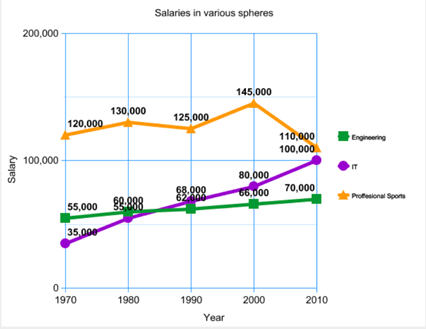
Part 2. The graph shows the change in average salaries across vatious spheres of employment in the US over a period of 40 years.
Summarize the information by selecting and reporting the main features and making comparisons where relevant. You should write about 150 words. (15 pts)
...................................................................................................................................................
...................................................................................................................................................
...................................................................................................................................................
Part 3. Write an essay of about 350 words on the following topic. (30 pts)
Some people say history is one of the most important school subjects. Other people think that, in today’s world, subjects like science and technology are more important than history.
Discuss both these views and give your own opinion.
...................................................................................................................................................
...................................................................................................................................................
...................................................................................................................................................
-----THE END-----
................................
................................
................................
Xem thêm đề thi học sinh giỏi Tiếng Anh lớp 11 hay khác:
Đề thi học sinh giỏi Tiếng Anh 11 trường THPT Chuyên Bắc Giang (Bắc Giang) năm 2024
Đề thi học sinh giỏi Tiếng Anh 11 trường THPT Chuyên Huỳnh Mẫn Đạt (Kiên Giang) năm 2024
Đề thi học sinh giỏi Tiếng Anh 11 trường THPT Chuyên Bảo Lộc (Lâm Đồng) năm 2024
Đề thi học sinh giỏi Tiếng Anh 11 trường THPT Chuyên Lào Cai (Lào Cai) năm 2023-2024
Đề thi học sinh giỏi Tiếng Anh 11 trường THPT Chuyên Lê Hồng Phong (Nam Định) năm 2024
Đề thi học sinh giỏi Tiếng Anh 11 trường THPT Chuyên Lam Sơn (Thanh Hóa) năm 2024
TÀI LIỆU CLC DÀNH CHO GIÁO VIÊN VÀ PHỤ HUYNH LỚP 9
Bộ giáo án, bài giảng powerpoint, đề thi file word có đáp án 2026 tại https://tailieugiaovien.com.vn/
Hỗ trợ zalo: VietJack Official
Tổng đài hỗ trợ đăng ký: 084 283 45 85
 Đề thi vào 10 các sở Hà Nội, Tp. Hồ Chí Minh...
41 tài liệu
Đề thi vào 10 các sở Hà Nội, Tp. Hồ Chí Minh...
41 tài liệu
 Giáo án Word 9
95 tài liệu
Giáo án Word 9
95 tài liệu
 Đề thi giữa kì, cuối kì 9
254 tài liệu
Đề thi giữa kì, cuối kì 9
254 tài liệu
 Chuyên đề dạy thêm Toán, Lí, Hóa... 9
71 tài liệu
Chuyên đề dạy thêm Toán, Lí, Hóa... 9
71 tài liệu
 Đề thi HSG 9
8 tài liệu
Đề thi HSG 9
8 tài liệu
 Bài giảng Powerpoint 9
42 tài liệu
Bài giảng Powerpoint 9
42 tài liệu
Công cụ giáo viên (2048.VN)
Tạo- trộn đề thi miễn phí từ file PDF, Word, Giao bài nhanh chóng, Hoàn toàn Free
Bộ đề thi các lớp các môn học được Giáo viên nhiều năm kinh nghiệm tổng hợp và biên soạn theo Thông tư mới nhất của Bộ Giáo dục và Đào tạo, được chọn lọc từ đề thi của các trường trên cả nước.
- Đề thi lớp 1 (các môn học)
- Đề thi lớp 2 (các môn học)
- Đề thi lớp 3 (các môn học)
- Đề thi lớp 4 (các môn học)
- Đề thi lớp 5 (các môn học)
- Đề thi lớp 6 (các môn học)
- Đề thi lớp 7 (các môn học)
- Đề thi lớp 8 (các môn học)
- Đề thi lớp 9 (các môn học)
- Đề thi lớp 10 (các môn học)
- Đề thi lớp 11 (các môn học)
- Đề thi lớp 12 (các môn học)
- Giáo án lớp 1 (các môn học)
- Giáo án lớp 2 (các môn học)
- Giáo án lớp 3 (các môn học)
- Giáo án lớp 4 (các môn học)
- Giáo án lớp 5 (các môn học)
- Giáo án lớp 6 (các môn học)
- Giáo án lớp 7 (các môn học)
- Giáo án lớp 8 (các môn học)
- Giáo án lớp 9 (các môn học)
- Giáo án lớp 10 (các môn học)
- Giáo án lớp 11 (các môn học)
- Giáo án lớp 12 (các môn học)