Đề thi HSG Tiếng Anh 11 trường THPT Chuyên Bắc Giang (Bắc Giang) năm 2024
Bài viết Đề thi học sinh giỏi Tiếng Anh 11 trường THPT Chuyên Bắc Giang, tỉnh Bắc Giang năm 2024 đề xuất cho kì thi HSG Tiếng Anh 11 các trường THPT Chuyên khu vực Duyên hải và Đồng bằng Bắc Bộ. Mời các bạn đón đọc:
Đề thi HSG Tiếng Anh 11 trường THPT Chuyên Bắc Giang (Bắc Giang) năm 2024
Chỉ từ 200k mua trọn bộ Đề thi học sinh giỏi Tiếng Anh 11 bản word có lời giải chi tiết:
- B1: gửi phí vào tk:
1133836868- CT TNHH DAU TU VA DV GD VIETJACK - Ngân hàng MB (QR) - B2: Nhắn tin tới Zalo VietJack Official - nhấn vào đây để thông báo và nhận đề thi
|
TỈNH BẮC GIANG TRƯỜNG THPT CHUYÊN BẮC GIANG (Đề thi đề xuất) |
KỲ THI CHỌN HỌC SINH GIỎI CÁC TRƯỜNG THPT CHUYÊN KHU VỰC DUYÊN HẢI VÀ ĐỒNG BẰNG BẮC BỘ LẦN THỨ XVI, NĂM 2024 ĐỀ THI MÔN: TIẾNG ANH - LỚP 11 Thời gian: 180 phút (Đề thi gồm có 20 trang, gồm .....câu) Ngày thi: 16/7/2024 |
SECTION 1: LISTENING (50 points)
Part 1. You will hear part of a radio discussion about iris recognition system. Decide whether following statements are True (T), False (F) or Not Given (NG). (10 pts)
Bài nghe:
1. To treat a variety of ailments, the biohackers have officially used poo of other people as medicine.
2. The immune system is an organ whose components can move around your body.
3. Our body automatically sends clear signals for us to improve our immune systems.
4. There are certain pills that can restore and boost our immune response for us to stay healthy.
5. Vaccination allows us to effectively and safely manipulate our immune responses.
Part 2. Listen to the recording and answer the questions. Write NO MORE THAN THREE WORDS taken from the recording for each answer in the corresponding numbered boxes provided. (10 pts)
Bài nghe:
1. What made people wait for eight hours to spend a short time with?
____________________________________________________________
2. Who did the Prince and Princess of Wales said thank you to?
____________________________________________________________
3. Besides the feeling of grief, what were the other feelings that King Charles have to face in public?
____________________________________________________________
4. Besides the audience, ministers who else did the reporter also see?
____________________________________________________________
5. What would King Charles host with the presence the world's leaders at the Adrian Buckingham Palace?
____________________________________________________________
Part 3. You will hear part of a radio discussion with Ellen Harrington of the Meadow Lane Residents Group, and Tim Barlow from Carton Town Planning Department. Choose the correct answer (A, B, C or D) which fits best according to what you hear. (10 pts)
Bài nghe:
1. What was Ellen's first reaction when the town centre was closed to traffic?
A. She was terrified.
B. She was miserable.
C. She was delighted.
D. She was suspicious.
2. The mood of the Meadow Lane residents can best be described as ____________.
A. resigned
B. dissatisfied
C. furious
D. dejected
3. How does Tim feel about the changes in the town centre?
A. He regrets they were made so quickly.
B. He believes they were inevitable.
C. He thinks the town council should have foreseen the problem.
D. He is proud the town council went forward with them.
4. What does Tim think about the protest Ellen's group is planning?
A. He doesn't think it will accomplish anything.
B. He thinks it is not aimed at the right people.
C. He doesn't think drivers will be affected.
D. He thinks it will be dangerous.
5. What does Ellen think will make the protest effective?
A. the amount of publicity it will generate
B. the inconvenience it will cause to drivers
C. the number of demonstrators who will take part
D. the forthcoming election
Part 4. Listen to a piece of news and fill in the gaps using no more than THREE WORDS OR NUMBER for each blank. (20 pts)
Bài nghe:
Recently in the Great Pyramids, a 100-feet long space, which is called a (1) ____________, has been discovered lately. According to “The Nature”, this is a significant discovery to archaeology because since the 1800s, there has been no other significant discovery like this (2) ____________. However, whether this can help to unravel the ancient mysteries is (3) ____________. There is no proof that a/an (4) ____________or burial chamber can be found from this space. There may be more others like this in the pyramid and this discovery is expected to help the researchers find out how it was built. To identify this space, not allowed to (5) ____________or use cameras, they had to take use of some appliances to track (6) ____________inside the structure. That’s not the only way the modern technology is helping archaeologists.
Adam Low, an archaeologist, admitted to being a man with (7) ____________the tomb of a Pharaoh, Seti I. It can be learnt from the tomb how ancient people have different thoughts, different values and (8) ____________. He can read the way they thought through the (9) ____________on the walls. With the help of technology, a dialogue crossing time can be built and become one of the most exciting moment. “The Hall of Beauties” is, in fact, only a (10) ____________built in a museum in Switzerland.
SECTION 2: LEXICO-GRAMMAR (30 points)
Part 1: Choose the answer that best completes each sentence. (20 pts)
1. Although the conditions weren't ideal for a walk, we decided to____________a go of it.
A. make
B. do
C. run
D. carry
2. She’s so ____________; you really have to watch you say or she’ll walk out of the room.
A. high and dry
B. prim and proper
C. rough and ready
D. sick and tired
3. We can’t speed up production ____ the expense of quality.
A. in
B. at
C. on
D. of
4. It never ____________my head that such a terrible thing would happen.
A. struck
B. dawned
C. occured
D. entered
5. My car was so old that I could only sell it for ____________.
A. rubbish
B. scrap
C. debris
D. waste
6. After years of being exposed to the sun and rain, the sign had become completely ____________.
A. unreadable
B. misread
C. readable
D. illegible
7. Man: “I heard you have a part in the school play tonight.” Woman: Yes, and I’m on ____________and needles.”
A. bins
B. pins
C. tins
D. rins
8. You need to stop sweeping your problems under the ____________. Nothing will get resolved like that!
A. curtain
B. pillow
C. blanket
D. carpet
9. Can I have a glass of water? I have got a ____________in my throat.
A. frog
B. goat
C. chick
D. duck
10. Winning the cup in 1998 was just a ____________in the pan – they haven’t won the match since then.
A. blaze
B. flash
C. flame
D. light
11. Unless we do everything by the ____________, we'll get into trouble.
A. government
B. law
C. book
D. police
12. I agreed that the shop treated you very badly. But just write a polite letter of complaint. It's not worth making a ____________about it.
A. tooth and nail
B. song and dance
C. pins and needles
D. length and breadth
13. She traveled ____________of Ireland looking for her missing brother.
A. from far and wide
B. the ins and outs
C. the length and breadth
D. ups and downs
14. I usually buy my clothes____________. It's cheaper than going to the dress maker.
A. off the peg
B. in public
C. on the shelf
D. on the house
15. After six months of convalescence in the nursing home, Tim is finally on the ____________.
A. go
B. run
C. mend
D. top
16. You really dropped____________the other day when you told Brian you'd seen his wife at the cinema. He thought she was at her mother's.
A. a log
B. a brick
C. a plank
D. a stone
17. Riley is between a ____________and a hard place as he accidentally set up his doctor's appointment on the same day as his son's first soccer game at school.
A. rock
B. stone
C. ball
D. dirt
18. He always tries to ____________, but his excuses are never believable.
A. cry over spilt milk
B. pull the wool over our eyes
C. bite the bullet
D. hit the ground running
19. When he found out he had been lied to, he really ____________.
A. blew a fuse
B. broke the ice
C. killed two birds with one stone
D. made a mountain out of a molehill
20. When the market crashed, many investors found themselves ____________.
A. in the same boat
B. holding the bag
C. over the moon
D. on cloud nine
Part 2. Give the correct form of the word in the brackets. (10 pts)
1. Their local story of ____________marriage, upward mobility and wealth was attached to an evolving taxonomy of identity, being instituted by the courts. (RACE)
2. They paid little attention to the ____________of the pieces. (FRAGMENT)
3. Questions were asked at the eye clinic but these are said to have brought merely a brisk and ____________response. (OFFICE)
4. The unresponsive audience made the lecturer somewhat ____________.What a shame. (HEART)
5. When the child makes a grammatical mistake, it is normally clear that the error arises from a partial understanding or ____________of the rules of the target grammar. (APPLY)
6. They exchanged ____________for a few minutes before saying goodbye. (PLEASANT)
7. In this view, what an agent intends depends on how the agent ____________her action, specifically, on what she says she was aiming at. (CONCEIVE)
8. The new policy only serves to ____________the inadequacy of help for the homeless. (ACCENT)
9. Restraining agencies include countervailing institutions such as the ____________, parliamentary committees, oversight agencies, auditor-generals or ombudsmen. (JUDGE)
10. The boy was very violent and his parents found him ____________. (MANAGE)
SECTION 3: READING (60 points)
Part 1: Fill each blank with ONE suitable word. (15 pts)
To all intents and (1) ____________, Jill had left her successful job as a lawyer to have a sabbatical for six months and everyone expected her to return to her highly-paid job. But in reality she was on her way to East Africa to work as a volunteer in an orphanage, intent (2) ____________staying there for ever. (3) ____________since she was six, she had been fascinated by stories about Africa and then horrified by the conditions (4) ____________which millions of children live. Two years ago she had gone on an expensive safari holiday with her friends to Uganda but she didn’t enjoy the holiday. (5) ____________she had seen children washing in the filthy puddles outside their shacks, the situation hadn’t seemed real to her. As a result, (6) ____________returning to her hotel, she made a decision that would change her life for ever. No (7) ____________had she arrived home than she sold her house and got a job as a volunteer (8) ____________the intention of making a difference to children’s lives. She deliberately didn’t tell anyone what she was doing in (9) ____________they tried to talk her out of it. (10) ____________all the secrecy.
Part 2. Read the following passage and choose the best answer A, B, C or D (10 pts)
A rather surprising geographical feature of Antarctica is that a huge freshwater lake, one of the world's largest and deepest, lies hidden there under four kilometers of ice. Now known as Lake Vostok, this huge body of water is located under the ice block that comprises Antarctica. The lake is able to exist in its unfrozen state beneath this block of ice because its waters are warmed by geothermal heat from the earth's core. The thick glacier above Lake Vostok actually insulates it from the frigid temperatures on the surface.
The lake was first discovered in the 1970s while a research team was conducting an aerial survey of the area. Radio waves from the survey equipment penetrated the ice and revealed a body of water of indeterminate size. It was not until much more recently that data collected by satellite made scientists aware of the tremendous size of the lake; the satellite-borne radar detected an extremely flat region where the ice remains level because it is floating on the water of the lake.
The discovery of such a huge freshwater lake trapped under Antarctica is of interest to the scientific community because of the potential that the lake contains ancient microbes that have survived for thousands upon thousands of years, unaffected by factors such as nuclear fallout and elevated ultraviolet light that have affected organisms in more exposed areas. The downside of the discovery, however, lies in the difficulty of conducting research on the lake in such a harsh climate and in the problems associated with obtaining uncontaminated samples from the lake without actually exposing the lake to contamination. Scientists are looking for possible ways to accomplish this.
1. The word "lies" in paragraph 1 is closest in meaning to ____________.
A. sleeps
B. sits
C. tells falsehoods
D. inclines
2. What is true of Lake Vostok?
A. It is completely frozen.
B. It is not a saltwater lake.
C. It is beneath a thick slab of ice.
D. It is heated by the sun.
3. Which of the following is closest in meaning to "frigid" in paragraph 1?
A. Extremely cold
B. Never changing
C. Quite harsh
D. Rarely recorded
4. All of the following are true about the 1970 survey of Antarctica EXCEPT that it ____________.
A. was conducted by air
B. made use of radio waves
C. did not measure the lake's exact size
D. was controlled by a satellite
5. It can be inferred from the passage that the ice would not be flat if ____________.
A. there were no lake
B. the lake was not so big
C. Antarctica were not so cold
D. radio waves were not used
6. The word "microbes" in paragraph 3 could best be replaced by which of the following?
A. Pieces of dust
B. Trapped bubbles
C. Tiny organisms
D. Rays of light
7. The pasage mentions which of the following as a reason for the importance of Lake Vostok to scientists.
A. It can be studied using radio waves.
B. It may contain uncontaminated microbes.
C. It may have elevated levels of ultraviolet light.
D. It has already been contaminated.
8. The word "downside" in paragraph 3 is closest in meaning to ____________.
A. bottom level
B. negative aspect
C. underside
D. buried section
9. The paragraph following the passage most probably discusses ____________.
A. further discoveries on the surface of Antarctica
B. problems with satellite-borne radar equipment
C. ways to study Lake Vostok without contaminating it
D. the harsh climate of Antarctica
10. The purpose of the passage is to____________.
A. explain how Lake Vostok was discovered
B. provide satellite data concerning Antarctica
C. discuss future plans for Lake Vostok
D. present an unexpected aspect of Antarctica's geography
Part 3: Read the text and do the following tasks. (13 pts)
A The first anybody knew about Dutchman Frank Siegmund and his family was when workmen tramping through a field found a narrow steel chimney protruding through the grass. Closer inspection revealed a chink of sky-light window among the thistles, and when amazed investigators moved down the side of the hill they came across a pine door complete with leaded diamond glass and a brass knocker set into an underground building. The Siegmunds had managed to live undetected for six years outside the border town of Breda, in Holland. They are the latest in a clutch of individualistic homemakers who have burrowed underground in search of tranquility.
B Most, falling foul of strict building regulations, have been forced to dismantle their individualistic homes and return to more conventional lifestyles. But subterranean suburbia, Dutch-style, is about to become respectable and chic. Seven luxury homes cosseted away inside a high earth-covered noise embankment next to the main Tilburg city road recently went on the market for $296,500 each. The foundations had yet to be dug, but customers queued up to buy the unusual part-submerged houses, whose back wall consists of a grassy mound and whose front is a long glass gallery.
C The Dutch are not the only would-be moles. Growing numbers of Europeans are burrowing below ground to create houses, offices, discos, and shopping malls. It is already proving a way of life in extreme climates; in winter months in Montreal, Canada, for instance, citizens can escape the cold in an underground complex complete with shops and even health clinics. In Tokyo builders are planning a massive underground city to be begun in the next decade, and underground shopping malls are already common in Japan, where 90 percent of the population is squeezed into 20 percent of the landscape.
D Building big commercial buildings underground can be a way to avoid disfiguring or threatening a beautiful or “environmentally sensitive” landscape. Indeed many of the buildings which consume most land – such as cinemas, supermarkets, theatres, warehouses, or libraries – have no need to be on the surface since they do not need windows.
E There are big advantages, too, when it comes to private homes. A development of 194 houses which would take up 14 hectares of land above ground would occupy 2.7 hectares below it, while the number of roads would be halved. Under minimal and insulation is excellent. “We get 40 to 50 enquiries a week,” says Peter Carpenter, secretary of the British Earth Sheltering Association, which builds similar homes in Britain. “People see this as a way of building for the future.” An underground dweller himself, Carpenter has never paid a heating bill, thanks to solar panels and natural insulation.
F In Europe, the obstacle has been conservative local authorities and developers who prefer to ensure quick sales with conventional mass-produce housing. But the Dutch development was greeted with undisguised relief by South Limburg planners because of Holland’s Chronic shortage of land. It was the Tilburg architect Jo Hurkmans who hit on the idea of making use of noise embankments on main roads. His two-floored, four-bedroomed, two-bathroomed detached homes are now taking shape. “They are not so much below the earth as in it,” he says. “All the light will come through the glass front, which runs from the second floor ceiling to the ground. Areas which do not need much natural lighting are at the back. The living accommodation is to the front so nobody notices that the back is dark.”
G In the US, where energy-efficient homes became popular after the oil crisis of 1973, 10,000 underground houses have been built. A terrace of five homes, Britain’s first subterranean development, is under way in Nottinghamshire, Italy’s outstanding example of subterranean architecture is the Olivetti residential centre in Ivrea. Commissioned by Roberto Olivetti in 1969, it comprises 82 one-bedroomed apartments and 12 maisonettes and forms a house/hotel for Olivetti employees. It is built into a hill and little can be seen from outside except a glass façade. Patrizia Vallecchi, a resident since 1992, says it is little different from living in a conventional apartment.
H Not everyone adapts so well, and in Japan scientists at the Shimizu Corporation have developed “space creation” systems which mix light, sounds, breezes, and scents to stimulate people who spend long periods below ground. Underground offices in Japan are being equipped with “virtual” windows and mirrors, while underground departments in the University of Minnesota have periscopes to reflect views and light.
I But Frank Siegmund and his family love their hobbit lifestyle. Their home evolved when he dug a cool room for his bakery business in a hill he had created. During a heat wave they took to sleeping there. “We felt at peace and so close to nature,” he says. “Gradually I began adding to the rooms. It sounds strange but we are close to the earth we draw strength from its vibrations. Our children love it; not every child can boast of being watched through their playroom windows by rabbits.”
Questions 1 – 9
The passage has nine paragraphs (A – I). Choose the most suitable heading for each paragraph from the list of headings below.
There are more headings than paragraphs so you will not use all of them.
|
List of Headings i- A designer describes his houses ii- Most people prefer conventional housing iii- Simulating a natural environment iv- How an underground family home developed v- Demands on space and energy are reduced vi- The plans for future homes vii- Worldwide examples of underground living accommodation viii- Some buildings do not require natural light ix- Developing underground services around the world x- Underground living improves health xi- Homes sold before completion xii- An underground home is discovered |
1. Paragraph A : ______
2. Paragraph B : ______
3. Paragraph C : ______
4. Paragraph D : ______
5. Paragraph E : ______
6. Paragraph F : ______
7. Paragraph G : ______
8. Paragraph H : ______
9. Paragraph I : ______
Questions 10 – 13
Complete the sentences below with words taken from the passage. Use NO MORE THAN THREE WORDS for each answer.
10. Many developers prefer mass-produced houses because they ____________
11. The Dutch development was welcomed by____________
12. Hurkman’s houses are built into ____________
13. The Ivrea center was developed for ____________
Part 4. Read the passage. Fill each gap (1-7) with one suitable paragraph (A-H). Note that there are more paragraphs than gaps. (7 pts)
When Bill Feeney stood out under the full moon on a frigid early April night in Northern Wisconsin in 1944 and gave a deep, full-throated howl, he was not expecting what he received: an equally deep, full-throated response from a wolf he and his colleagues from the Wisconsin Conservation Department had been tracking. Rather than calling out the names of fellow researchers whom he believed to be nearby, Feeney had howled as a bit of a joke.
(1)____________
Mimicking calls has spread far beyond wolves, however, and beyond voice to new devices and digital recordings, as researchers now use vocalizations to get a peek into many corners of the animal kingdom. Feeney reportedly howled just that one time. This was likely because he was leading the wolf study in secret and felt nightly howling sessions would not be a good way to keep the research clandestine.
(2)____________
In fact, Wisconsin, Minnesota, and Michigan now each have wolf hunting seasons and cull quotas. Officially, Feeney was conducting a major deer study, but the secret wolf study was an offshoot. He focused on counting and better understanding wolves’ social and hunting habits - knowledge he knew might be unattainable in the future, given that the state was paying a bounty of 20 dollars for a dead adult wolf and 10 dollars for a pup.
(3)____________
Feeney and the biologists who worked for him disagreed with the bounty and hoped the species would persist, and Feeney even told the famed ecologist Aldo Leopold that he would publish the wolf study findings, which showed that wolves did not significantly affect deer population.
(4)____________
Indeed, they did. That planted the seed, and he and his colleagues began howling as a means of locating wolves during late summer, when lack of snow and thick foliage prevents conventional surveys, which are done mostly by tracking paw prints and conducting visual surveys during the winter. After testing out their voices, they realized their own howls were as convincing to the wolves as the recordings of real wolves.
(5)____________
Then, he waits and listens. If there is no response, he will repeat the four-howl sequence, at the same cadence but louder. If this fails to elicit a response the howler might try a third time or move to a different location before howling again. Biologists have long been using vocalizations not just to locate animals but also to better understand animal communication and social structure.
(6)____________
“With digital files we can manipulate them. You can take a single note and change its frequency and do playbacks right away and see how the animal we are studying responds. With tape, you have to splice and it takes hours on end.” Webster says vocalizations let researchers start to unlock animal language, which is especially important with birds because they use sound to identify species and find mates and rivals.
(7)____________
“Birds in cities sing differently than those in the country, because we humans make a hell of a lot of noise, so they shift the way they sing to make it louder”. Animal vocalization has a considerably longer history in hunting than it does in wildlife research. In both applications, vocalizing is the art of fooling wild animals by imitating their ilk, but the motivations are vastly different. For wildlife biologists and other researchers, vocalization is a tool for conserving or arguably, saving wildlife. Hunters use vocalizations, as well as decoys and olfactory attractants - smells, to lure animals to within their gun or bow range.
The Paragraphs:
A. While wolves are fairly easy to imitate with the human voice, many other species are more difficult to mimic closely enough. Instead, researchers rely on recordings. 'It’s far easier to do the kinds of studies we do than it was a few years ago because now we’re using digital files,' says Mike Webster, a professor in Cornell’s Department of Neurobiology and Behavior and the director of the Macaulay Library, which holds the world’s largest archive of wildlife sounds and videos.
B. In fact, many types of animals use language in important and fascinating ways - whales are a focus area because their calls travel across thousands of miles under water. ‘We can’t talk to birds in bird-ese, but we’re getting closer to understanding birdsongs,’ says Webster. ‘We’re basically writing the translation dictionary.’ Studying recordings lets researchers discern things like the emotional state of individual birds, and it has revealed clues as to how animals adapt to changing environments.
C. But the war disrupted academic publication schedules, and the public’s abhorrence of wolves grew more intense at each public meeting about deer-management policies. Feeney become quite reticent, eventually sequestering all the research notebooks. The study remained secret and the researchers mum. In the late 1950s, biologist Douglas Pimlott began broadcasting recordings of wolf howls in Ontario’s Algonquin Provincial Park, wondering if they might respond.
D. Though the woods of Iron County were sparsely populated, they were frequented by trappers trying their damnedest to kill every wolf they could. In the 1940s, Wisconsin was only one of four states where wolves were still extant - the last known gray wolf in that state was killed in 1958. The species has now returned and has been removed from the state’s endangered species list.
E. The first auditory attractants used in North America were developed thousands of years ago by Native American hunters, who imitated the animals they sought both by using their own voices and by constructing calls using wood or bone. Hunters also camouflaged themselves, sometimes in the hides of the animals they sought. In the late 1800s, non-indigenous hunters began using their voices, and eventually fashioned mechanical duck and turkey calls made from wood, using designs similar to those of Indian hunters.
F. Deer hunters were already steamed over the recent introduction of hunting regulations, and considered wolves a major competitor. 'The public was so anti-predator and specifically anti-wolf that it would have been committing employment (and possibly life) suicide to admit to doing any investigation on wolves,' says Richard Thiel, a wolf biologist who led Wisconsin’s wolf recovery plan in the 1980s.
G. This meant Pimlott and his crew could ditch the truck from which they broadcast the recordings, and set out on foot into the forest, armed only with their voices and notebooks. Over time, a protocol was developed that wildlife biologists still use today. The vocalist issues an initial howl - not too loud in case the pack is nearby - and then repeats the howl three times, turning 90 degrees each time, to ensure it is amplified to each of the cardinal directions.
H. Since he is deceased, we can’t ask him whether he considered this to be a new research tool that built on tracking wolf prints, examining scat, and searching for dens. Feeney’s call and response came years before wildlife biologists began to use vocalizations as a tool to study wolf packs. Imitation is a surprisingly good way to locate dens and estimates pack sizes and composition.
Part 5: Read the text and do the following tasks. (15 pts)
Adults and children are frequently confronted with statements about the alarming rate of loss of tropical rainforests. For example, one graphic illustration to which children might readily relate is the estimate that rainforests are being destroyed at a rate equivalent to one thousand football fields every forty minutes – about the duration of a normal classroom period. In the face of the frequent and often vivid media coverage, it is likely that children will have formed ideas about rainforests – what and where they are, why they are important, what endangers them – independent of any formal tuition. It is also possible that some of these ideas will be mistaken.
Many studies have shown that children habor misconceptions about “pure”, curriculum science. These misconceptions do not remain isolated but become incorporated into a multifaceted, but organized, conceptual framework, making it and the component ideas, some of which are erroneous, more robust but also accessible to modification. These ideas may be developed by children absorbing ideas through the popular media. Sometimes this information may be erroneous. It seems schools may not be providing an opportunity for children to re-express their ideas and so have them tested and refined by teachers and their peers.
Despite the extensive coverage in the popular media of the destruction of rainforests, little formal information is available about children’s ideas in this area. The aim of the present study is to start to provide such information, to help teachers design their educational strategies to build upon correct ideas and to displace misconceptions and to plan programmes in environmental studies in their schools.
The study surveys children’s scientific knowledge and attitudes to rainforests. Secondary school children were asked to complete a questionnaire containing five open-form questions. The most frequent responses to the first question were descriptions which are self-evident from the term “rainforest”. Some children described them as damp, wet or hot. The second question concerned the geographical location of rainforests. The commonest responses were continents or countries: Africa (given by 43% of children), South America (30%), Brazil (25%). Some children also gave more general locations, such as being near the Equator.
Responses to question three concerned the importance of rainforests. The dominant idea, raised by 64% of the pupils, was that rainforests provide animals with habitats. Fewer students responded that rainforests provide plant habitats, even fewer mentioned the indigenous populations of rainforests. More girls (79%) than boys (60%) raised the idea of rainforests as animal habitats.
Similarly, but at a lower level, more girls (13%) than boys (5%) said that rainforests provided human habitats. These observations are generally consistent with our previous studies of pupils’ views about the use and conservation of rainforests, in which girls were shown to be more sympathetic to animals and expressed views which seem to place an intrinsic value on non-human animal life.
The fourth question concerned the causes of the destruction of rainforests. Perhaps encouragingly, more than half of the pupils (59%) identified that it is human activities which are destroying rainforests, some personalizing the responsibility by the use of terms such as “we are”. About 18% of the pupils referred specifically to logging activity.
One misconception, expressed by some 10% of the pupils, was that acid rain is responsible for rainforest destruction; a similar proportion said that pollution is destroying rainforests. Here, children are confusing rainforest destruction with damage to the forests of Western Europe by these factors. While two fifths of the students provided the information that the rainforests provide oxygen, in some cases this response also embraced the misconception that rainforest destruction would reduce atmospheric oxygen, making the atmosphere incompatible with human life on Earth.
In answer to the final question about the importance of rainforest conservation, the majority of children simply said that we need rainforests to survive. Only a few of the pupils (6%) mentioned that rainforest destruction may contribute to global warming. This is surprising considering the high level of media coverage on this issue. Some children expressed the idea that the conservation of rainforests is not important.
The results of this study suggest that certain ideas predominate in the thinking of children about rainforests. Pupils’ responses indicate some misconceptions in basic scientific knowledge of rainforests’ ecosystems such as their ideas about rainforests as habitats for animals, plants, and humans, and the relationship between climatic change and destruction of rainforests.
Pupils did not volunteer ideas that suggested that they appreciated the complexity of causes of rainforest destruction. In other words, they gave no indication of an appreciation of either the range of ways in which rainforests are important or the complex social, economic, and political factors which drive the activities which are destroying the rainforests. One encouragement is that the results of similar studies about other environmental issues suggest that older children seem to acquire the ability to appreciate, value, and evaluate conflicting views. Environmental education offers an arena in which these skills can be developed, which is essential for these children as future decision-makers.
Questions 1 – 4
Do the following statements agree with the information given in the passage ? Write
TRUE if the statement agrees with the information,
FALSE if the statement contradicts the information,
NOT GIVEN if there is no information on this.
1. The plight of the rainforests has largely been ignored by the media.
2. It has been suggested that children hold mistaken views about the “pure” science that they study at school.
3. The study involved asking children a number of yes/no questions such as “Are there any rainforests in Africa?”
4. The study reported here follows on from a series of studies that have looked at children’s understanding of rainforests.
Questions 5 – 9
The box below gives a list of responses A – P to the questionnaire discussed in the passage . Answer the following questions by choosing the correct responses A – P.
5. What was the children’s most frequent response when asked where the rainforests were?
6. What was the most common response to the question about the importance of the rainforests?
7. What did most children give as the reason for the loss of the rainforests?
8. Why did most children think it important for the rainforests to be protected?
9. Which of the responses is cited as unexpectedly uncommon, given the amount of time spent on the issue by the newspapers and television?
|
A There is a complicated combination of reasons for the loss of the rainforests. B The rainforests are being destroyed by the same things that are destroying the forests of Western Europe. C Rainforests are located near the Equator. D Brazil is home to the rainforests. E Without rainforests some animals would have nowhere to live. F Rainforests are important habitats for a lot of plants. G People are responsible for the loss of the rainforests. H The rainforests are a source of oxygen. I Rainforests are of consequence for a number of different reasons. J As the rainforests are destroyed, the world gets warmer. K Without rainforests there would not be enough oxygen in the air. L There are people for whom the rainforests are home. M Rainforests are found in Africa. N Rainforests are not really important to human life. O The destruction of the rainforests is the direct result of logging activity. P Humans depend on the rainforests for their continuing existence. |
Question 10
Which of the following is the most suitable title for passage 2?
A. The development of a programme in environmental studies within a science curriculum
B. Children’s ideas about the rainforests and the implications for course design
C. The extent to which children have been misled by the media concerning the rainforests
D. How to collect, collate, and describe the ideas of secondary school children
E. The importance of the rainforests and the reasons for their destruction
SECTION 4: WRITING (60 points)
Part 1: Read the following extract and use your own words to summarize it. Your summary should be from 100 to 120 words long. (15 pts)
Health is a multifaceted concept encompassing physical, mental, and emotional well-being. Maintaining good health is crucial for a productive and fulfilling life. The foundation of good health lies in four key areas: a balanced diet, regular exercise, adequate sleep, and mental wellness.
A balanced diet is fundamental to health. It provides essential nutrients that the body needs to function correctly. A diet rich in fruits, vegetables, lean proteins, whole grains, and healthy fats supports bodily functions and prevents chronic diseases like diabetes and heart disease. Avoiding processed foods and excessive sugar intake is equally important for maintaining a healthy weight and overall well-being.
Regular physical activity is another vital component of good health. Engaging in at least 30 minutes of moderate exercise most days of the week can significantly reduce the risk of chronic illnesses, enhance cardiovascular health, and improve mental health. Activities such as walking, cycling, swimming, and yoga help maintain physical fitness and flexibility, contributing to overall health.
Adequate sleep is essential for optimal functioning. Adults typically need 7-9 hours of sleep per night. Quality sleep aids in bodily recovery, supports brain function, and enhances mood. Chronic sleep deprivation can lead to various health issues, including weakened immunity, weight gain, and heightened stress levels.
Mental well-being is the fourth pillar of health. Managing stress through mindfulness, meditation, and deep breathing exercises improves mental health. Social connections and engaging in activities that bring joy and satisfaction are also crucial for emotional well-being.
In summary, good health requires a holistic approach involving proper nutrition, regular physical activity, sufficient sleep, and mental wellness practices. By prioritizing these aspects, individuals can improve their quality of life and achieve optimal health.
...................................................................................................................................................
...................................................................................................................................................
...................................................................................................................................................
Part 2: (15 pts)
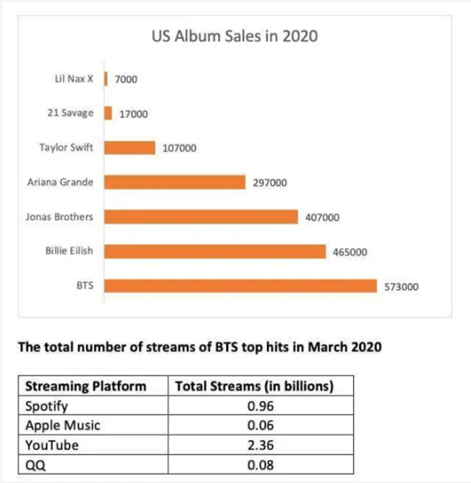
The chart show the album sales in the USA in 2020 and data on BTS top hits streams worldwide in March 2020
Summarize the information by selecting and reporting the main features, and make comparisons where relevant. Write a report of at least 150 words.
...................................................................................................................................................
...................................................................................................................................................
...................................................................................................................................................
Part 3: Write an essay of about 350 words to express your opinion on the following issue (30 pts)
Some people think that the increasing use of computers and mobile phones in communication has negative effects on young people’s reading and writing skills. To what extent do you agree or disagree?
Give reasons and relevant examples to support your answer. You should write at least 350 words.
...................................................................................................................................................
...................................................................................................................................................
...................................................................................................................................................
THE END
................................
................................
................................
Xem thêm đề thi học sinh giỏi Tiếng Anh lớp 11 hay khác:
Đề thi học sinh giỏi Tiếng Anh 11 trường THPT Chuyên Lê Quý Đôn (Điện Biên) năm 2023-2024
Đề thi học sinh giỏi Tiếng Anh 11 trường THPT Chuyên Huỳnh Mẫn Đạt (Kiên Giang) năm 2024
Đề thi học sinh giỏi Tiếng Anh 11 trường THPT Chuyên Bảo Lộc (Lâm Đồng) năm 2024
Đề thi học sinh giỏi Tiếng Anh 11 trường THPT Chuyên Lào Cai (Lào Cai) năm 2023-2024
Đề thi học sinh giỏi Tiếng Anh 11 trường THPT Chuyên Lê Hồng Phong (Nam Định) năm 2024
TÀI LIỆU CLC DÀNH CHO GIÁO VIÊN VÀ PHỤ HUYNH LỚP 9
Bộ giáo án, bài giảng powerpoint, đề thi file word có đáp án 2026 tại https://tailieugiaovien.com.vn/
Hỗ trợ zalo: VietJack Official
Tổng đài hỗ trợ đăng ký: 084 283 45 85
 Đề thi vào 10 các sở Hà Nội, Tp. Hồ Chí Minh...
41 tài liệu
Đề thi vào 10 các sở Hà Nội, Tp. Hồ Chí Minh...
41 tài liệu
 Giáo án Word 9
95 tài liệu
Giáo án Word 9
95 tài liệu
 Đề thi giữa kì, cuối kì 9
254 tài liệu
Đề thi giữa kì, cuối kì 9
254 tài liệu
 Chuyên đề dạy thêm Toán, Lí, Hóa... 9
71 tài liệu
Chuyên đề dạy thêm Toán, Lí, Hóa... 9
71 tài liệu
 Đề thi HSG 9
8 tài liệu
Đề thi HSG 9
8 tài liệu
 Bài giảng Powerpoint 9
42 tài liệu
Bài giảng Powerpoint 9
42 tài liệu
Công cụ giáo viên (2048.VN)
Tạo- trộn đề thi miễn phí từ file PDF, Word, Giao bài nhanh chóng, Hoàn toàn Free
Bộ đề thi các lớp các môn học được Giáo viên nhiều năm kinh nghiệm tổng hợp và biên soạn theo Thông tư mới nhất của Bộ Giáo dục và Đào tạo, được chọn lọc từ đề thi của các trường trên cả nước.
- Đề thi lớp 1 (các môn học)
- Đề thi lớp 2 (các môn học)
- Đề thi lớp 3 (các môn học)
- Đề thi lớp 4 (các môn học)
- Đề thi lớp 5 (các môn học)
- Đề thi lớp 6 (các môn học)
- Đề thi lớp 7 (các môn học)
- Đề thi lớp 8 (các môn học)
- Đề thi lớp 9 (các môn học)
- Đề thi lớp 10 (các môn học)
- Đề thi lớp 11 (các môn học)
- Đề thi lớp 12 (các môn học)
- Giáo án lớp 1 (các môn học)
- Giáo án lớp 2 (các môn học)
- Giáo án lớp 3 (các môn học)
- Giáo án lớp 4 (các môn học)
- Giáo án lớp 5 (các môn học)
- Giáo án lớp 6 (các môn học)
- Giáo án lớp 7 (các môn học)
- Giáo án lớp 8 (các môn học)
- Giáo án lớp 9 (các môn học)
- Giáo án lớp 10 (các môn học)
- Giáo án lớp 11 (các môn học)
- Giáo án lớp 12 (các môn học)