Đề kiểm tra Tiếng Anh 12 Global Success Unit 8 (có lời giải)
Đề kiểm tra Tiếng Anh 12 Global Success Unit 8: Wildlife conservation có đáp án chi tiết đầy đủ các mức độ sẽ giúp học sinh lớp 12 ôn luyện Tiếng Anh 12.
Đề kiểm tra Tiếng Anh 12 Global Success Unit 8 (có lời giải)
Chỉ từ 200k mua trọn bộ Bài tập ôn tập + Đề kiểm tra Tiếng Anh 12 Global Success theo chương theo cấu trúc mới bản word có lời giải chi tiết, trình bày đẹp mắt, dễ dàng chỉnh sửa:
- B1: gửi phí vào tk:
1133836868- CT TNHH DAU TU VA DV GD VIETJACK - Ngân hàng MB (QR) - B2: Nhắn tin tới Zalo VietJack Official - nhấn vào đây để thông báo và nhận đề thi
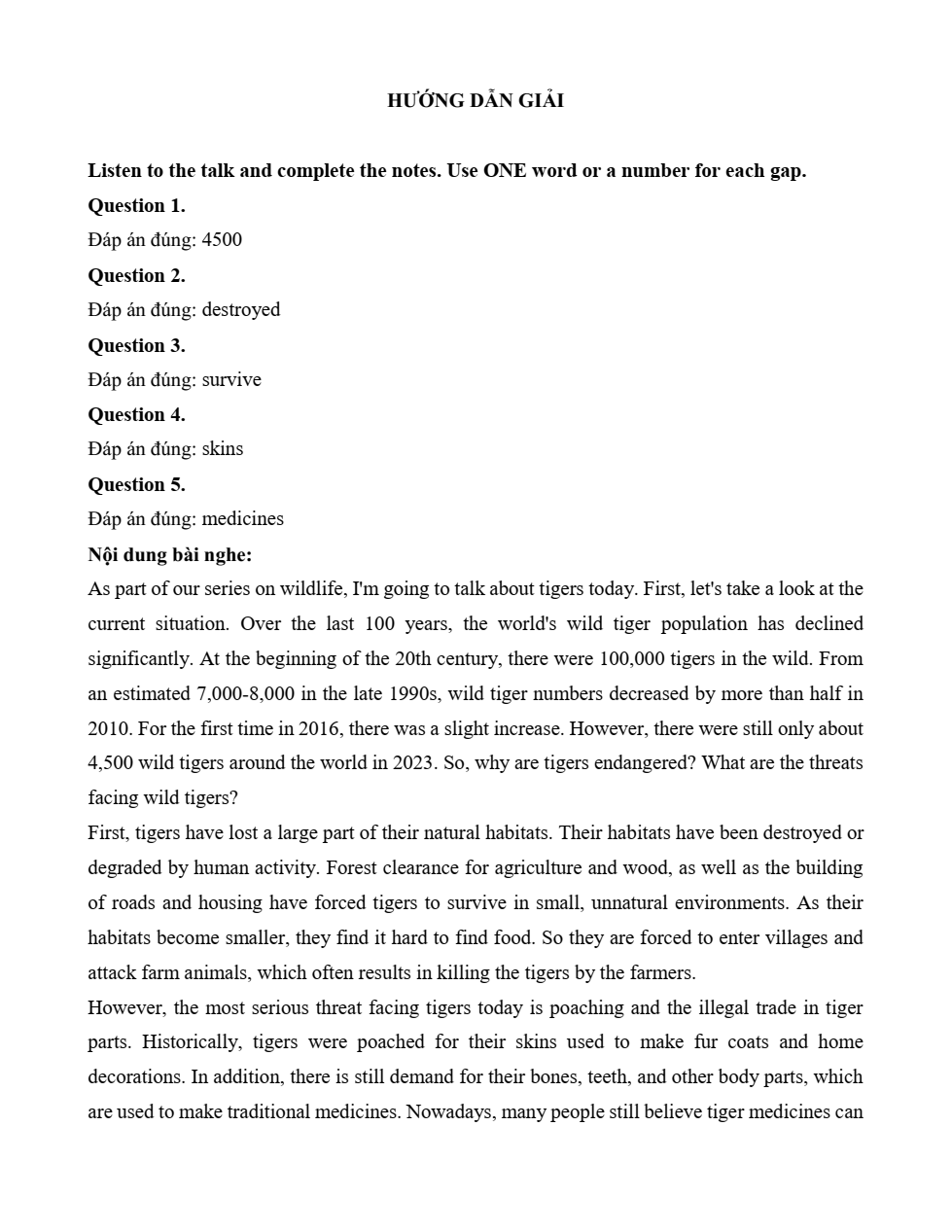
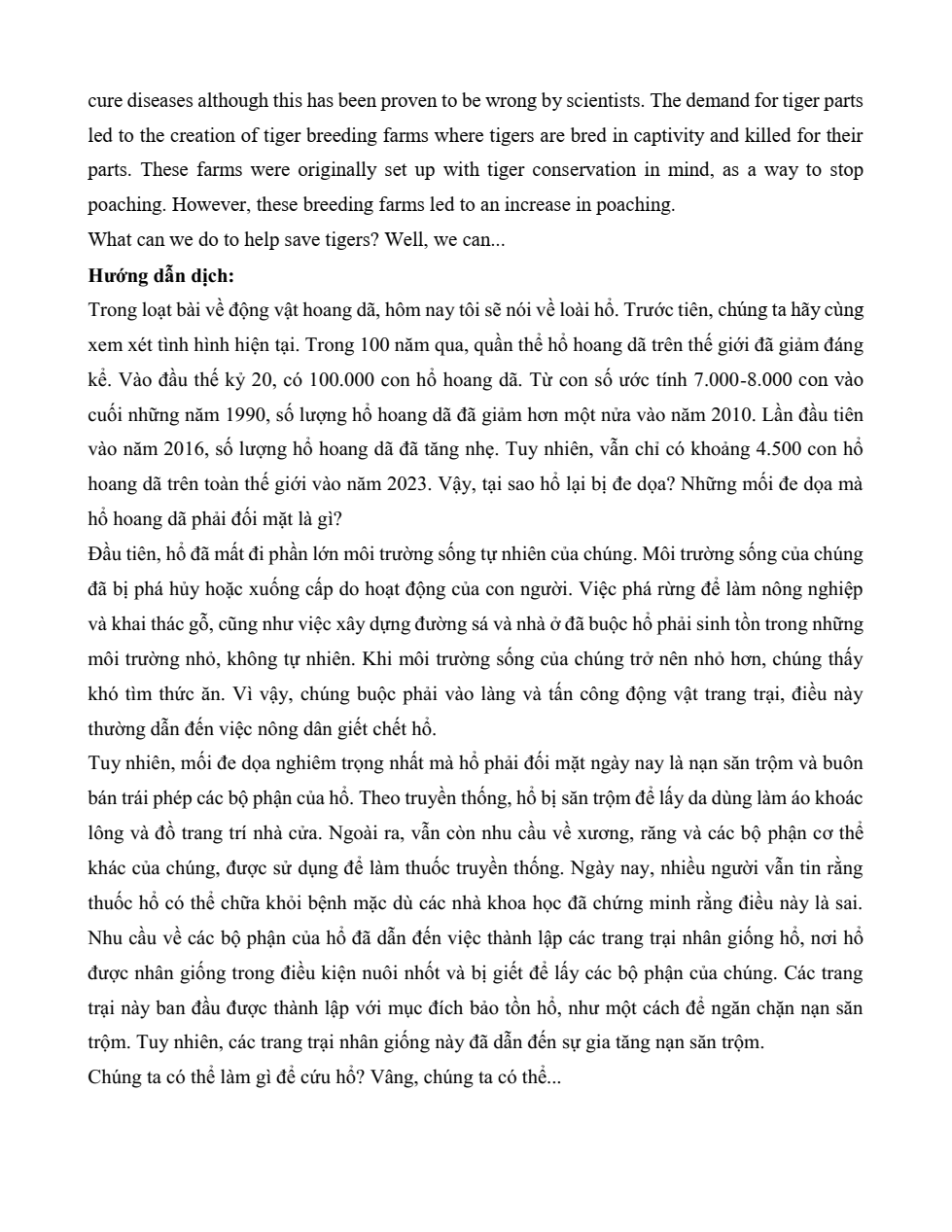
Listen to the talk and complete the notes. Use ONE word or a number for each gap.
Bài nghe:
|
TIGERS |
|
|
Estimated population in 2023 |
There were about (1)______ wild tigers left in the world. |
|
Threats facing tigers |
Habitat loss: - Tigers' habitats have been (2)______ or degraded by human activity. - Habitat loss forces tigers to (3)______ in small, unnatural environments. Poaching and illegal trade in tiger parts: - Tigers were poached for their (4)______ used to make fur coats and home decorations. - Tigers are also poached for their bones, teeth, and other body parts, which are used to make traditional (5)______. |
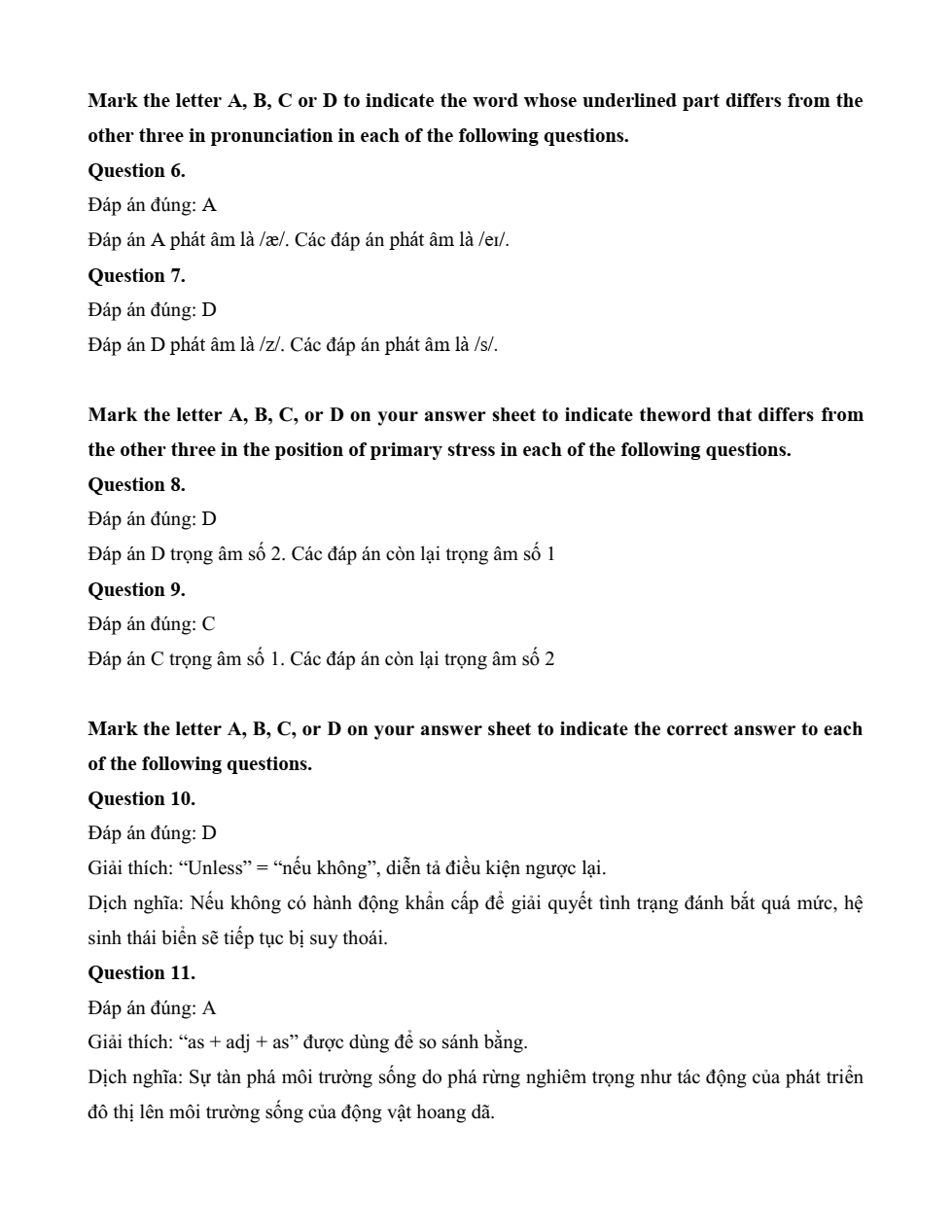
Mark the letter A, B, C or D to indicate the word whose underlined part differs from the other three in pronunciation in each of the following questions.
Question 6.
A. mammal
B. endangered
C. primate
D. cage
Question 7.
A. spawning
B. survive
C. nursery
D. debris
Mark the letter А, B, C, or D on your answer sheet to indicate theword that differs from the other three in the position of primary stress in each of the following questions.
Question 8.
A. rescue
B. primate
C. poacher
D. extinct
Question 9.
A. survive
B. release
C. urgent
D. conserve
Mark the letter А, B, C, or D on your answer sheet to indicate the correct answer to each of the following questions.
Question 10. A_________ urgent action is taken to address overfishing, marine ecosystems will continue to degrade.
A. Provided that
B. Even when
C. If
D. Unless
Question 11. The habitat destruction caused by deforestation is _________ the impact of urban development on wildlife habitat.
A. as severe as
B. severe than
C. not more severe than
D. not as severe like
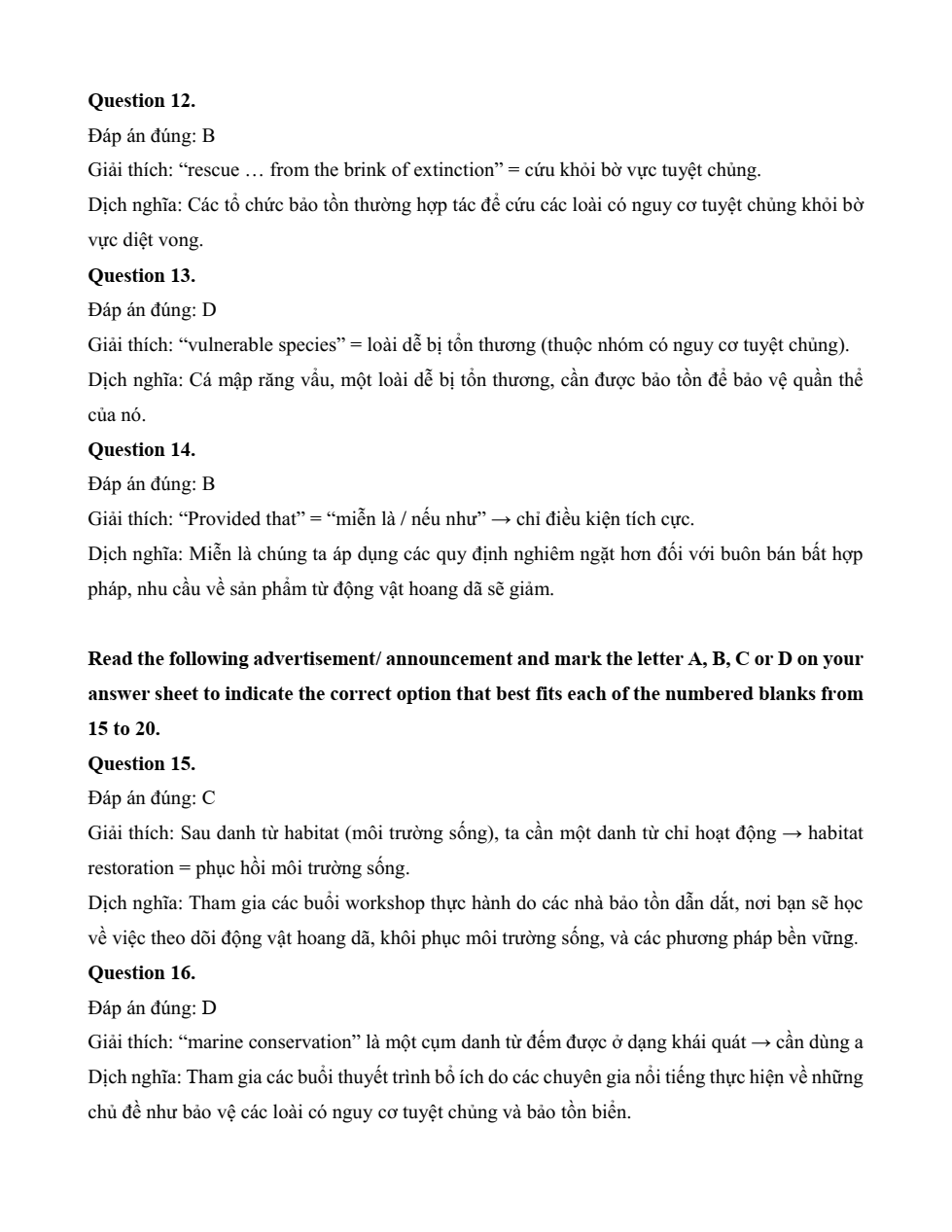
Question 12. Conservation organisations often collaborate to _________ endangered species from the brink of extinction.
A. degrade
B. rescue
C. survive
D. recover
Question 13. The snaggletooth shark, a ______ species, requires conservation efforts to protect its population.
A. extinct
B. harsh
C. dangered
D. vulnerable
Question 14. _________ we impose stricter regulations on illegal trade, the demand for wildlife products will be reduced.
A. Unless
B. Provided that
C. Until
D. While
Read the following advertisement/ announcement and mark the letter A, B, C or D on your answer sheet to indicate the correct option that best fits each of the numbered blanks from 15 to 20.
|
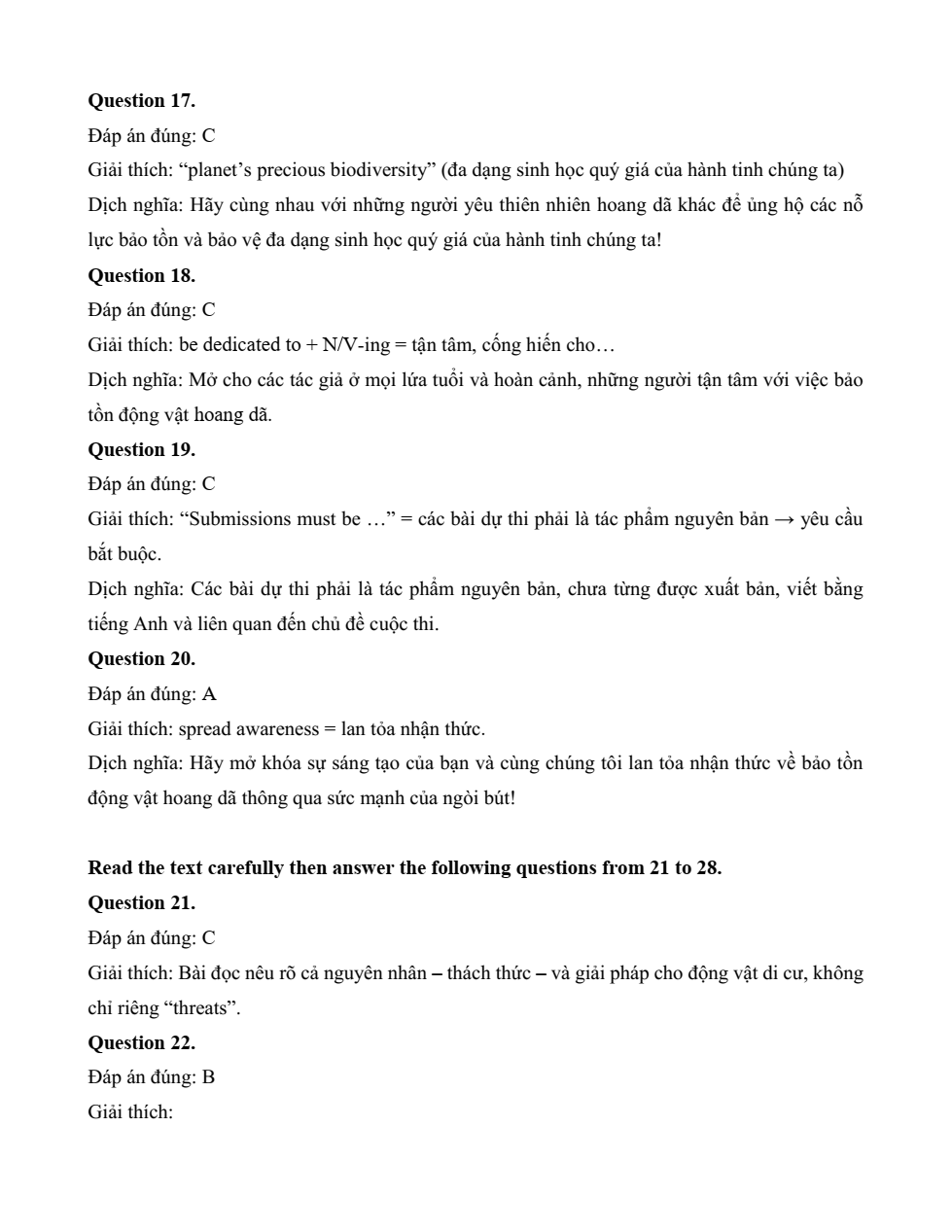
DISCOVER WILDLIFE CONSERVATION EXHIBITION! Date: Saturday, February 15th Time: 10:00 AM to 6:00 PM Location: Viet Nature Conservation Center, Ha Noi Immerse yourself in the fascinating world of wildlife conservation at our upcoming exhibition! Explore captivating exhibits featuring endangered species, their habitats, and conservation efforts. Activities: - Engage in hands-on workshops led by conservationists, where you’ll learn about wildlife tracking, habitat (15) _________, and sustainable practices. - Join informative presentations by renowned experts on topics like endangered species protection and (16) _________ marine conservation. - Capture memories with your favourite animals with our interactive wildlife photo booth. - Enjoy delicious refreshments and browse eco-friendly products at our conservation marketplace. Contact Information: For inquiries, email us at info@wildlifeexpo.com or call 024- 456-7890. Come together with fellow wildlife enthusiasts to support conservation efforts and protect our planet’s precious (17) _________! Admission is free for all ages. |
Question 15.
A. restorative
B. restored
C. restoration
D. restore
Question 16.
A. an
B. Ø (no article)
C. the
D. a
Question 17.
A. conversation
B. exhibition
C. biodiversity
D. desire
|
CALLING ALL WRITERS: WILDLIFE CONSERVATION WRITING COMPETITION! Are you passionate about wildlife conservation? Do you have a talent for storytelling? Here’s your chance to make a difference through your words! We’re excited to announce our Wildlife Conservation Writing Competition. Topic: “Preserving Our Precious wildlife: Stories of Hope and Action” Share your inspiring stories, essays, or poems highlighting the importance of wildlife conservation and the efforts being made to protect endangered species and their habitats. Requirements: Open to writers of all ages and backgrounds who are dedicated (18) _________ wildlife conservation. Submissions (19) _________ original, unpublished works in English and relate to the competition theme. Submit your Entry: Email your submission to wildlifecontest@example.com by March 31st. Include your name, age (if under 18), and contact information in the email. Prizes: Winners will be announced on April 10th, and will receive cash prizes and publication opportunities. Unlock your creativity and join us in spreading (20) _________ about wildlife conservation through the power of writing! |
Question 18.
A. on
B. with
C. in
D. to
Question 19.
A. may be
B. ought be
C. must be
D. could be
Question 20.
A. awareness
B. captivity
C. demand
D. removal
Read the text carefully then answer the following questions from 21 to 28.
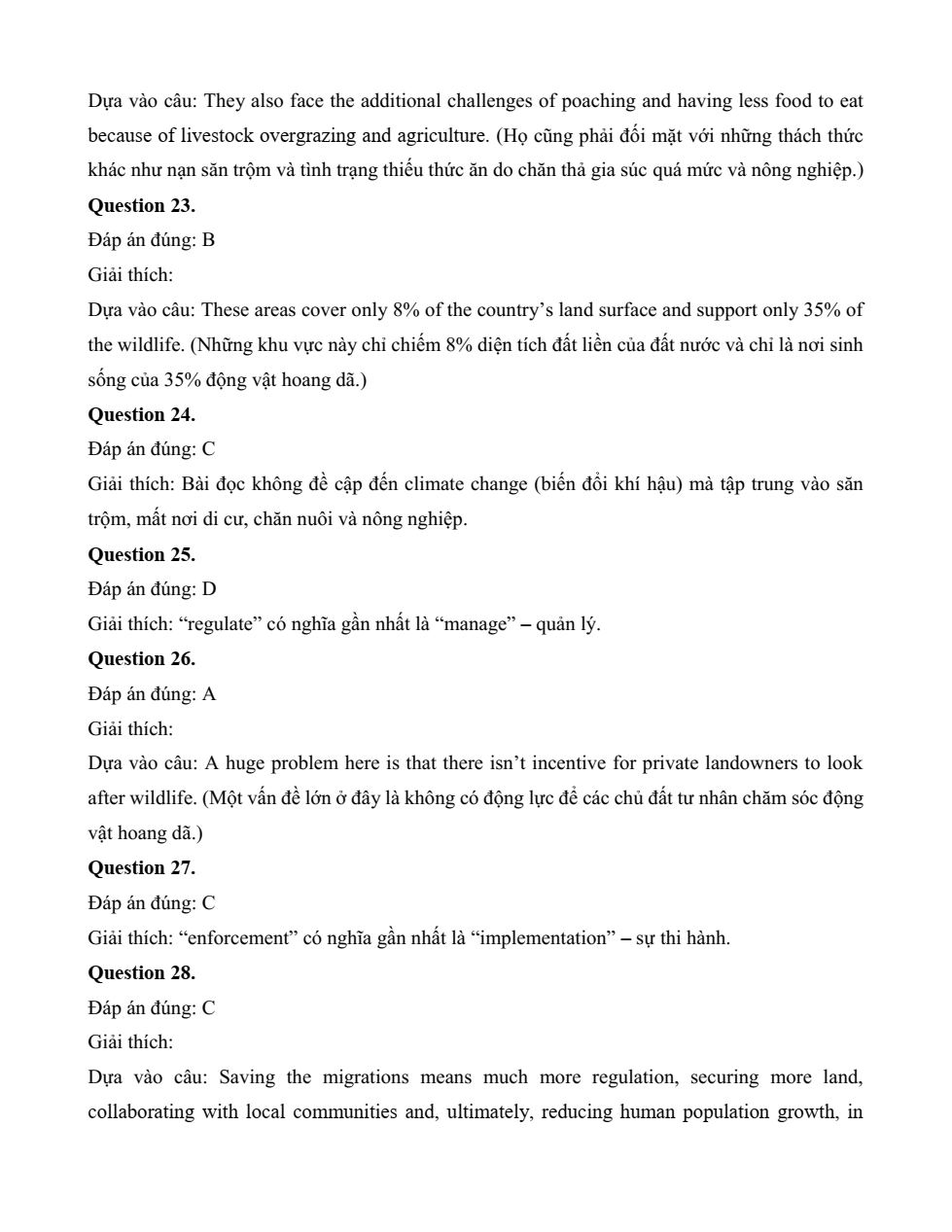
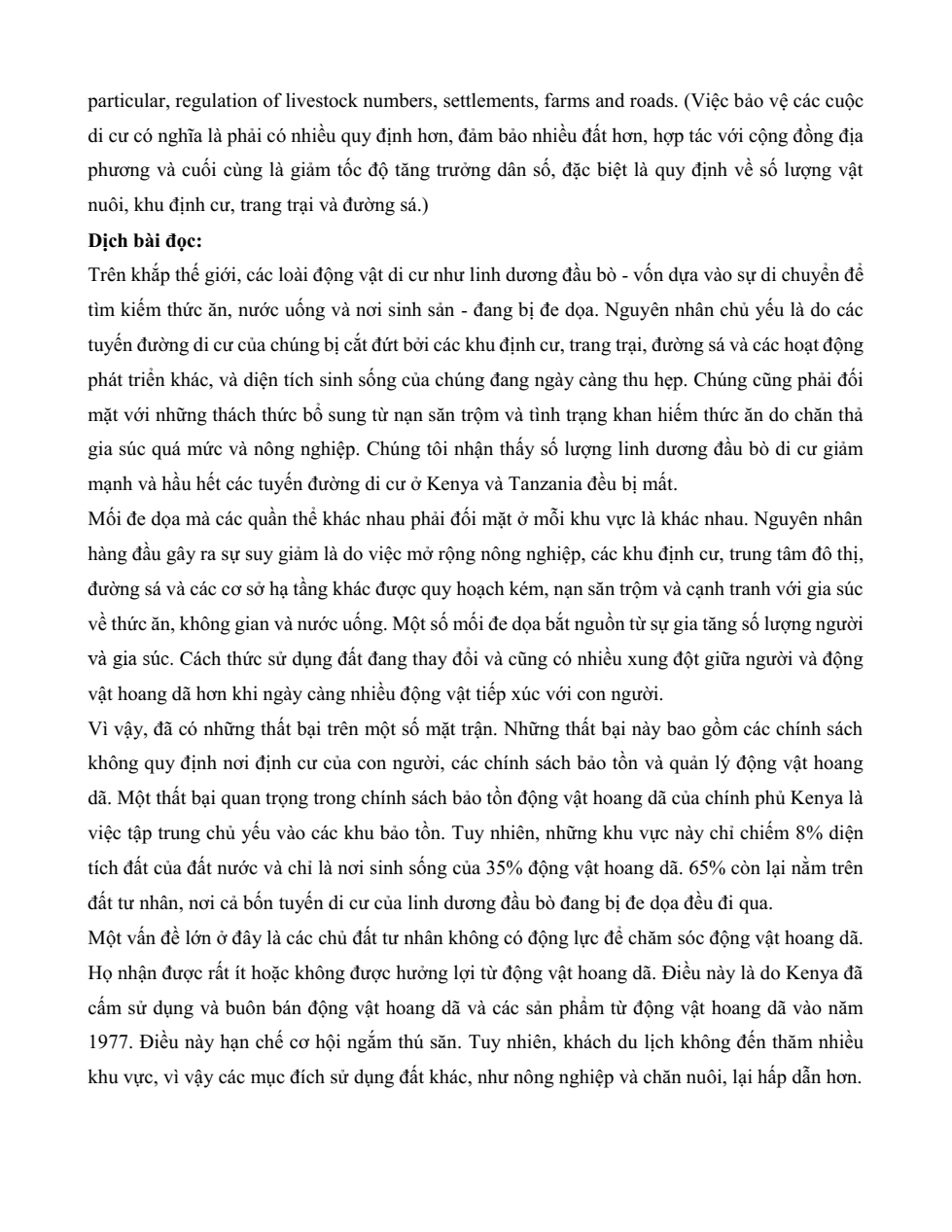
Across the world, migratory animals like wildebeest - which rely on movement to find food, water and calving grounds - are under threat. This is mainly because their migration routes are being cut off by settlements, farms, roads and other developments, and the areas where they roam are getting smaller. They also face the additional challenges of poaching and having less food to eat because of livestock overgrazing and agriculture. We found extreme declines in the numbers of migrating wildebeest and loss of most migration routes in Kenya and Tanzania.
The threats facing the various populations differ in each area. The leading causes of decline are poorly planned agricultural expansion, settlements, urban centres, roads and other infrastructure, poaching and competition with livestock for food, space and drinking water. Some threats are driven by increasing human and livestock numbers. The way land is used is changing and there’s also more human-wildlife conflict as more animals come into contact with people.
So, there have been failures on a number of fronts. These include policies that don’t regulate where people settle, wildlife conservation and management policies. A key government wildlife policy failure in Kenya is that it has focused primarily on protected areas. But these areas cover only 8% of the country’s land surface and support only 35% of the wildlife. The other 65% occupy private lands, which all the four threatened wildebeest migrations cross.
A huge problem here is that there isn’t incentive for private landowners to look after wildlife. They receive little to no benefit from wildlife. This is because Kenya banned the use of and trade in wildlife and wildlife products in 1977. This limits opportunities to game viewing. But tourists don’t visit many areas and so other land uses, like agriculture and livestock production, are more appealing.
Urgent action is needed to save these migrations. Saving the migrations means much more regulation, securing more land, collaborating with local communities and, ultimately, reducing human population growth, in particular, regulation of livestock numbers, settlements, farms and roads. Land must be restored - meaning settlements cleared and cultivation on migration routes stopped. Deforestation must also be better managed. And robust law enforcement is needed to reduce the illegal hunting of animals for bushmeat.
The consequences of not acting will be huge. Migrations of zebra and Thomson’s gazelle in Kenya’s Rift Valley and elephants in Kenya have already been lost. Wildebeest could go the same way.
Question 21. Which of the following would be the best title for the passage?
A. Urgent Action Needed to Save Migratory Animals
B. Threats to Migratory Animals like wildebeest
C. Challenges Facing Migratory Animals and Solutions
D. The Role of Protected Areas in Wildlife Preservation
Question 22. The word “they” in paragraph 1 refers to _______.
A. calving grounds
B. migratory animals
C. migration routes
D. areas
Question 23. According to paragraph 3, what percentage of Kenya’s wildlife is supported by protected areas?
A. 8%
B. 35%
C. 65%
D. 92%
Question 24. What is NOT a threat for migratory animals like wildebeest?
A. illegal hunting
B. loss of migration routes
C. climate change
D. competition with other animals
Question 25. The word “regulate” in paragraph 3 is closest in meaning to _______.
A. reattach
B. impose
C. conserve
D. manage
Question 26. Which of the following is stated in paragraph 4?
A. Private landowners have no motivation to care for wildlife.
B. Kenya prohibited illegal wildlife trade and wildlife products in 1987.
C. The ban on wildlife use and trade has led to increased opportunities for game viewing.
D. Tourists visit areas in Kenya for wildlife viewing rather than for other land uses.
Question 27. The word “enforcement” in paragraph 5 is closest in meaning to _______.
A. conservation
B. criteria
C. implementation
D. disregard
Question 28. What is one of the urgent actions needed to save migratory animal migrations?
A. increasing human population growth
B. diminishing regulation of livestock numbers
C. cooperating with local communities
D. encouraging more agricultural expansion
Read the text carefully then answer the following questions from 29 to 33.
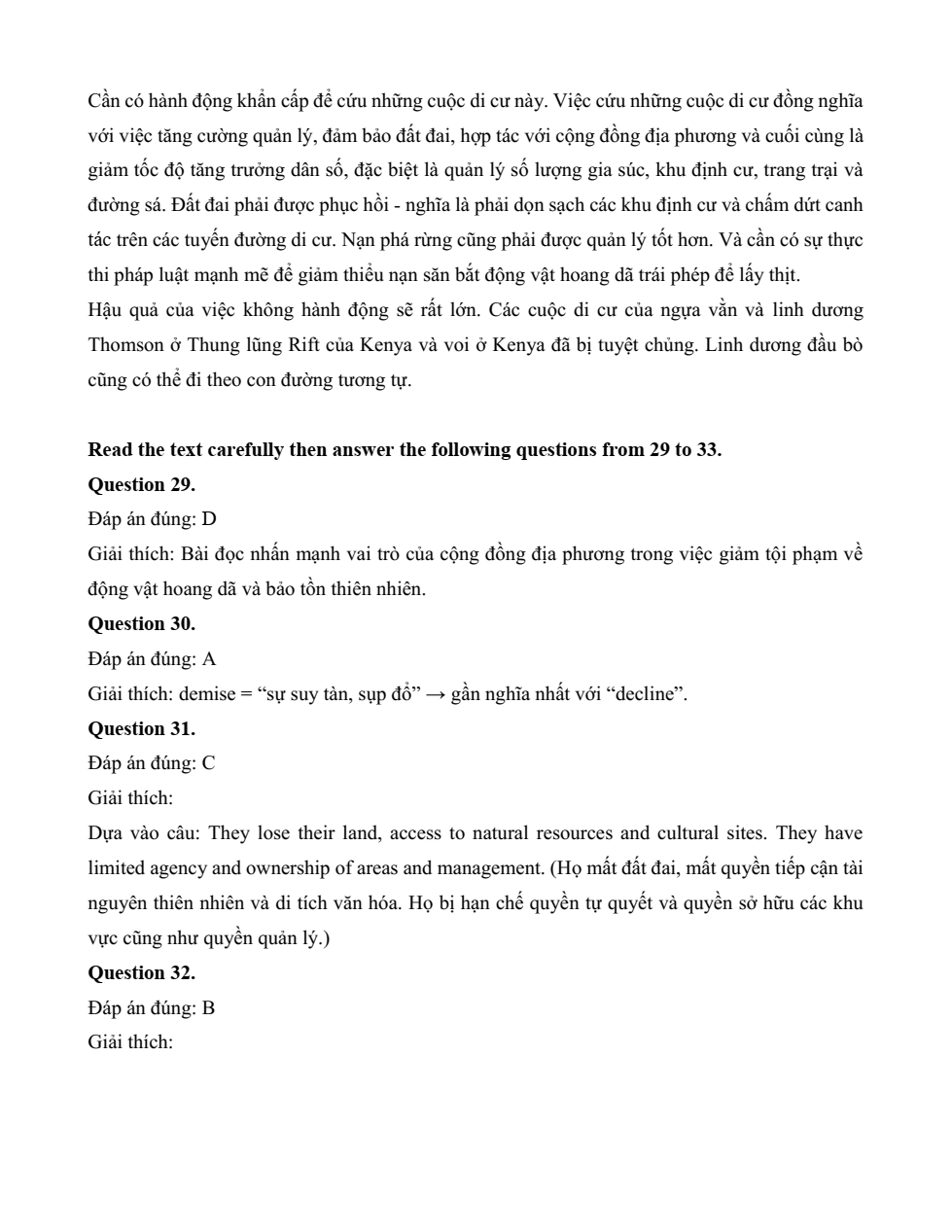
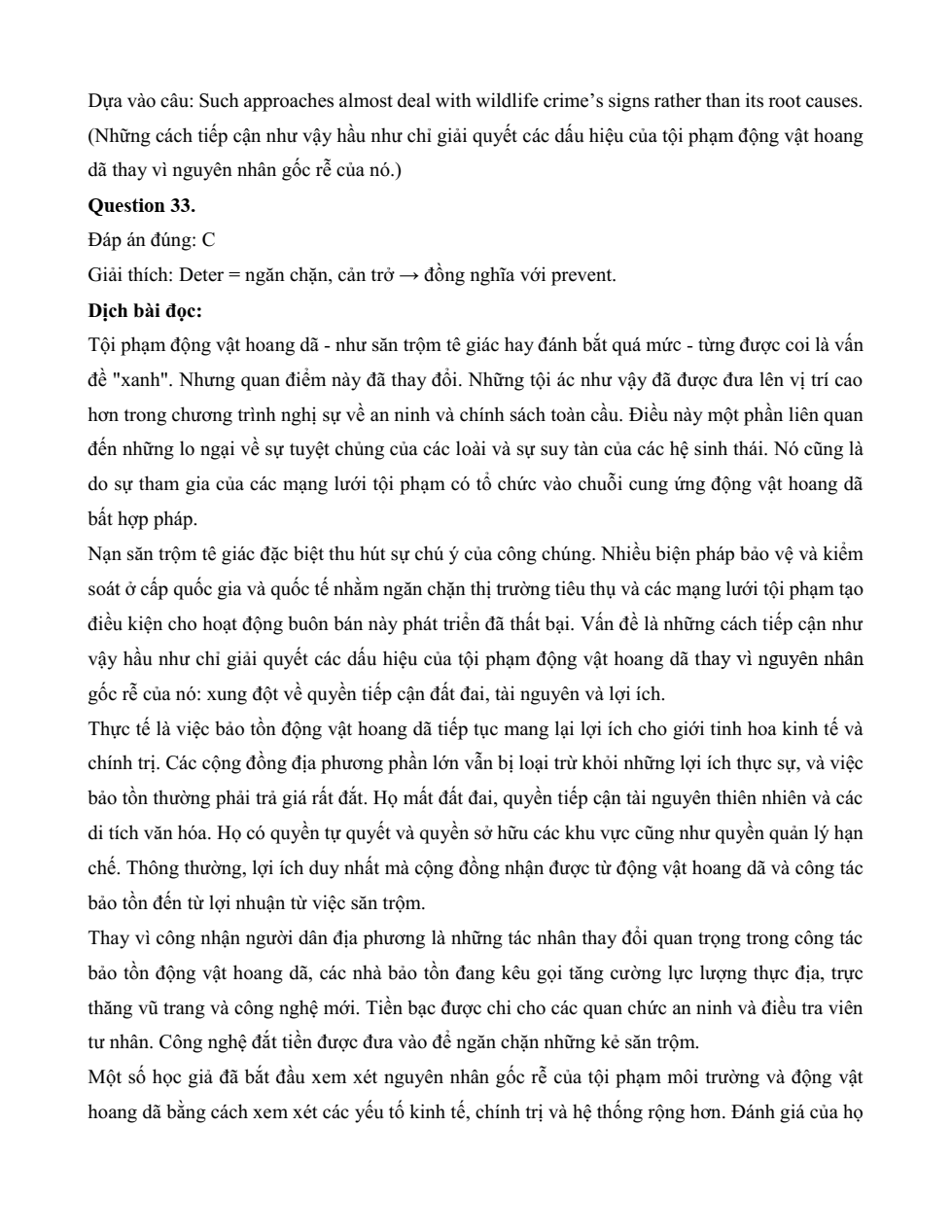
Wildlife crimes - like rhino poaching or overfishing-were once considered a “green” matter. But this has changed. Such crimes have moved higher up on global security and policy agendas. This is partly linked to concerns about the extinction of species and the demise of ecosystems. It’s also been caused by the involvement of organised criminal networks in illegal wildlife supply chains.
Rhino poaching has particularly attracted public attention. A lot of protective and controlling national and international measures aimed at preventing the consumer markets and criminal networks that allow the trade to flourish have failed. The problem is that such approaches almost deal with wildlife crime’s signs rather than its root causes: a conflict over access to land, resources and benefits.
The reality is that wildlife conservation continues to benefit economic and political elites. Local communities remain mostly excluded from real benefits, and conservation often comes at a huge cost to them. They lose their land, access to natural resources and cultural sites. They have limited agency and ownership of areas and management. Often the only benefits for communities from wildlife and conservation come from the poaching profits.
Instead of recognising local people as important change agents in wildlife conservation, conservationists are calling for more boots on the ground, helicopter gunships and new technologies. Money is spent on security officials and private investigators. Expensive technologies are brought in to deter poachers.
Some scholars have started to look at the root causes of environmental and wildlife crimes by considering broader economic, political and systemic factors. Their assessment is that community empowerment is key. This will not only address basic inequality and poverty, but can reduce wildlife crime and other types of crime. This is borne out by Namibia’s experiences: there, former poachers have become wildlife guardians. Local communities may become protectors of wildlife and conservation areas if they were granted agency, ownership and benefits.
Although not perfect, the example of communal conservation areas in Namibia provides fascinating insights into the process of encouraging communities. One thing is clear: we need to create happy sustainable communities that benefit from and live in harmony with ecosystems.
Question 29. Which of the following can be the best title for the passage?
A. The Reasons for Wildlife Crimes
B. The Effective Measures in Preventing Wildlife Crimes
C. Wildlife Conservation Efforts
D. The Key Role of Communities in Wildlife Conservation
Question 30. The word “demise” in paragraph 1 is closest in meaning to ________.
A. decline
B. evolution
C. conservation
D. displacement
Question 31. The word “they” in paragraph 3 refers to ________.
A. economic and political elites
B. real benefits
C. local communities
D. cultural sites
Question 32. What is the main criticism of current approaches to wildlife conservation?
A. They focus too much on community empowerment.
B. They fail to tackle the root causes of wildlife crimes.
C. They prioritise profits over wildlife conservation.
D. They involve too many protective and regulatory measures.
Question 33. The word “deter” in paragraph 4 is closest in meaning to ________.
A. release
B. stimulate
C. prevent
D. arrest
Mark the letter A, B, C or D on your answer sheet to indicate the correct arrangement of the sentences to make a meaningful paragraph/ letter in each of the following questions.
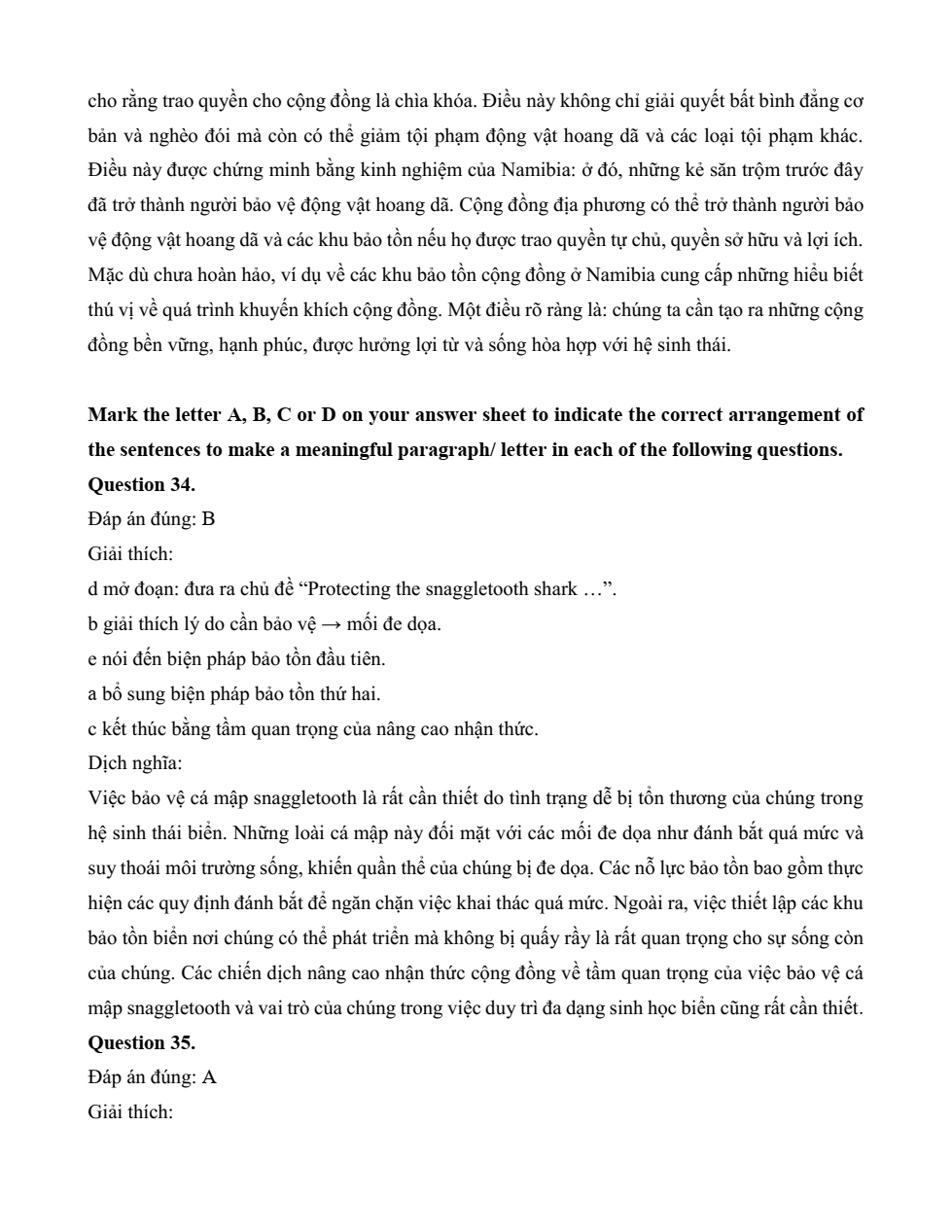
Question 34.
a. Additionally, establishing marine protected areas where they can thrive undisturbed is crucial for their survival.
b. These sharks face threats such as overfishing and habitat degradation, endangering their populations.
c. Public awareness campaigns about the importance of preserving snaggletooth sharks and their role in maintaining marine biodiversity are also essential for supporting conservation measures.
d. Protecting the snaggletooth shark is imperative due to its vulnerable status in the marine ecosystem.
e. Conservation efforts involve implementing fishing regulations to prevent overexploitation of their populations.
A. d-b-a-e-c
B. d-b-e-a-c
C. d-c-b-e-a
D. b-d-e-c-a
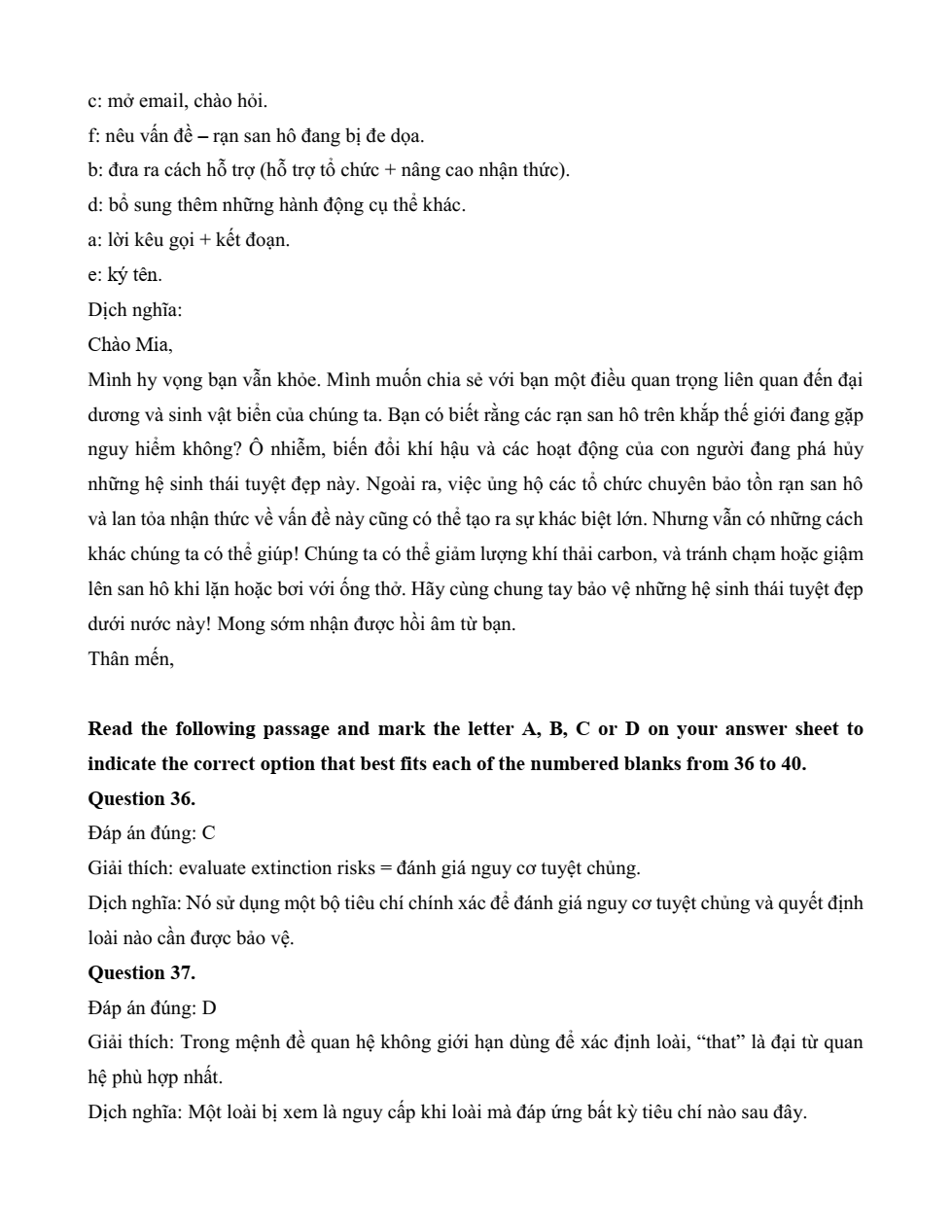
Question 35.
a. Let’s all do our part to protect these incredible underwater habitats! Hope to hear from you soon.
b. Additionally, supporting organisations dedicated to coral reef conservation and spreading awareness about the issue can make a big difference.
c. Hi Mia, I hope you’re all doing well. I want to share something important with you regarding our oceans and marine life.
d. But there are ways we can help! We can reduce our carbon footprint, and avoid touching or stepping on coral when snorkelling or diving.
e. Best regards,
f. Do you know that coral reefs around the world are in danger? Pollution, climate change, and human activities are harming these beautiful ecosystems.
A. c-f-b-d-a-e
B. c-f-a-d-b-e
C. c-f-d-b-a-e
D. c-a-f-d-b-e
Read the following passage and mark the letter A, B, C or D on your answer sheet to indicate the correct option that best fits each of the numbered blanks from 36 to 40.
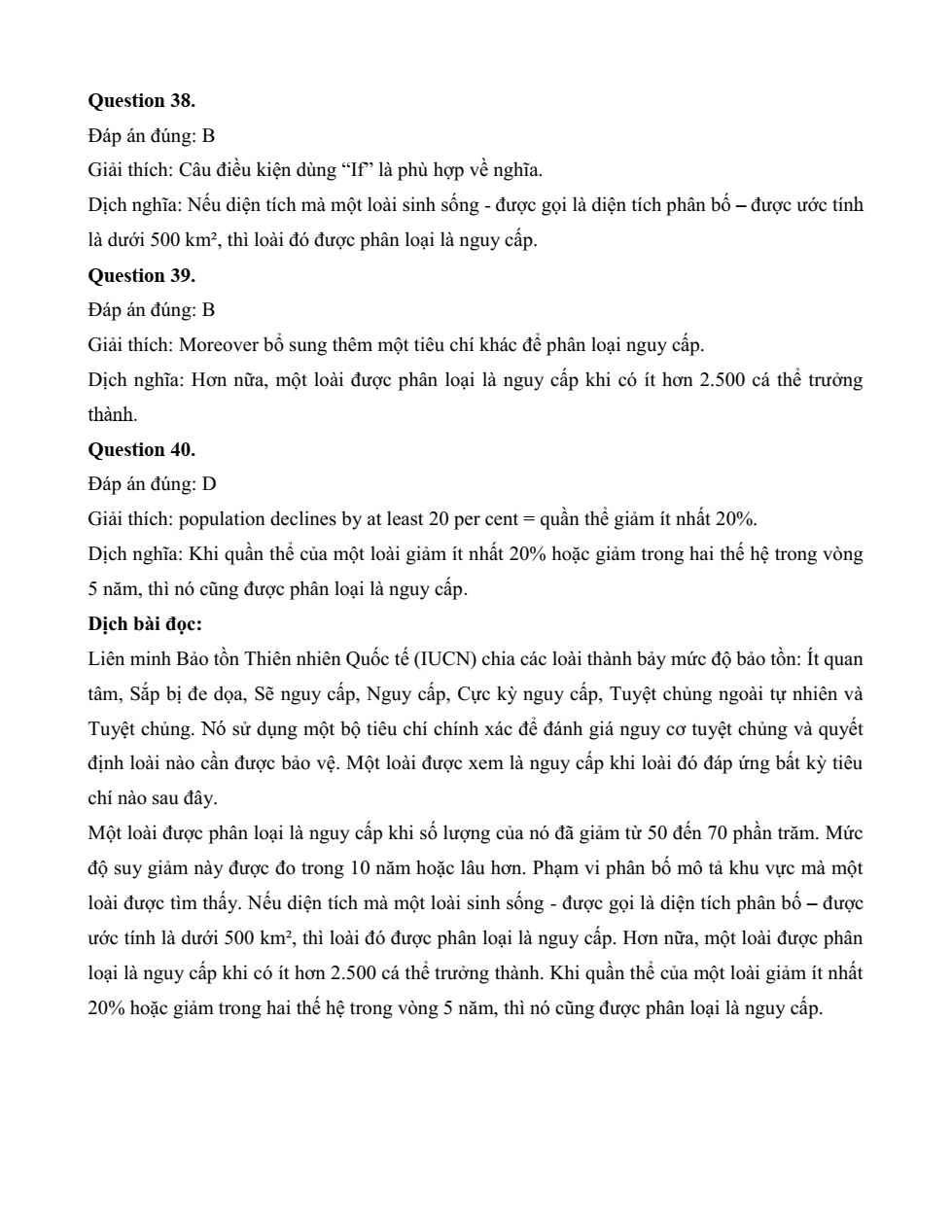
The International Union for Conservation of Nature (IUCN) Red List divides species into seven levels of conservation: Least Concern, Near Threatened, Vulnerable, Endangered, Critically Endangered, Extinct in the Wild, and Extinct. It uses a set of precise criteria to (36) extinction risks and decides which species need protection. An endangered species is one (37) meets any of the following criteria.
A species is classified as endangered when its population has declined between 50 and 70 per cent. This decline is measured over 10 years or longer. Geographic range describes the area where a species is found. (38) the area that a species lives on, known as its area of occupancy, is estimated to be less than 500 square kilometres, then the species is classified as endangered. (39), a species is classified as endangered when there are fewer than 2,500 mature individuals. When a species (40) declines by at least 20 per cent or two generations within five years, it is also classified as endangered.
Question 36.
A. release
B. identify
C. evaluate
D. conserve
Question 37.
A. whose
B. whom
C. where
D. that
Question 38.
A. Because
B. If
C. Unless
D. Though
Question 39.
A. However
B. Moreover
C. Therefore
D. Yet
Question 40.
A. captivity
B. deforestation
C. threat
D. . population
................................
................................
................................
Xem thêm đề kiểm tra Tiếng Anh lớp 12 Global Success có đáp án hay khác:
Đề kiểm tra Tiếng Anh 12 Global Success Unit 5 (có lời giải)
Đề kiểm tra Tiếng Anh 12 Global Success Unit 6 (có lời giải)
Đề kiểm tra Tiếng Anh 12 Global Success Unit 7 (có lời giải)
Đề kiểm tra Tiếng Anh 12 Global Success Unit 9 (có lời giải)
Đề kiểm tra Tiếng Anh 12 Global Success Unit 10 (có lời giải)
TÀI LIỆU CLC DÀNH CHO GIÁO VIÊN VÀ PHỤ HUYNH LỚP 12
Bộ giáo án, bài giảng powerpoint, đề thi file word có đáp án 2026 tại https://tailieugiaovien.com.vn/
Hỗ trợ zalo: VietJack Official
Tổng đài hỗ trợ đăng ký: 084 283 45 85
 500+ đề thi thử tốt nghiệp THPT Quốc gia form 2026
41 tài liệu
500+ đề thi thử tốt nghiệp THPT Quốc gia form 2026
41 tài liệu
 100+ đề thi HSA,TSA,V-ACT,BCA,BQP...2026
95 tài liệu
100+ đề thi HSA,TSA,V-ACT,BCA,BQP...2026
95 tài liệu
 Đề thi giữa kì, cuối kì 12
254 tài liệu
Đề thi giữa kì, cuối kì 12
254 tài liệu
 Chuyên đề dạy thêm Toán, Lí, Hóa... 12
71 tài liệu
Chuyên đề dạy thêm Toán, Lí, Hóa... 12
71 tài liệu
 Đề thi HSG 12
8 tài liệu
Đề thi HSG 12
8 tài liệu
 Bài giảng Powerpoint 12
42 tài liệu
Bài giảng Powerpoint 12
42 tài liệu
Công cụ giáo viên (2048.VN)
Tạo- trộn đề thi miễn phí từ file PDF, Word, Giao bài nhanh chóng, Hoàn toàn Free
- Soạn văn 12 (hay nhất)
- Soạn văn 12 (ngắn nhất)
- Soạn văn 12 (siêu ngắn)
- Giải sgk Toán 12
- Giải Tiếng Anh 12 Global Success
- Giải sgk Vật Lí 12
- Giải sgk Hóa học 12
- Giải sgk Sinh học 12
- Giải sgk Lịch Sử 12
- Giải sgk Địa Lí 12
- Giải sgk Giáo dục KTPL 12
- Giải sgk Tin học 12
- Giải sgk Công nghệ 12
- Giải sgk Hoạt động trải nghiệm 12
- Giải sgk Giáo dục quốc phòng 12
- Giải sgk Âm nhạc 12
- Giải sgk Mĩ thuật 12