Đề kiểm tra Tiếng Anh 12 Global Success Unit 9 (có lời giải)
Đề kiểm tra Tiếng Anh 12 Global Success Unit 9: Career paths có đáp án chi tiết đầy đủ các mức độ sẽ giúp học sinh lớp 12 ôn luyện Tiếng Anh 12.
Đề kiểm tra Tiếng Anh 12 Global Success Unit 9 (có lời giải)
Chỉ từ 200k mua trọn bộ Bài tập ôn tập + Đề kiểm tra Tiếng Anh 12 Global Success theo chương theo cấu trúc mới bản word có lời giải chi tiết, trình bày đẹp mắt, dễ dàng chỉnh sửa:
- B1: gửi phí vào tk:
1133836868- CT TNHH DAU TU VA DV GD VIETJACK - Ngân hàng MB (QR) - B2: Nhắn tin tới Zalo VietJack Official - nhấn vào đây để thông báo và nhận đề thi
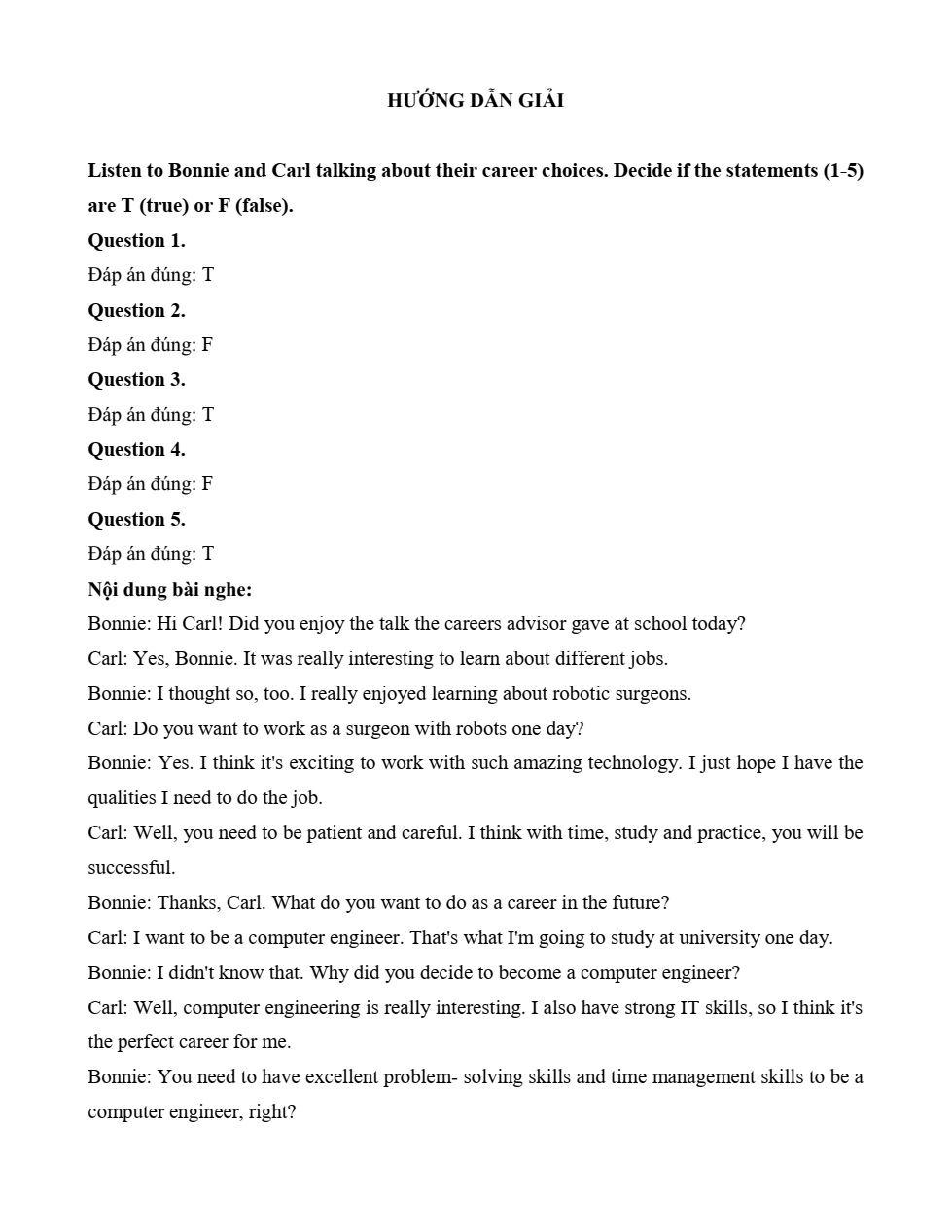
Listen to Bonnie and Carl talking about their career choices. Decide if the statements (1-5) are T (true) or F (false).
Bài nghe:
|
1. A careers advisor gave a talk at Carl's school. |
|
|
2. Bonnie wants to design robots one day. |
|
|
3. Carl said that Bonnie would be successful. |
|
|
4. Carl wants to teach at a university one day. |
|
|
5. Carl thinks that he has the skills for his dream job. |
|
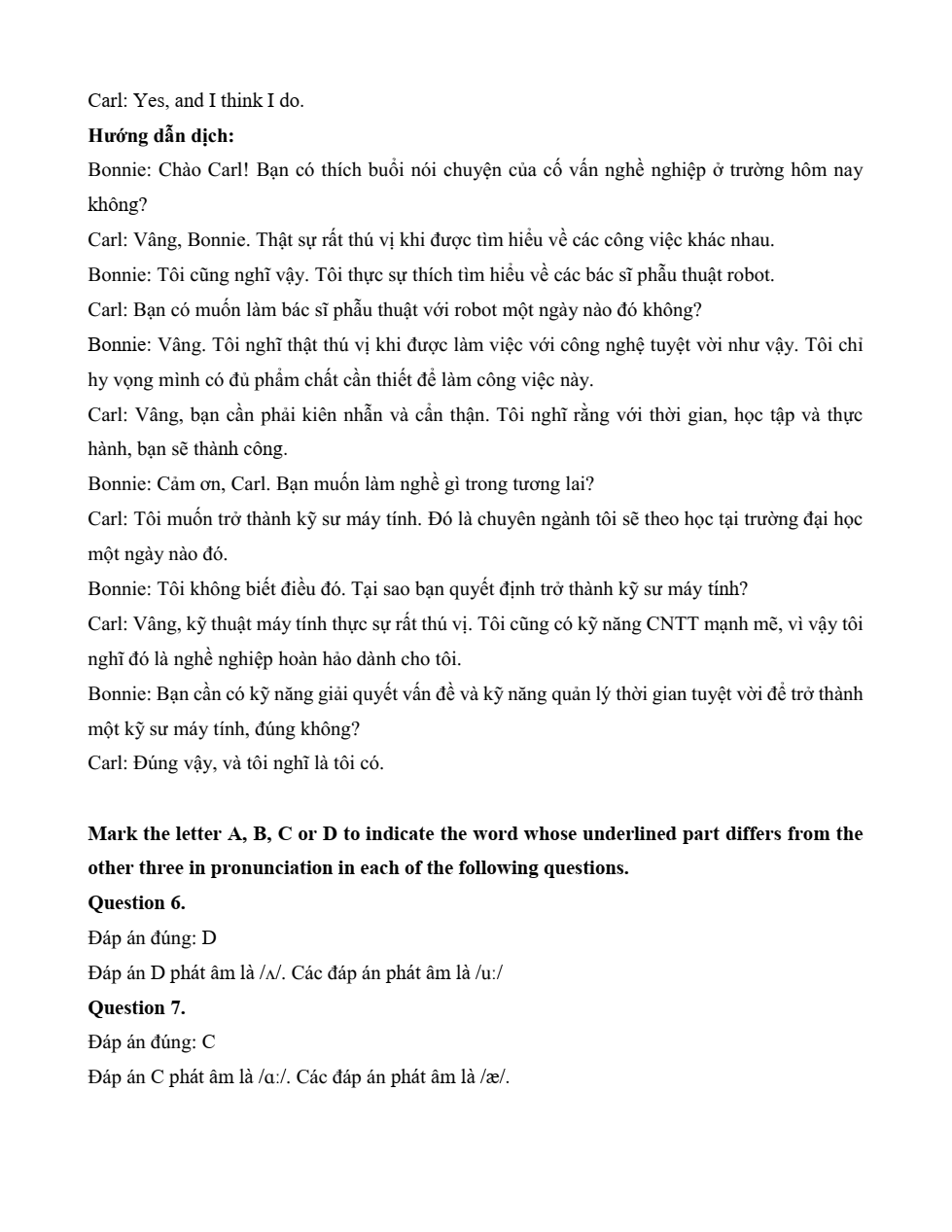
Mark the letter A, B, C or D to indicate the word whose underlined part differs from the other three in pronunciation in each of the following questions.
Question 6.
A. tutor
B. pursue
C. misuse
D. customer
Question 7.
A. passion
B. character
C. barista
D. cashier
Mark the letter А, B, C, or D on your answer sheet to indicate the word that differs from the other three in the position of primary stress in each of the following questions.
Question 8.
A. diploma
B. character
C. reference
D. childminder
Question 9.
A. recruiter
B. barista
C. pharmacist
D. adviser
Mark the letter А, B, C, or D on your answer sheet to indicate the correct answer to each of the following questions.
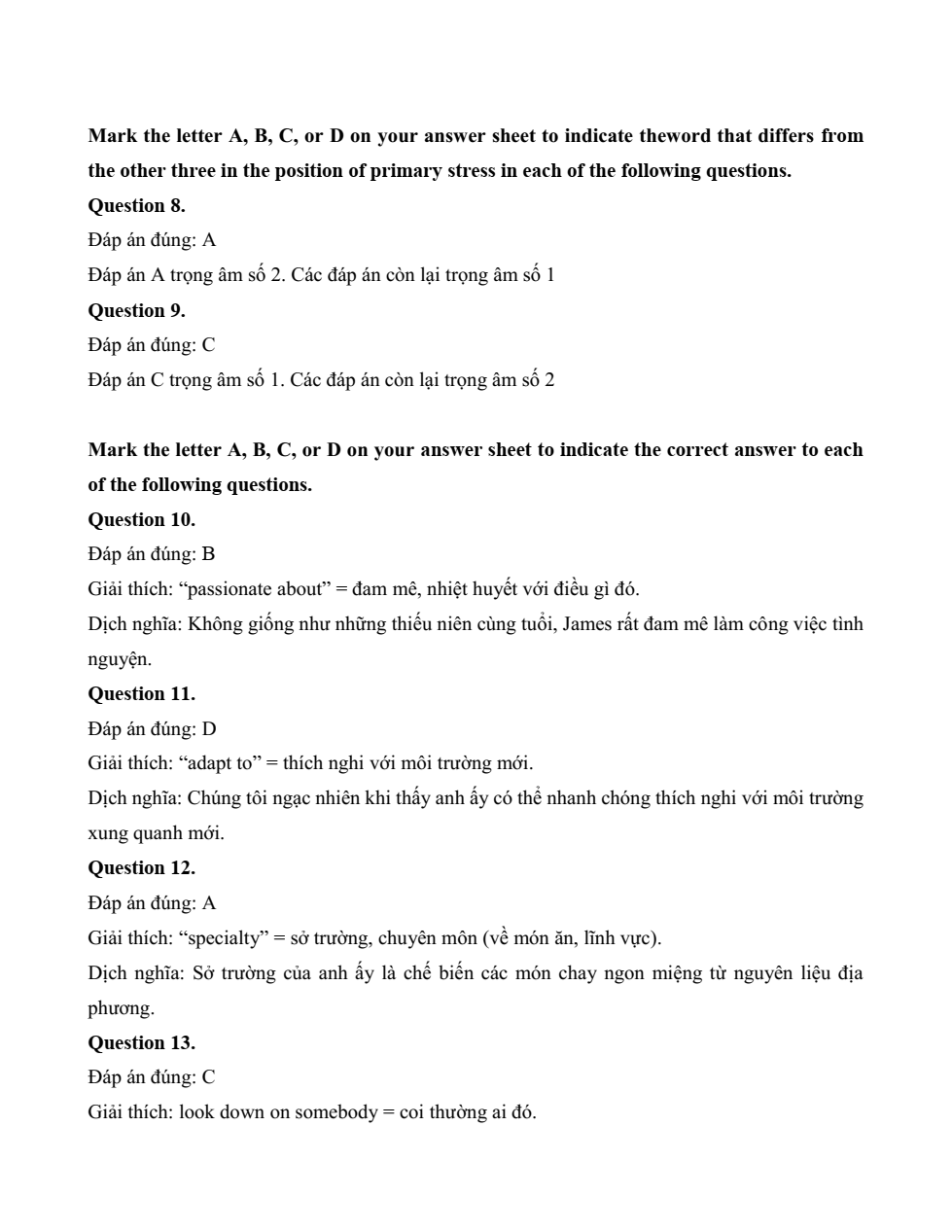
Question 10. Unlike other teenagers his age, James is ________ about doing voluntary work.
A. automated
B. passionate
C. fascinating
D. obsolete
Question 11. We were surprised to find that he was able to quickly ________ to his new surroundings.
A. gain
B. pursue
C. match
D. adapt
Question 12. His ________ lies in crafting delicious vegetarian dishes using locally sourced ingredients.
A. specialty
B. path
C. position
D. applicant
Question 13. Don’t look down _________ anyone at work. You might need their help one day.
A. to
B. during
C. on
D. behind
Question 14. He decided to work extra hours to _________ up for the time when he was off from work.
A. take
B. make
C. say
D. get
Read the following advertisement/ announcement and mark the letter A, B, C or D on your answer sheet to indicate the correct option that best fits each of the numbered blanks from 15 to 20.
|
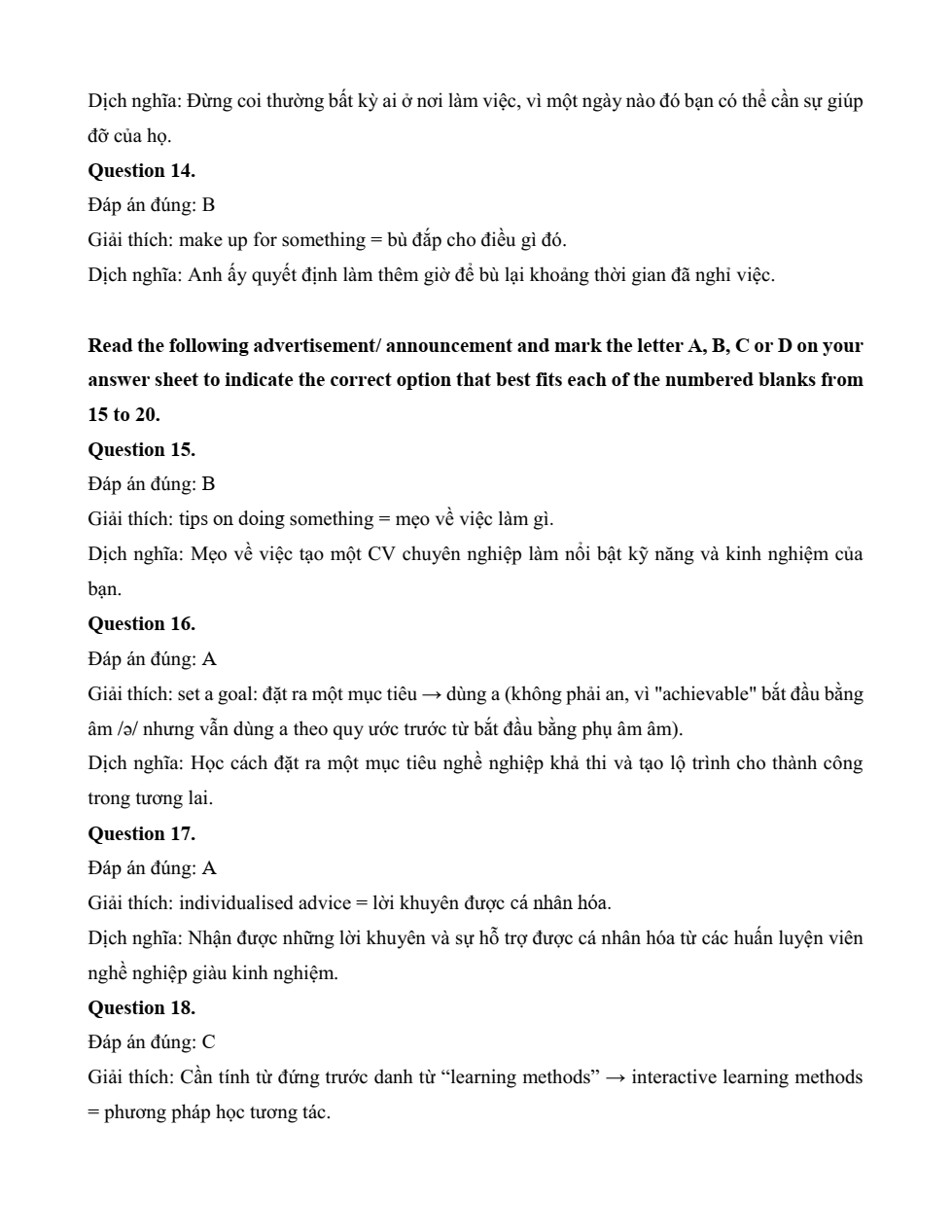
Welcome to our workshop! Here you can discover various career paths and learn how to identify your interests and strengths. CV Writing: get tips (15) _________ creating a professional cv that highlights your skills and experiences. Networking Skills: develop effective networking strategies to expand your professional connections and opportunities. Goal Setting: learn how to set (16) _________ achievable career goals and create a roadmap for your future success. Personalised Guidance: receive (17) _________ advice and support from experienced career coaches. |
Question 15.
A. in
B. on
C. with
D. of
Question 16.
A. a
B. an
C. the
D. Ø (no article)
Question 17.
A. individualised
B. individual
C. individualise
D. individualing
|
Welcome to our vocational school! Here we can unlock your potential: Discover exciting career opportunities with our vocational programs. Hands-On Training: Gain practical skills and experience through (18) ____________ learning methods. Industry-Experienced Instructors: Learn from professionals (19) ____________ bring real-world expertise to the classroom. Affordable Tuition: Invest in your future (20) _________ breaking the bank with our competitive tuition rates. Diverse Programs: Explore a wide range of vocational courses in fields such as healthcare, technology, business, and more. |
Question 18.
A. interaction
B. interacted
C. interactive
D. interact
Question 19.
A. which
B. who
C. whom
D. where
Question 20.
A. in
B. with
C. without
D. out
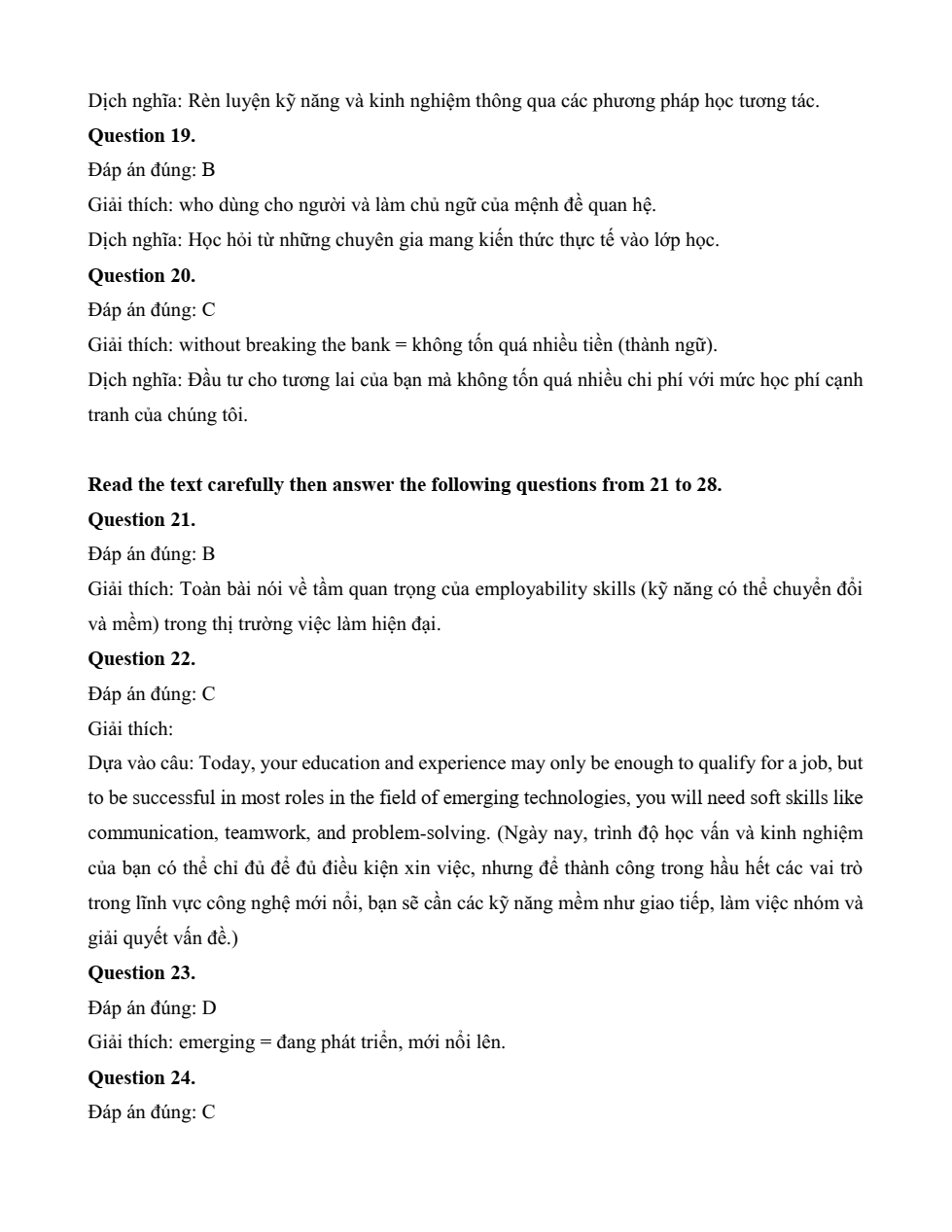
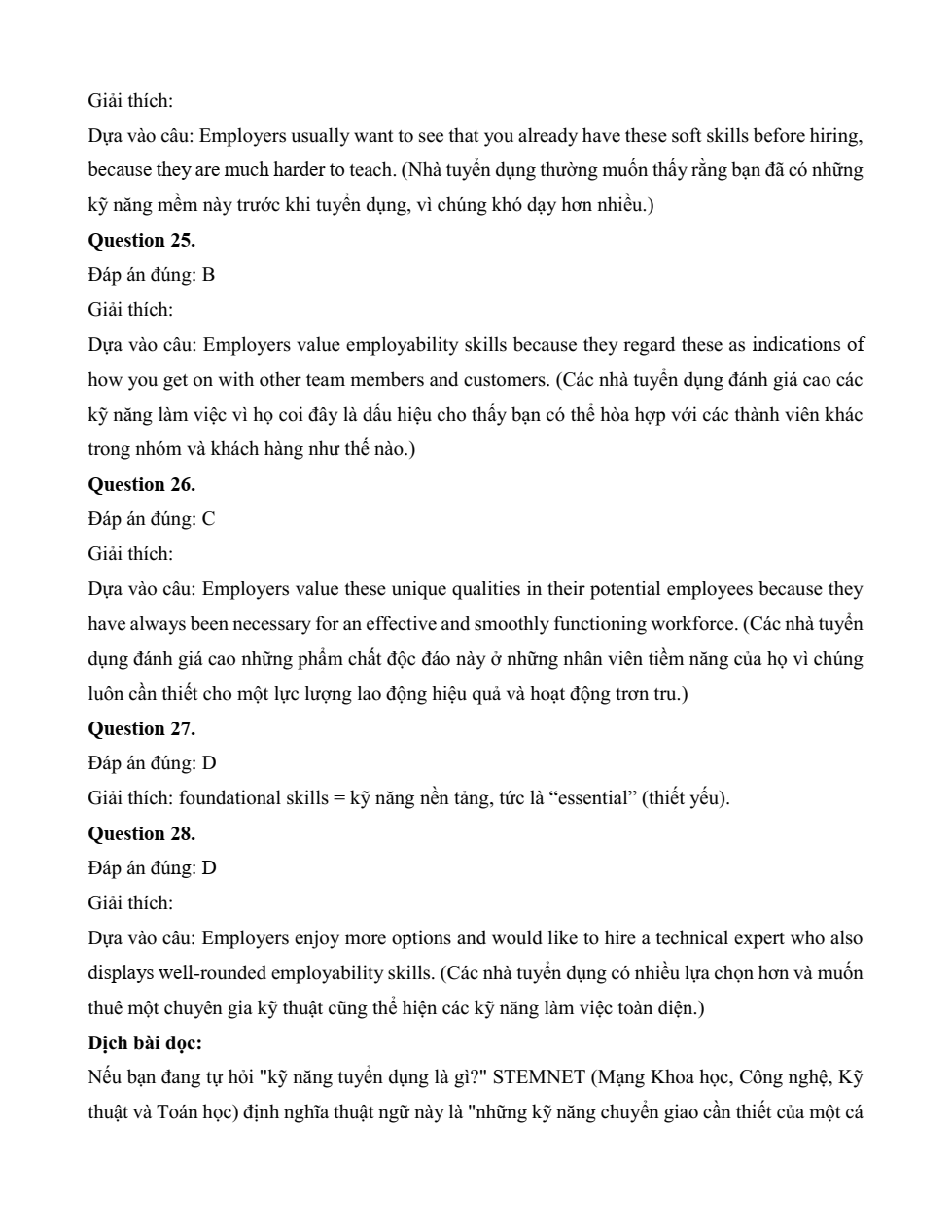
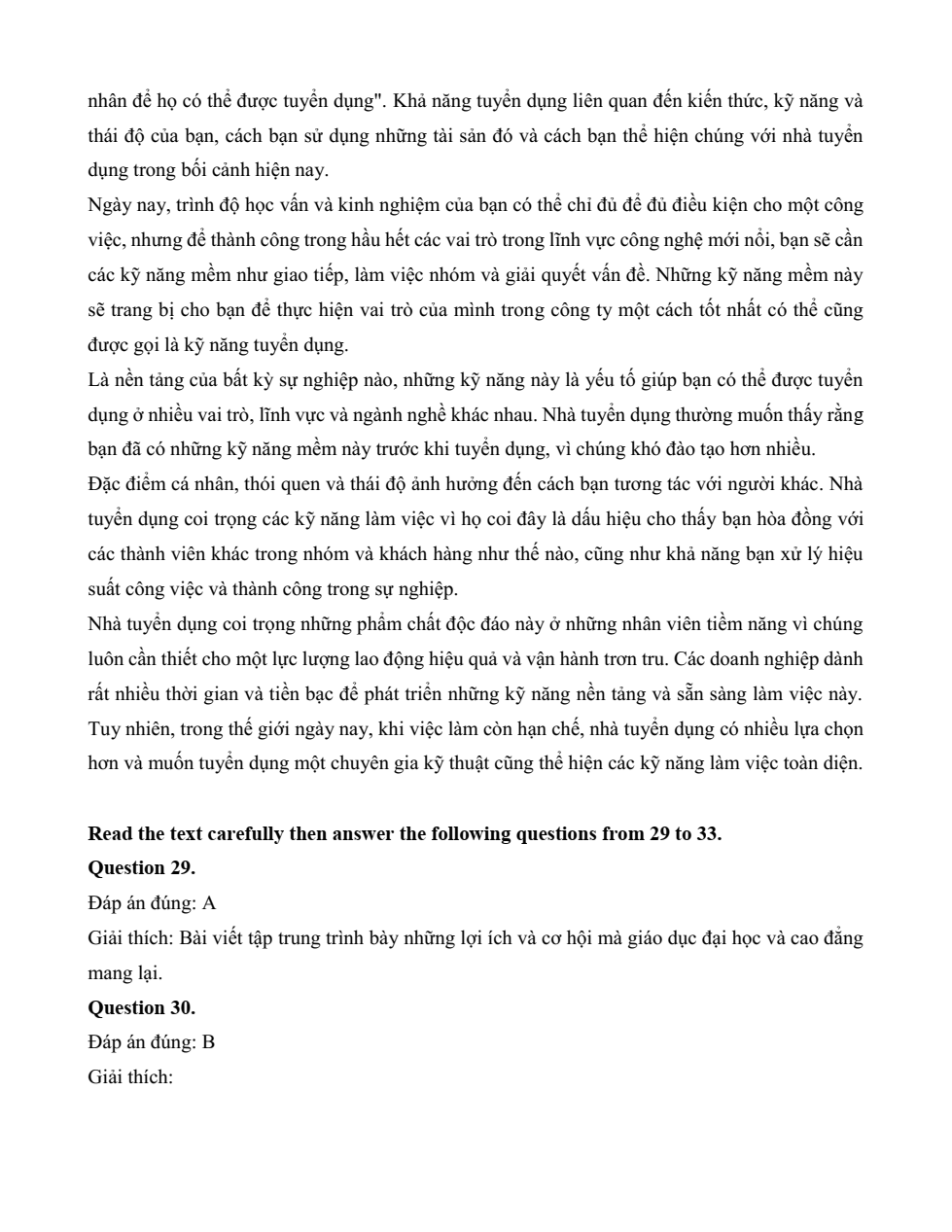
Read the text carefully then answer the following questions from 21 to 28.
If you’re asking yourself, “what are employability skills?” STEMNET (Science, Technology, Engineering, and Mathematics Network) defines this term as “transferable skills needed by an individual to make them employable.” Employability relates to your knowledge, skills, and attitudes, how you use those assets, and how you present them to employers in today’s context.
Today, your education and experience may only be enough to qualify for a job, but to be successful in most roles in the field of emerging technologies, you will need soft skills like communication, teamwork, and problem-solving. These soft skills that will equip you to carry out your role in the company to the best of your ability are also referred to as employability skills.
The building blocks of any career, these skills are what make you employable across various roles, sectors, and industries. Employers usually want to see that you already have these soft skills before hiring, because they are much harder to teach.
Personal characteristics, habits, and attitudes influence how you interact with others. Employers value employability skills because they regard these as indications of how you get on with other team members and customers, and how efficiently you are likely to handle your job performance and career success.
Employers value these unique qualities in their potential employees because they have always been necessary for an effective and smoothly functioning workforce. Enterprises spend a large amount of time and money developing these foundational and work-readiness skills. But in today’s world, where jobs are limited, employers enjoy more options and would like to hire a technical expert who also displays well- rounded employability skills.
Question 21. What would be the best title for the passage?
A. The Importance of STEM Education
B. Enhancing Employability Skills in Today’s Job Market
C. The Role of Skills in Career Development
D. The Evolution of Employment Criteria
Question 22. What is the significance of soft skills in the field of emerging technologies?
A. They are not necessary.
B. They are required for job qualification.
C. They ensure success in most roles.
D. They hinder career growth.
Question 23. The word “emerging” in paragraph 2 is CLOSEST in meaning to __________.
A. inevitable
B. stable
C. falling
D. developing
Question 24. The word “they” in paragraph 3 refers to __________.
A. blocks
B. employers
C. skills
D. roles
Question 25. Why do employers value employability skills according to the passage?
A. They are easy to teach.
B. They indicate how you get along with others.
C. They are irrelevant to job performance.
D. They hinder career success.
Question 26. The word “they” in paragraph 4 refers to __________.
A. employers
B. others
C. skills
D. habits
Question 27. The word “foundational” in paragraph 5 refers to __________.
A. positive
B. ignored
C. secondary
D. essential
Question 28. What is the current trend in hiring practices mentioned in the passage?
A. Employers focus solely on technical expertise.
B. Enterprises invest less in soft skills development.
C. Jobs are abundant, leading to fewer options for employers.
D. Employers prefer candidates with both technical and employability skills.
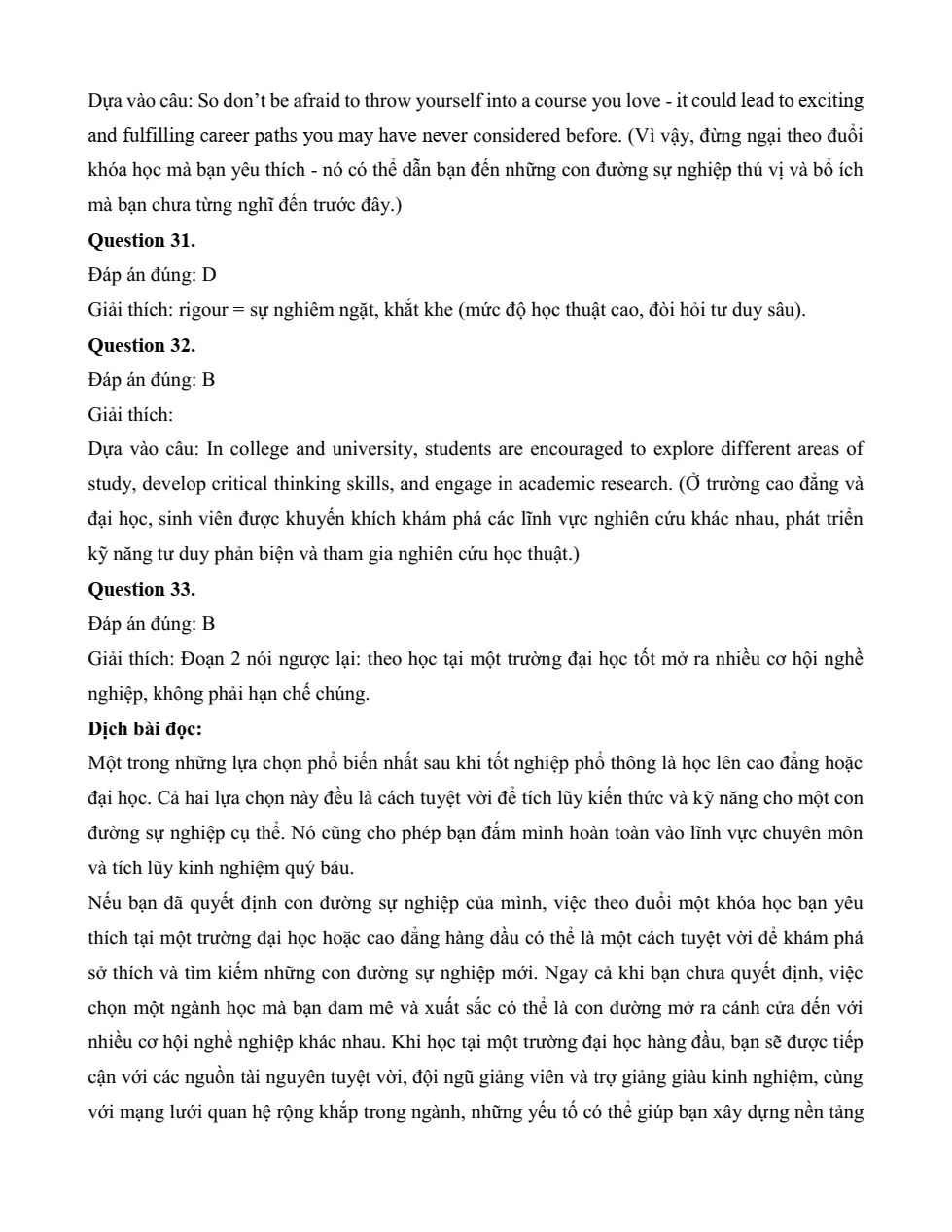
Read the text carefully then answer the following questions from 29 to 33.
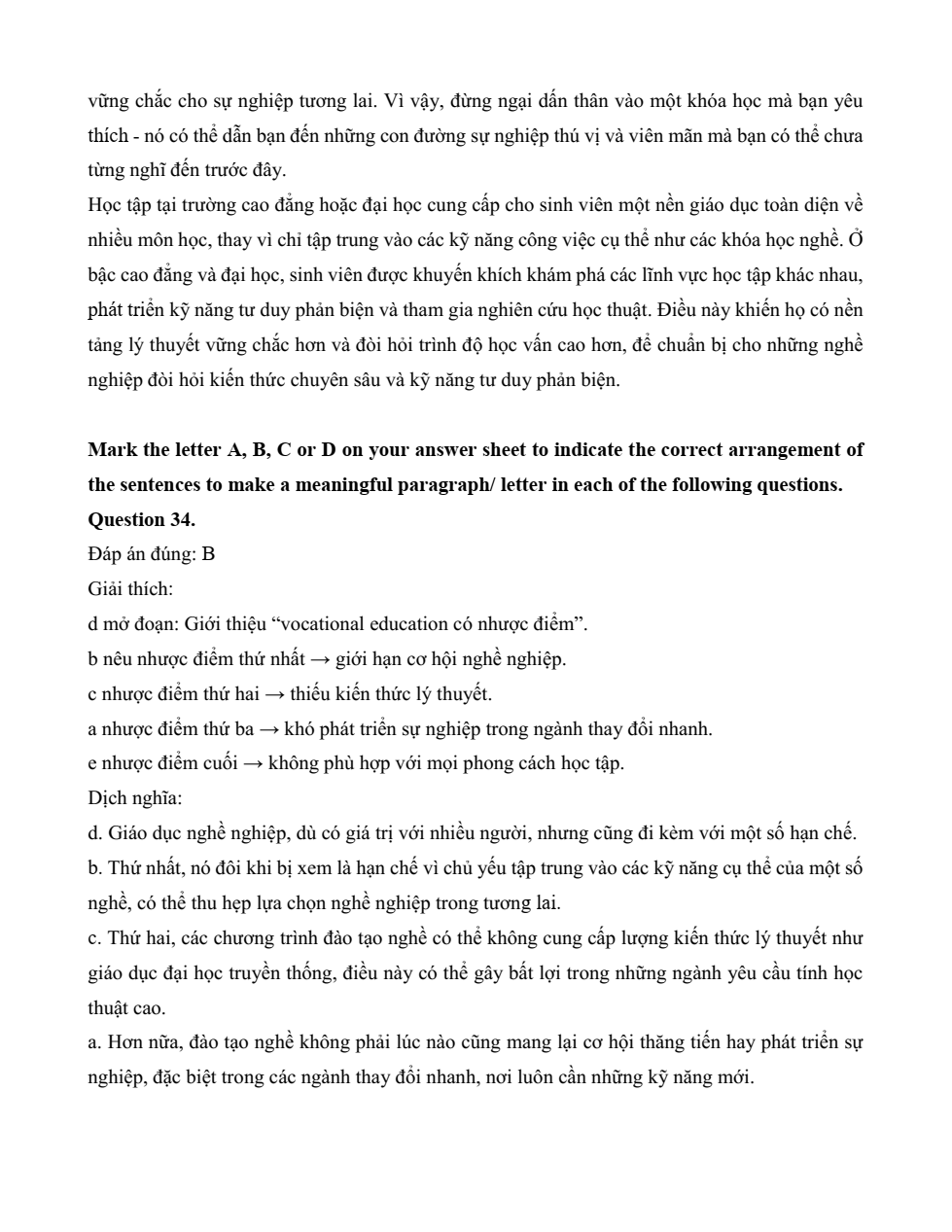
One of the most common options after leaving school is going to college or university. Both options are a great way to gain knowledge and skills for a specific career path. It also allows you to fully immerse yourself in the subject and gain valuable experience.
If you’ve already decided on your career path, pursuing a course you love at a top- rated university or college can be a great way to explore your interests and discover new career paths. Even if you haven’t made up your mind, choosing a subject that you are passionate about and excels in, can be a pathway to opening doors to various career opportunities. When you study at a top university, you will have access to excellent resources, experienced lecturers and tutors, and a wide range of industry connections that can help you build a solid foundation for your future career. So don’t be afraid to throw yourself into a course you love - it could lead to exciting and fulfilling career paths you may have never considered before.
Studying at college or university provides students with a broad education in a variety of subjects, rather than focusing on specific job skills, like vocational courses do. In college and university, students are encouraged to explore different areas of study, develop critical thinking skills, and engage in academic research. This makes them a lot more theory-based and require a higher level of academic rigour, in preparation for careers that require advanced knowledge and critical thinking skills.
Question 29. What would be the best title for the passage?
A. Benefits of College and University Education
B. Making Choices After Leaving School
C. Advantages of Studying for Career Development
D. Learning Skills in Universities and Colleges
Question 30. The word “it” in paragraph 2 refers to __________.
A. career
B. course
C. foundation
D. yourself
Question 31. The word “rigour” in paragraph 3 is CLOSEST in meaning to __________.
A. study
B. story
C. qualification
D. strictness
Question 32. What is the focus of college and university education?
A. developing vocational skills
B. encouraging exploration and critical thinking
C. providing limited subject choices
D. offering job-specific training
Question 33. Which of the following is NOT true according to the passage?
A. College and university courses focus on developing broad education in various subjects.
B. Pursuing a course at a well-ranking university or college can limit career opportunities.
C. Studying at a top university provides access to excellent resources and industry connections.
D. Studying in university requires more theory-based knowledge than vocational courses.
Mark the letter A, B, C or D on your answer sheet to indicate the correct arrangement of the sentences to make a meaningful paragraph/ letter in each of the following questions.
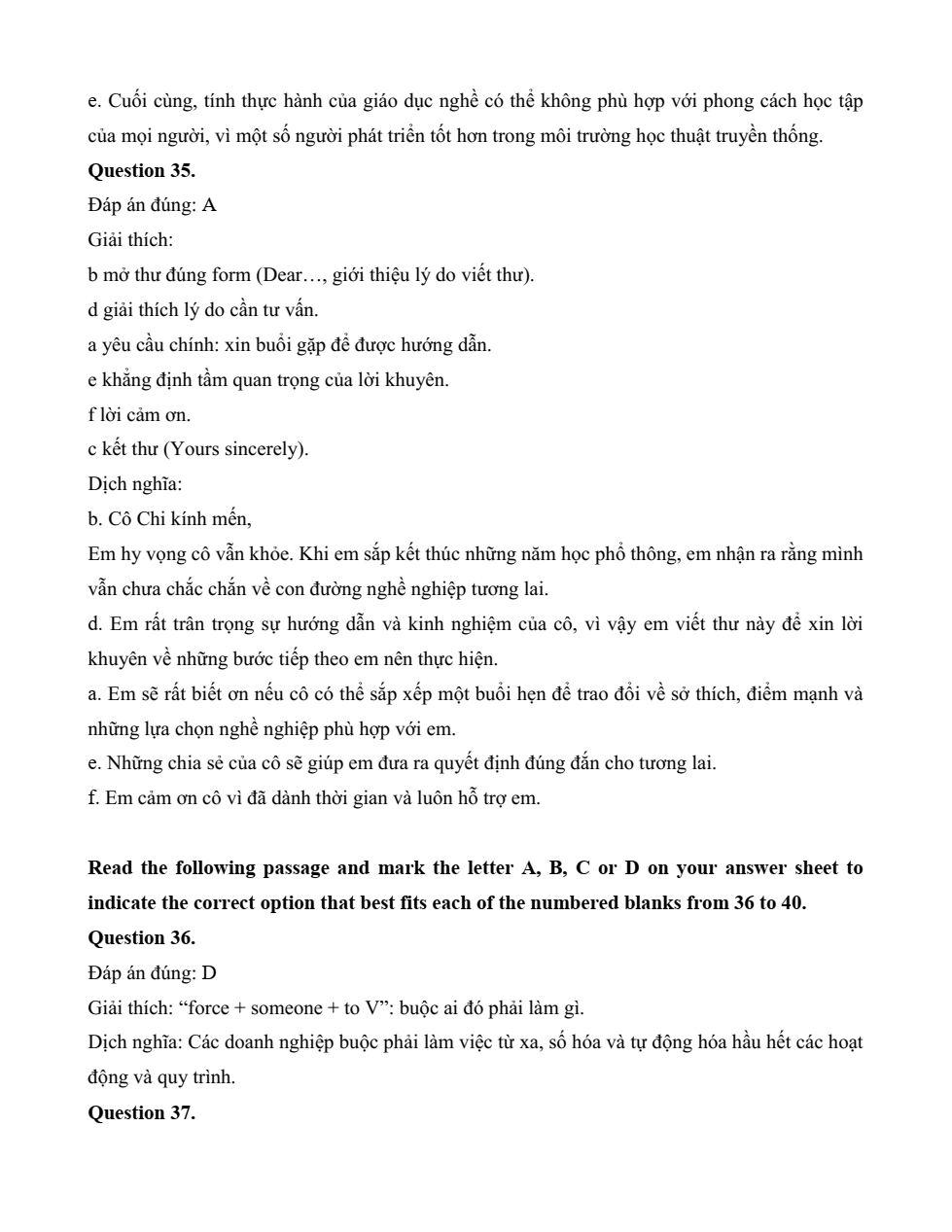
Question 34.
a. Furthermore, vocational training may not always provide opportunities for advancement or career growth beyond a certain point, especially in rapidly evolving industries where new skills are constantly in demand.
b. Firstly, it can sometimes be considered as limiting, as it focuses primarily on specific skill sets related to certain trades or professions, potentially narrowing future career options.
c. Secondly, vocational programs may not always offer the same level of theoretical knowledge as traditional higher education, which could be a disadvantage in certain industries that prioritise academic knowledge.
d. Vocational education, while valuable for many, also comes with its drawbacks.
e. Lastly, the practical nature of vocational education might not suit everyone’s learning style, as some individuals may thrive in more traditional classroom settings.
A. d-c-e-a-b
B. d-b-c-a-e
C. c-d-a-e-b
D. b-d-c-e-a
Question 35.
a. I would appreciate it if we could schedule a meeting to discuss my interests, strengths, and potential career options.
b. Dear Ms. Chi,
I hope this letter finds you well. As I approach the end of my high school journey, I find myself uncertain about my future career path.
c. Yours sincerely,
d. I value your guidance and expertise, which is why I’m reaching out to seek your advice on what steps I should take next.
e. Your insights would greatly help me make informed decisions about my future.
f. Thank you for your time and support.
A. b-d-a-e-f-c
B. b-d-e-f-a-c
C. b-a-d-f-e-c
D. b-f-e-d-a-c
Read the following passage and mark the letter A, B, C or D on your answer sheet to indicate the correct option that best fits each of the numbered blanks from 36 to 40.
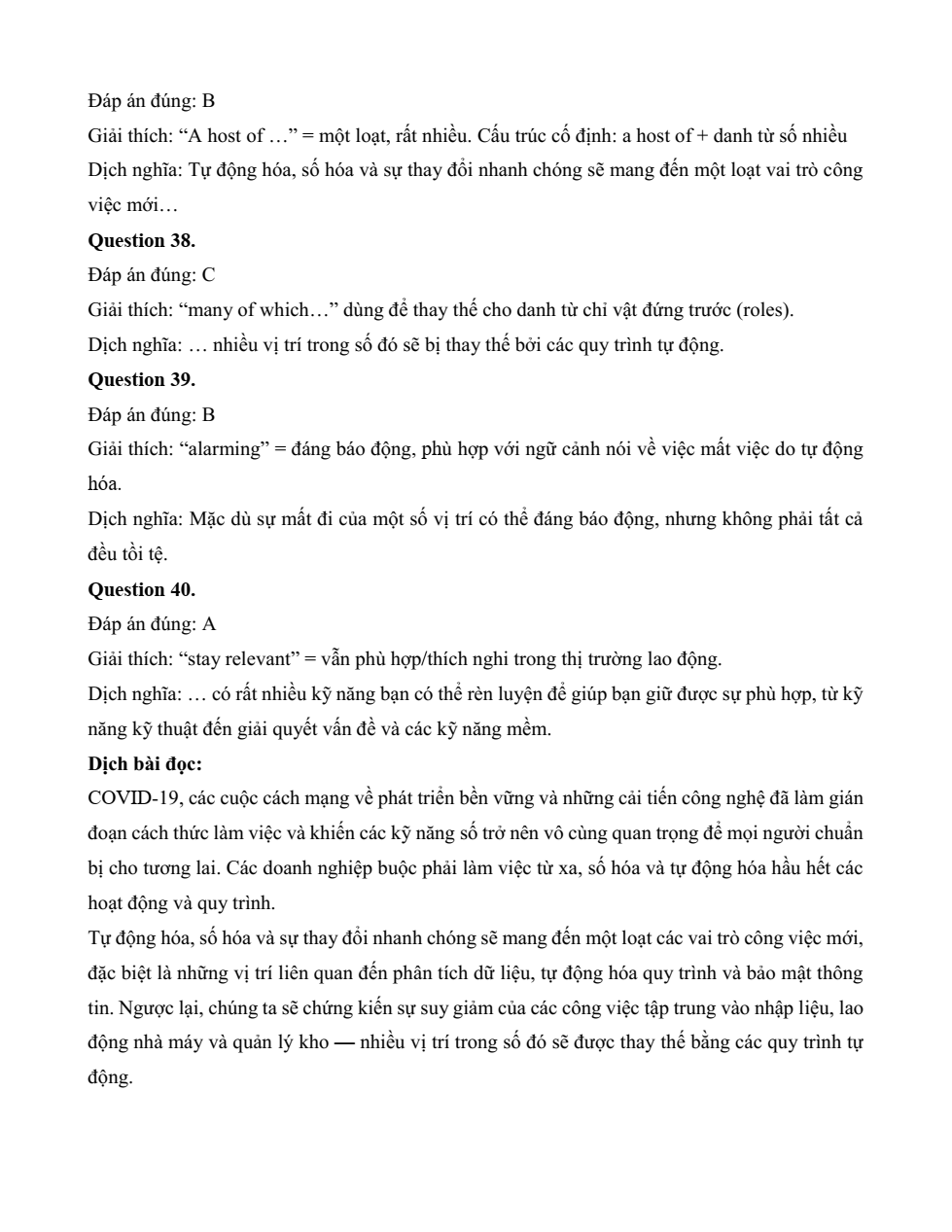
COVID-19, the sustainable revolutions and technology improvements have disrupted work and made digital skills critical for people to prepare for the future. Businesses are forced (36) _______ work remote, digitise, and automate most of the operations and processes.
Automation, digitization and rapid change will bring with it (37) _______ whole host of new job roles, particularly around data analysis, process automation and information security. In contrast, we will see the decline of roles focusing on data entry and factory work and stock-keeping, many of (38) ________ will be replaced by automated processes.
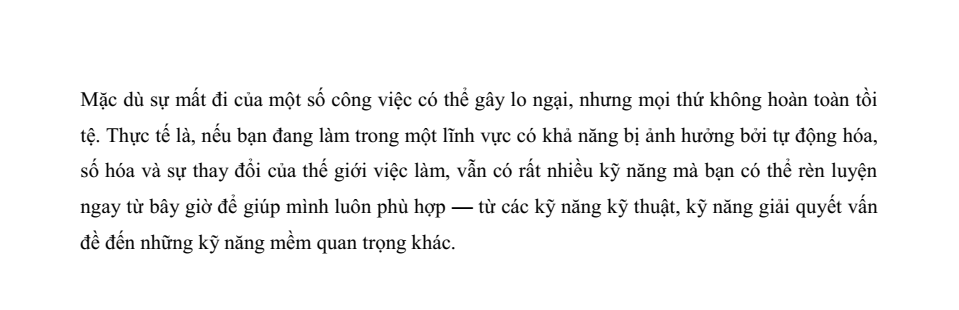
While the loss of certain job roles may seem (39) _________, it’s not all doom and gloom. In fact, if you’re working in a role likely to be affected by the impact of automation, digitization and the changing world of work, there are plenty of skills you can work on right now to help you stay (40) _______, ranging from technical skills to problem solving and soft skills.
Question 36.
A. making
B. make
C. to making
D. to make
Question 37.
A. an
B. a
C. the
D. Ø (no article)
Question 38.
A. what
B. whom
C. which
D. who
Question 39.
A. optional
B. alarming
C. discouraging
D. demanding
Question 40.
A. relevant
B. active
C. sedentary
D. indifferent
................................
...............................
................................
Xem thêm đề kiểm tra Tiếng Anh lớp 12 Global Success có đáp án hay khác:
Đề kiểm tra Tiếng Anh 12 Global Success Unit 5 (có lời giải)
Đề kiểm tra Tiếng Anh 12 Global Success Unit 6 (có lời giải)
Đề kiểm tra Tiếng Anh 12 Global Success Unit 7 (có lời giải)
Đề kiểm tra Tiếng Anh 12 Global Success Unit 8 (có lời giải)
Đề kiểm tra Tiếng Anh 12 Global Success Unit 10 (có lời giải)
TÀI LIỆU CLC DÀNH CHO GIÁO VIÊN VÀ PHỤ HUYNH LỚP 12
Bộ giáo án, bài giảng powerpoint, đề thi file word có đáp án 2026 tại https://tailieugiaovien.com.vn/
Hỗ trợ zalo: VietJack Official
Tổng đài hỗ trợ đăng ký: 084 283 45 85
 500+ đề thi thử tốt nghiệp THPT Quốc gia form 2026
41 tài liệu
500+ đề thi thử tốt nghiệp THPT Quốc gia form 2026
41 tài liệu
 100+ đề thi HSA,TSA,V-ACT,BCA,BQP...2026
95 tài liệu
100+ đề thi HSA,TSA,V-ACT,BCA,BQP...2026
95 tài liệu
 Đề thi giữa kì, cuối kì 12
254 tài liệu
Đề thi giữa kì, cuối kì 12
254 tài liệu
 Chuyên đề dạy thêm Toán, Lí, Hóa... 12
71 tài liệu
Chuyên đề dạy thêm Toán, Lí, Hóa... 12
71 tài liệu
 Đề thi HSG 12
8 tài liệu
Đề thi HSG 12
8 tài liệu
 Bài giảng Powerpoint 12
42 tài liệu
Bài giảng Powerpoint 12
42 tài liệu
Công cụ giáo viên (2048.VN)
Tạo- trộn đề thi miễn phí từ file PDF, Word, Giao bài nhanh chóng, Hoàn toàn Free
- Soạn văn 12 (hay nhất)
- Soạn văn 12 (ngắn nhất)
- Soạn văn 12 (siêu ngắn)
- Giải sgk Toán 12
- Giải Tiếng Anh 12 Global Success
- Giải sgk Vật Lí 12
- Giải sgk Hóa học 12
- Giải sgk Sinh học 12
- Giải sgk Lịch Sử 12
- Giải sgk Địa Lí 12
- Giải sgk Giáo dục KTPL 12
- Giải sgk Tin học 12
- Giải sgk Công nghệ 12
- Giải sgk Hoạt động trải nghiệm 12
- Giải sgk Giáo dục quốc phòng 12
- Giải sgk Âm nhạc 12
- Giải sgk Mĩ thuật 12